
Loop Industries’ Commercial Push Highlights Challenges in Scaling Circular PET Technology
Loop Industries advances its sustainable PET recycling technology globally while facing significant execution and financing hurdles.
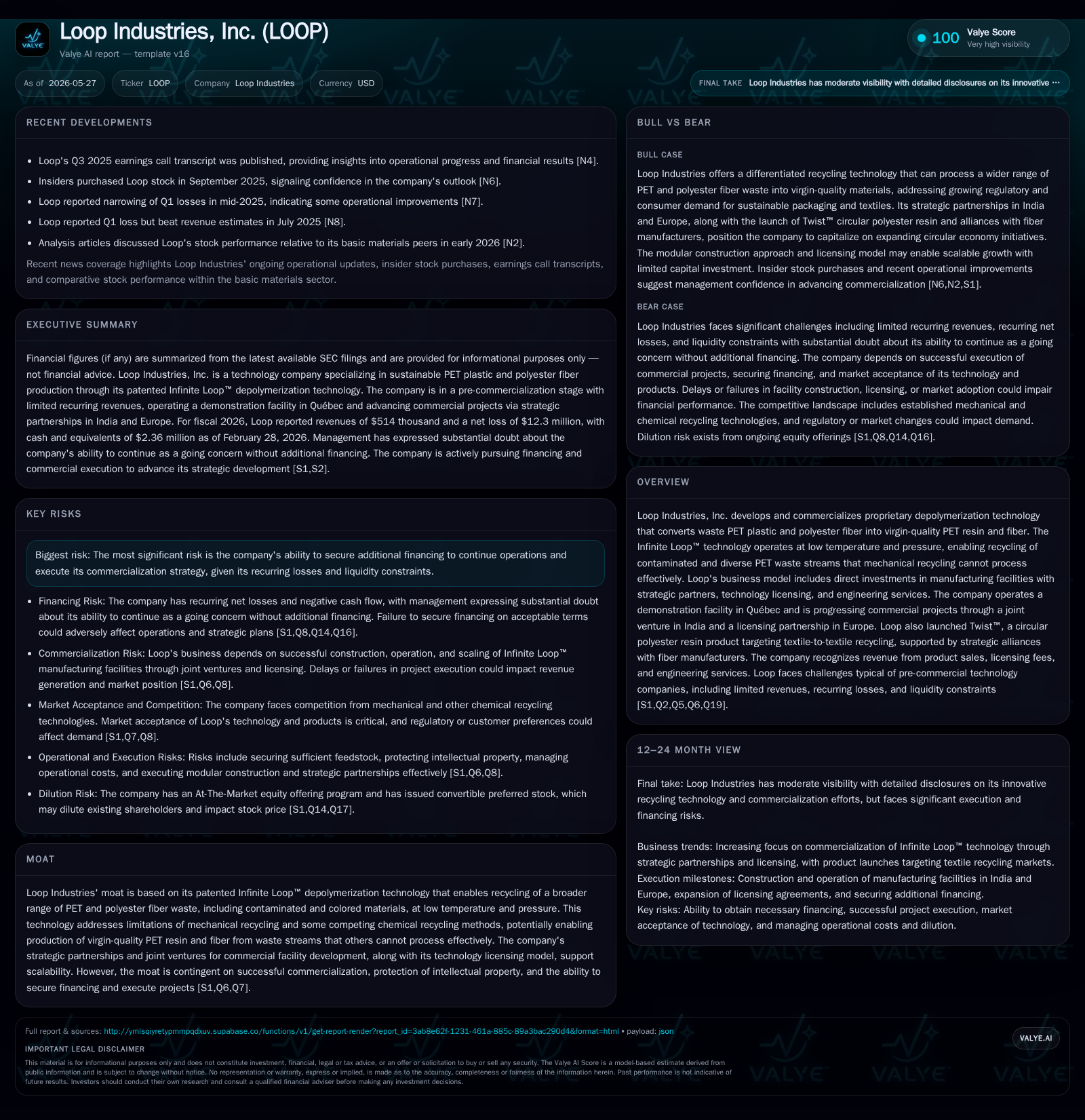
Loop Industries is progressing in commercializing its patented Infinite Loop™ chemical recycling technology, focusing on expanding manufacturing capacity via strategic joint ventures and licensing agreements, notably in India and Europe. Despite partnerships with major apparel and industrial customers driven by growing sustainability mandates, the company’s recent quarterly report flags ongoing liquidity constraints and no recurring revenue from core product sales, underscoring commercialization risks. The balance sheet shows modest cash reserves supplemented by undrawn credit lines but insufficient for twelve-month operational funding without additional financing. Loop's path hinges on successful scale-up execution, securing capital, and marketplace adoption of its circular polyester resin offerings.
Latest Operating Update: Progress and Pressures from the Q3 Filing
Loop Industries’ latest quarterly filing dated January 14, 2026 [S2] provides critical insights into its near-term operational dynamics as the company accelerates the commercial deployment of its Infinite Loop™ depolymerization technology. The core narrative revolves around an ambitious global expansion plan designed to enable primarily apparel companies and consumer packaged goods (CPG) firms to integrate Loop’s chemically recycled PET resin and polyester fiber into their products and packaging. This focus aligns closely with intensifying recycled content mandates emerging worldwide.
Management acknowledges that despite escalating regulatory support for sustainable materials, the global PET/polyester market remains heavily dependent on fossil fuel-derived monomers due to quality requirements that many recycled sources cannot meet. This reinforces the relevance of Loop's low temperature, low pressure chemical recycling capable of handling contaminated or colored PET waste streams mechanically unrecyclable elsewhere.
This filing marks a pivotal juncture where commercialization progress is not merely aspirational but imperative for validating Loop’s technology moat and sustaining operational continuity amid industry-wide sustainability transitions.
Business Model: Proprietary Infinite Loop™ Technology and Market Applications
The company’s business model centers on converting diverse PET waste—including polyester fiber and contaminated plastics—into virgin-quality PET resin using a proprietary depolymerization process branded Infinite Loop™ [S1]. Unlike mechanical recycling reliant on clean feedstock, this chemical upcycling allows broader waste input acceptance at lower temperature and pressure conditions, potentially reducing energy consumption and improving scalability.
Loop operates a demonstration plant in Québec that serves as a testbed for technology validation. Importantly, large-scale commercial facilities are targeted through joint ventures—such as a 50/50 partnership in India with Ester—and a licensing alliance with Reed Circular Economy (RCE) controlling a European joint venture [S1]. These collaborations reflect a capital-light growth approach emphasizing licensing revenues alongside manufacturing returns.
Revenue streams are diversified:
- Direct product sales focus on Loop™ PET resin marketed to brand owners demanding high-performance recycled content.
- Technology licensing grants utilization rights of patented processes to regional partners under royalty schemes.
- Engineering services underpin facility design, project development, construction support, creating near-term cash inflows ahead of full-scale production.
Recent launches extend product offerings to include Twist™, a circular polyester resin produced entirely from post-consumer textile waste targeting textile-to-textile recycling markets—a segment poised for growth given apparel industry commitments to circularity [S1].
Industry Dynamics: PET Recycling Trends, Competitors, and Adoption Barriers
The broader industry context is characterized by entrenched reliance on virgin fossil-based PET feedstocks constrained by quality limitations in traditional mechanical recycling. Chemical depolymerization methods like Infinite Loop™ offer differentiated value by reclaiming monomers from more contaminated inputs.
However, pricing power remains constrained as recycled PET must compete with fluctuating commodity PET resin prices influenced by oil market volatility. Adoption incentives largely derive from regulatory recycled content mandates across jurisdictions coupled with consumer demand for sustainability credentials.
Competition includes other chemical recycling startups as well as established petrochemical players exploring advanced circular solutions. Quality specifications imposed by high-profile brand customers impose switching costs despite growing demand for certified recycled polymers.
In this environment, Loop’s patented low-temperature process affords a technical moat; however, industrial-scale validation beyond pilot projects is critical to prove cost competitiveness versus incumbent materials [S2],[S1].
Growth Drivers: Sustainability Mandates, Strategic Partnerships, and Product Innovation
Growth prospects hinge fundamentally on expanding access to sustainably sourced polyester driven by legislation mandating minimum recycled content thresholds especially in packaging (e.g., EU's Single Use Plastics Directive) and textiles sectors committing to circular supply chains.
Strategic partnerships underpin scaling initiatives:
- The India JV facilitates entry into one of the largest emerging polyester-consuming markets with infrastructure tailored for regional cost curves.
- The European licensing deal through Infinite Loop Europe SAS leverages RCE’s capital capabilities to deploy plants across key Western markets.
Product innovation through Twist™ adds meaningful dimension targeting textile-to-textile recycling—a sector distinct from bottle-grade applications—with signed multiyear supply agreements including Nike [S2],[S1]. These contracts exemplify tangible revenue catalysts tied directly to commissioning new manufacturing capacity.
Modular plant designs aimed at cost reduction further support expansion ambitions by enabling standardized construction in low-cost regions for assembly near demand centers.
Key Risks: Financing Sufficiency, Commercial Execution, and Intellectual Property Protection
Recurring net losses since inception paired with negative operating cash flows exacerbate capital concerns. The company actively pursues equity raises—including an At-The-Market offering activated in July 2025 that has generated several rounds of proceeds—and debt amendments; however, funding certainty remains absent [S2],[S13].
Commercial execution risks persist around timely completion of large-scale Infinite Loop™ facilities in India and Europe. Delays or cost overruns could impair scaling economics crucial for transition from demonstration phase to meaningful recurring product revenues.
Intellectual property defense is integral given competitive spillover risks inherent in proprietary chemical recycling processes. While no current material legal threats against the company exist per filings, continued vigilance is necessary [S1].
Dilution risk linked to ongoing equity issuances also poses shareholder value considerations amid capital need urgencies.
What to Watch Next: Milestones, Partner Developments, and Financial Health
Investors should monitor several key upcoming indicators reflecting progress:
- Commissioning dates for the India joint venture manufacturing facility including ramp schedules proving throughput targets achievable.
- Expansion of licensing contracts or new partner announcements that demonstrate geographic diversification of revenue streams.
- Additional supply agreements with major apparel or CPG brands adopting Twist™ or Loop-branded resins indicating market traction beyond pilot volumes.
- Quarterly financial results evidencing changes in cash burn rates or signs of improved operating leverage correlated with commercial ramp activities.
- Capital raising activity updates clarifying funding status given looming liquidity risks highlighted in January filing [S2]
Progress against these milestones will provide tangible evidence supporting scalability assumptions underpinning valuation theses within an evolving regulatory landscape favoring circular economy solutions.
Concise Financial Profile: Capital Structure and Liquidity Insights
As of the latest fiscal year-end February 28, 2026 reported in May filings [F1],[S23], Loop Industries held $2.36 million in cash alongside an available $2.57 million undrawn Canadian bank credit facility secured against its Terrebonne property. Total debt stood near $3.12 million at November 30, 2025 [F1],[S13], partially offsetting liquid resources resulting in net debt roughly $0.76 million.
During the nine months ended November 30, 2025 alone, the company repaid $215 thousand of long-term debt while raising approximately $889 thousand net proceeds from ATM equity offerings demonstrating active balance sheet management but also ongoing dependence on external capital [S2],[S13].
Disclaimer: This analysis is for informational purposes only based on publicly available filings as cited; it does not constitute investment advice or research views regarding any securities mentioned herein.
Disclaimer: This is research-only, informational analysis and not investment advice. It may include AI-generated interpretation and general industry context. Always verify important details using primary sources.

Comments