
Lowe’s Companies Inc: Navigating Competitive Pressures in Home Improvement Retail
Lowe’s operates at the intersection of retail scale, supply chain complexity, and evolving consumer demand in the U.S. home improvement sector.
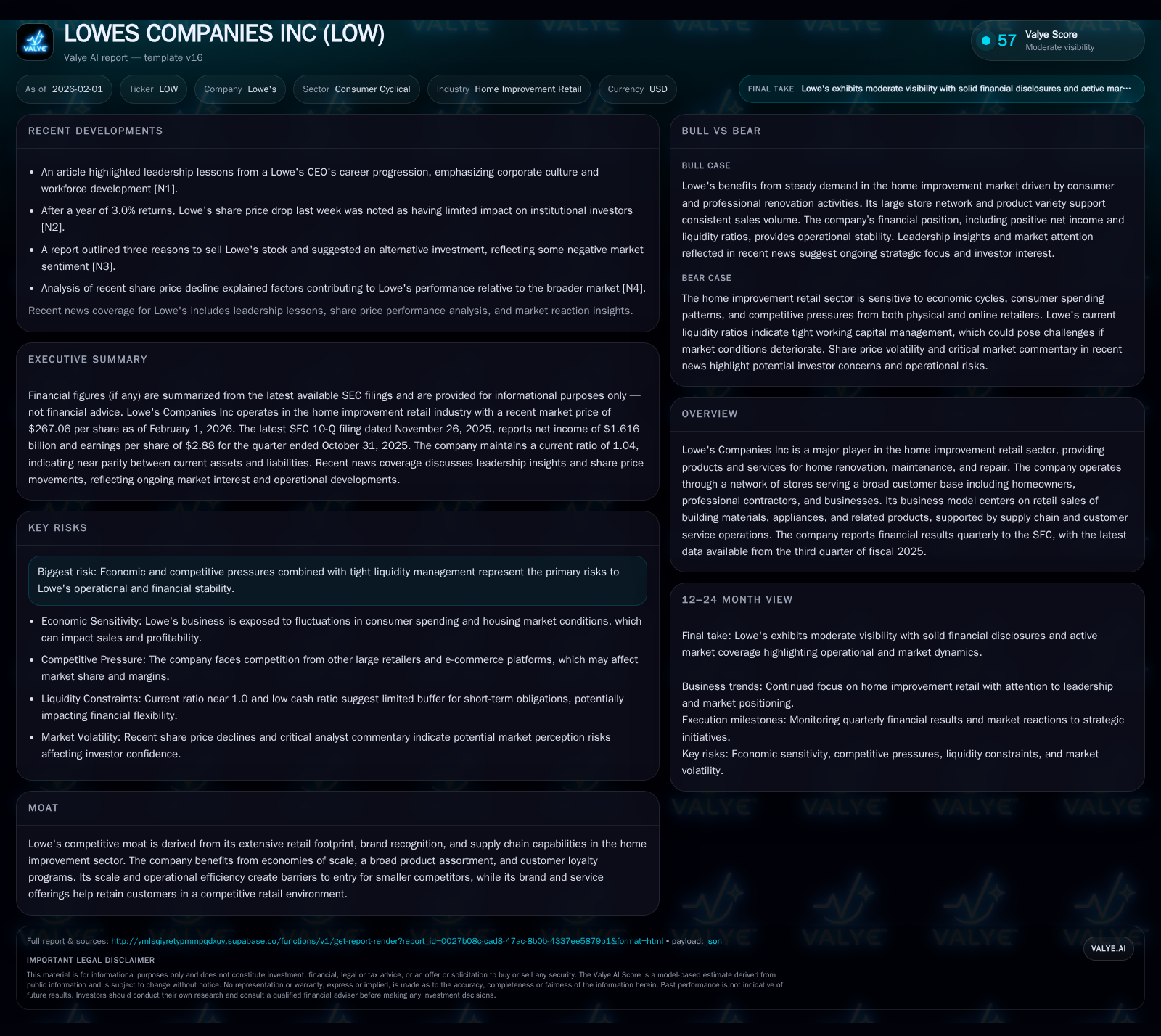
Lowe’s Companies Inc remains a formidable player in home improvement retail, leveraging its extensive store network, brand strength, and supply chain capabilities. Recent market volatility and competitive headwinds reflect sector-wide pressures including macroeconomic uncertainty and tightening liquidity. The company’s business model centers on a broad product assortment serving both DIY consumers and professional contractors, supported by operational scale. Key challenges include maintaining margin resilience amid inflationary costs and managing inventory amid shifting demand patterns.
What Changed Recently
In the last 45 days, Lowe’s share price experienced a notable decline despite delivering a modest 3.0% return over the prior year, signaling investor apprehension about near-term profitability and competitive positioning [N2, N4]. Analysts have pointed to rising input costs, intensified competition especially from e-commerce entrants, and macroeconomic uncertainties as key drivers behind the recent stock underperformance [N3]. Concurrently, internal narratives highlight a leadership journey emphasizing operational discipline and culture as essential to navigating the evolving retail landscape [N1]. These developments underscore the tension between Lowe’s entrenched market position and the pressures imposed by changing consumer behavior and cost structures.
Business Model as a System
Lowe’s operates a complex, integrated retail ecosystem primarily focused on home improvement products and services. Its customer base spans DIY homeowners, professional contractors, and commercial clients, necessitating a broad and diverse product offering that includes building materials, appliances, tools, and seasonal items [S1, S2]. The company’s value proposition depends on its extensive physical footprint, enabling wide geographic coverage and localized inventory availability.
The supply chain is a backbone of Lowe’s system, involving procurement from a myriad of suppliers, inventory management across distribution centers and stores, and logistics coordination to balance demand and supply efficiently. Customer service and loyalty programs further reinforce retention and drive repeat business. Financially, Lowe’s reported a net income of approximately $1.6 billion for the quarter ending October 2025, supported by current assets of $20.2 billion and current liabilities of $19.45 billion, yielding a current ratio of 1.04, which points to tight liquidity but operational adequacy [S3].
The system relies heavily on operational scale for cost leverage—bulk purchasing lowers supplier costs, while distribution efficiencies reduce logistics expenses. Additionally, cross-selling opportunities across product categories and services create revenue synergies. However, this scale also demands sophisticated coordination to avoid inventory glut or stockouts, which can erode margins or customer satisfaction.
Industry Map & Competitive Battlefield
The home improvement retail industry is characterized by a blend of large-scale big-box retailers, specialty chains, local independents, and increasingly significant digital players. Lowe’s primary competitors include Home Depot, a comparable scale competitor, alongside regional chains and emerging online platforms offering home improvement goods.
Competitive factors extend beyond price to encompass product assortment breadth, in-store experience, professional services, and digital engagement capabilities. Contractors represent a critical segment, requiring tailored service, credit facilities, and reliable supply chains. DIY consumers demand convenience, variety, and increasingly, seamless omni-channel experiences.
The environment is further complicated by fluctuating housing market dynamics, seasonal demand swings, and raw material cost volatility. E-commerce penetration—while still a minority share of total sales—continues to grow, pressuring traditional retailers to innovate in fulfillment and customer engagement.
Where the Economics Become Real
At the unit economic level, Lowe’s profitability depends on its ability to manage inventory turns efficiently while controlling procurement and distribution costs. The company’s scale offers bargaining power with suppliers but also exposes it to commodity price swings, which can compress gross margins if not offset by price adjustments.
Labor costs and store operating expenses represent significant fixed and semi-variable costs, requiring steady sales volumes to maintain margin leverage. The professional contractor segment typically yields higher margin sales but demands credit management and service costs. Conversely, the DIY segment can be more price sensitive and volatile in demand.
Liquidity management is pivotal, as reflected in a current ratio just above 1.0, signaling limited cushion against short-term liabilities [S3]. This tight liquidity environment necessitates disciplined cash flow management, especially when investing in technology upgrades or supply chain enhancements.
Diligence Questions / Disconfirming Signals
- How effectively can Lowe’s sustain and grow its professional contractor segment amid rising competition from specialized service providers and digital channels?
- Is the company’s supply chain resilient enough to absorb commodity price shocks and logistical disruptions without severe margin impact?
- How rapidly can Lowe’s scale its omni-channel capabilities to counteract e-commerce competitors while preserving in-store profitability?
- Does the current leadership approach and internal culture transformation translate into measurable operational improvements?
- Are there early signs of customer attrition or shifts in consumer preferences that could challenge Lowe’s traditional retail model?
Final Thoughts
Lowe’s Companies Inc operates at the heart of a dynamic and competitive home improvement retail sector where scale, supply chain excellence, and customer engagement are crucial. Recent market developments highlight challenges from cost inflation, competitive pressure, and evolving consumer expectations. The company’s foundational strengths in brand, footprint, and operational scale provide a robust platform but require ongoing adaptation to sustain profitability and growth. Key risks remain centered on economic cyclicality, liquidity constraints, and the pace of digital transformation.
This report is based on publicly available information as of early 2026 and is intended solely for informational purposes. It does not constitute investment advice or a recommendation to buy or sell any securities.
Disclaimer: This is research-only, informational analysis and not investment advice. It may include AI-generated interpretation and general industry context. Always verify important details using primary sources.

Comments