
Lightbridge Corp's Breakthrough Fuel Technology and Its Financial Trajectory
Lightbridge advances proprietary metallic nuclear fuel development while scaling R&D investments amid early-stage commercial challenges.
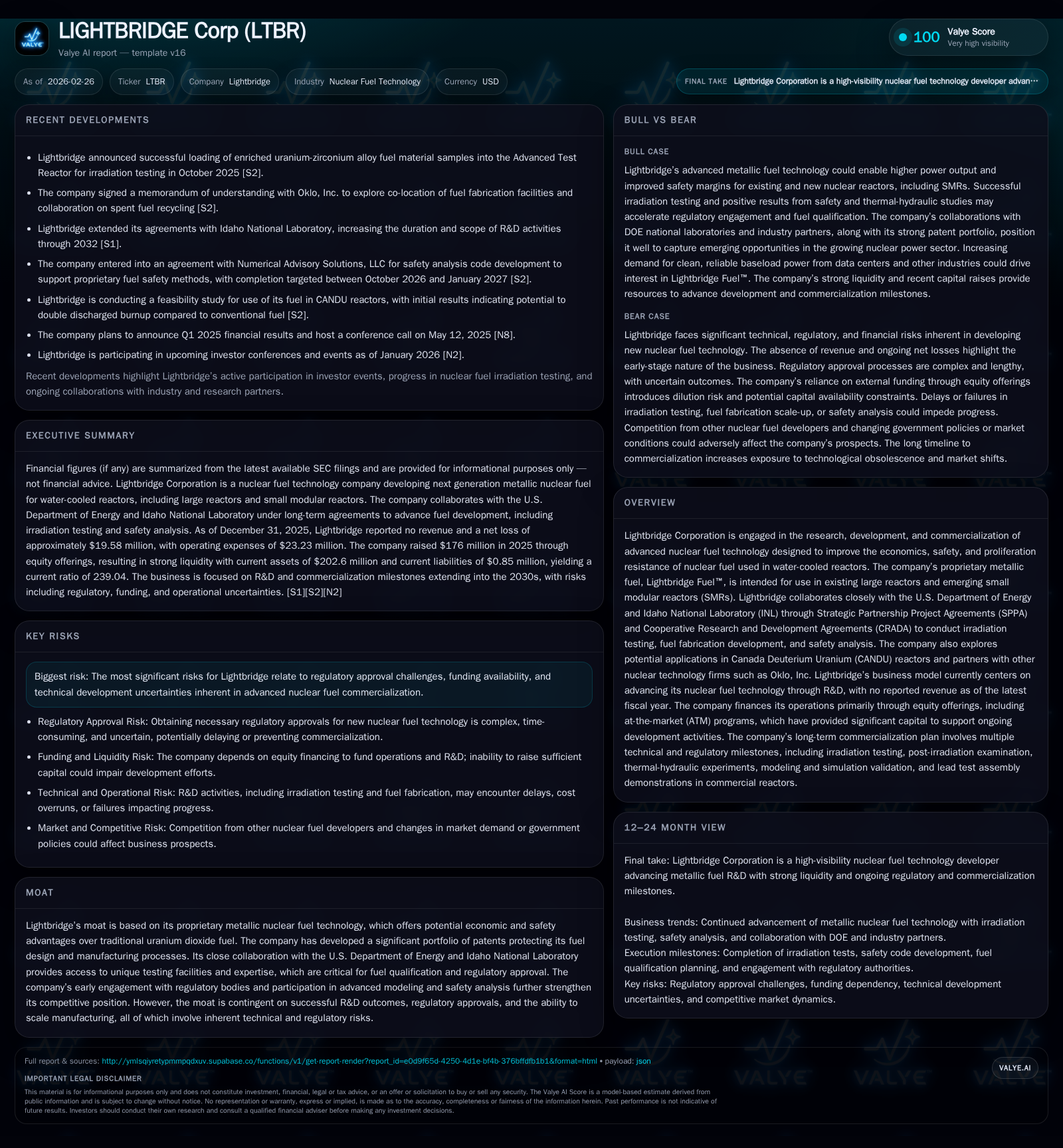
Lightbridge Corporation is pioneering metallic nuclear fuel technology designed to enhance economic and safety profiles of water-cooled reactors, including conventional large plants and emerging small modular reactors (SMRs). Over recent years, the company has substantially increased its R&D and general administrative spending to underpin critical irradiation testing in partnership with U.S. government labs. Despite no revenues yet, Lightbridge boasts strong liquidity fueled by significant equity raises, supporting its heavy investment phase. Commercialization success hinges on navigating regulatory approvals, securing HALEU supply, and demonstrating fabrication scalability.
From Concept to Development: Lightbridge Fuel’s Growth Journey
Lightbridge Corporation focuses on developing a transformative metallic nuclear fuel known as Lightbridge Fuel™, which promises significant benefits over legacy uranium dioxide fuels used in water-cooled reactors. Its superior heat transfer properties aim to lower operating temperatures in both large existing reactors and emerging small modular reactors (SMRs), enhancing safety margins while enabling power uprates—a critical capability especially valued by utilities and industrial users such as data centers seeking reliable clean energy solutions [S2].
The company’s growth trajectory has been propelled by close collaborations with the U.S. Department of Energy (DOE) and Idaho National Laboratory (INL), leveraging Cooperative Research and Development Agreements (CRADA) and Strategic Partnership Project Agreements (SPPA). These partnerships grant Lightbridge access to unique irradiation test facilities vital for fuel qualification under regulatory standards—a foundational step before any market deployment [S1], [S2].
From a financial perspective, these technical efforts are mirrored by escalating investment in research and development (R&D). Reported R&D expenses doubled from approximately $4.6 million in 2024 to $9.2 million in 2025, driven primarily by labor costs associated with INL projects (+$1.2M), substantial increases in IT infrastructure supporting advanced modeling (+$1.9M), and increased employee compensation plus stock-based awards (+$1.8M) that collectively reflect an expanded talent base dedicated to complex engineering challenges [S1], [S5], [S14].
General & administrative expenses also grew by 65% year-over-year to $14 million in 2025, fueled by augmented professional fees for legal, strategic advisory services, lobbying efforts related to environmental impact assessments, and higher stock-based compensation aimed at retention of critical expertise [S1]. These increases underscore the company's concerted effort to build a competitive moat based on intellectual property development and regulatory positioning.
Financial Footprint: Escalating R&D and Operating Expenses in Context
Lightbridge operates at a developmental stage characterized by no revenues but intensifying operating expenditures aligned with technology qualification milestones. The operating loss surged nearly 78% year-over-year from $13.1 million in 2024 to $23.2 million in 2025 [F1], reflecting project scale-up.
Net loss expanded accordingly by 66%, reaching approximately $19.6 million last fiscal year [F1]. This widening deficit is consistent with the typical cost profile of companies advancing capital-intensive nuclear technologies prior to commercialization.
Operating cash flow was negative $14.3 million for 2025—an increase of over 50% compared to the prior year—primarily due to elevated spending on R&D programs and general administration that had not yet generated offsetting cash inflows [F1], [S1]. Despite this growing burn rate, Lightbridge’s financial position remains fortified by robust capital raises.
Historical performance (annual)
| FY | Rev | Net ($mm) | CFO ($mm) | OpInc ($mm) | Net YoY |
|---|---|---|---|---|---|
| 2025 | 0 | -20 | -14 | -23 | -66.1% |
| 2024 | 0 | -12 | -9 | -13 | -49.0% |
| 2023 | 0 | -8 | -6 | -9 | -5.5% |
| 2022 | 0 | -7 | -7 | -8 |
Source: SEC companyfacts cache [F1].
Capital returns and efficiency (annual)
| FY | ROE% |
|---|---|
| 2025 | -9.6 |
| 2024 | -29.1 |
| 2023 | -27.4 |
| 2022 | -25.7 |
Source: SEC companyfacts cache [F1].
Table: Lightbridge Historical Financial Performance Summary (FY2022-FY2025) [F1], supplemented by [S1], [S5]
Regulatory Milestones and Market Readiness: A Roadmap Forward
Regulatory engagement constitutes a cornerstone of Lightbridge’s pathway toward commercial viability. The company’s collaborative framework with DOE national laboratories enables access to irradiation test beds crucial for verifying the performance and safety of its metallic fuel under real reactor conditions—an obligatory prerequisite for licensing [S2], [N1].
Operationally, Lightbridge relies heavily on CRADA/SPPA agreements administered through Bechtel Energy Alliance (BEA), which oversee INL operations relevant to fuel testing programs. These contracts outline defined scopes with capped costs ($14.2 million remaining as of December 31, 2025), providing structured paths for technological advancement while controlling financial exposure [S18], [S20].
A material hurdle remains the availability of High-Assay Low-Enriched Uranium (HALEU), essential feedstock for fabricating metallic fuels capable of meeting performance criteria with enriched uranium content above typical commercial thresholds yet below weapons-grade levels [S4]. Securing a cost-effective HALEU supply chain will be pivotal.
Moreover, scale-up from laboratory-scale fabrication to commercial-scale manufacturing poses substantive engineering challenges given process complexity and stringent quality assurance demands inherent in nuclear fuel production.
Capital Strategy: Evaluating Cash Inflows, Expenditures, and Shareholder Returns
Lightbridge has strategically augmented its capital base through aggressive equity financing initiatives centered around at-the-market (ATM) offerings managed primarily via Jefferies LLC [S12], [S16]. Net proceeds leapt from roughly $20.9 million in 2024 to an impressive $176 million in fiscal 2025 alone—facilitating both an enhanced cash runway and expanded capability for R&D investments.
Cash balances ballooned proportionally—from near $40 million at end-2024 up to approximately $201.9 million at end-2025—resulting in an exceptional current ratio exceeding 230 as current liabilities remain modest (~$847K) [F1], [S6]. This liquidity cushion aligns neatly with the operational reality of zero revenue generation during heavy development phases.
The company's balance sheet reveals zero long-term debt obligations or preferred shares outstanding at fiscal year-end; furthermore, Lightbridge distributed no dividends nor executed share repurchases for either observed period—a structural reflection of capital allocation priorities firmly weighted towards advancing proprietary technology rather than immediate shareholder payouts [S16].
Stock-based compensation expenses have escalated markedly across both general & administrative ($4.4M vs ~$1.8M prior year) and R&D functions ($1.4M vs ~$0.3M prior year). Such allocations underscore management’s emphasis on talent acquisition/retention strategically critical for sustaining innovation momentum within highly specialized nuclear science fields [S1], [S14].
Unpacking Risks: Regulatory, Funding, and Technical Challenges
Inherent uncertainties shadowing the advanced nuclear fuel sector figure prominently among Lightbridge’s disclosed risk factors: regulatory hurdles are daunting given stringent approval processes governing nuclear materials usage; any delays or denials could stall or derail commercialization timelines entirely [S4].
The company explicitly warns about dependencies on cost-effective HALEU supplies—a resource currently constrained globally—and on establishing reliable commercial-scale fuel fabrication infrastructure essential before market entry can occur safely and competitively.
Enhanced lobbying efforts indicate proactive risk mitigation strategies responding not only to evolving regulation but also environmental scrutiny pertinent to novel nuclear technologies [N1]. These combined variables frame an ambitious yet challenging road ahead marked by high capital intensity against an uncertain timeline.
Looking Ahead: Key Catalysts to Monitor for Commercialization Progress
Absent explicit forward financial guidance or quantitative milestones from filings or recent disclosures [N1], analysis necessarily centers around event-driven indicators likely influencing progress appraisal:
- Completion status and results from ongoing irradiation test campaigns under CRADA/SPPA agreements – fundamental data underpinning regulatory submissions.
- Subsequent regulatory filings reflecting submission dates or interactions with regulators – signaling advancement toward qualifications/licensing.
- Expansion or initiation of strategic partnerships especially involving small modular reactor developers like Oklo Inc., augmenting potential application markets.
- Participation announcements at investor conferences heralding demonstration projects or pilot fabrication facilities potentially impacting investor confidence levels [N3].
- Broader dynamics within the SMR sector adoption curve could influence demand trajectories for metallic fuels offering load-following capabilities tailored for intermittent renewable energy integration.
Overall, visibility into these operational events will provide tangible benchmarks against which Lightbridge’s progression can be gauged amidst prevailing technology validation uncertainties.
Disclaimer: This report provides a factual analysis based strictly on publicly available documents without offering investment advice or forecasts beyond disclosed information.
Disclaimer: This is research-only, informational analysis and not investment advice. It may include AI-generated interpretation and general industry context. Always verify important details using primary sources.

Comments