
Latch (DOOR): Smart Access Ambitions Meet Profitability and Execution Crossroads
Latch, now operating under the DOOR brand, aims to unify smart access, property management, and resident services for North American multifamily rentals. Despite a differentiated platform and recent moves into property management and services, the company faces acute profitability pressures and must prove it can convert integration and ecosystem advantages into sustainable growth.
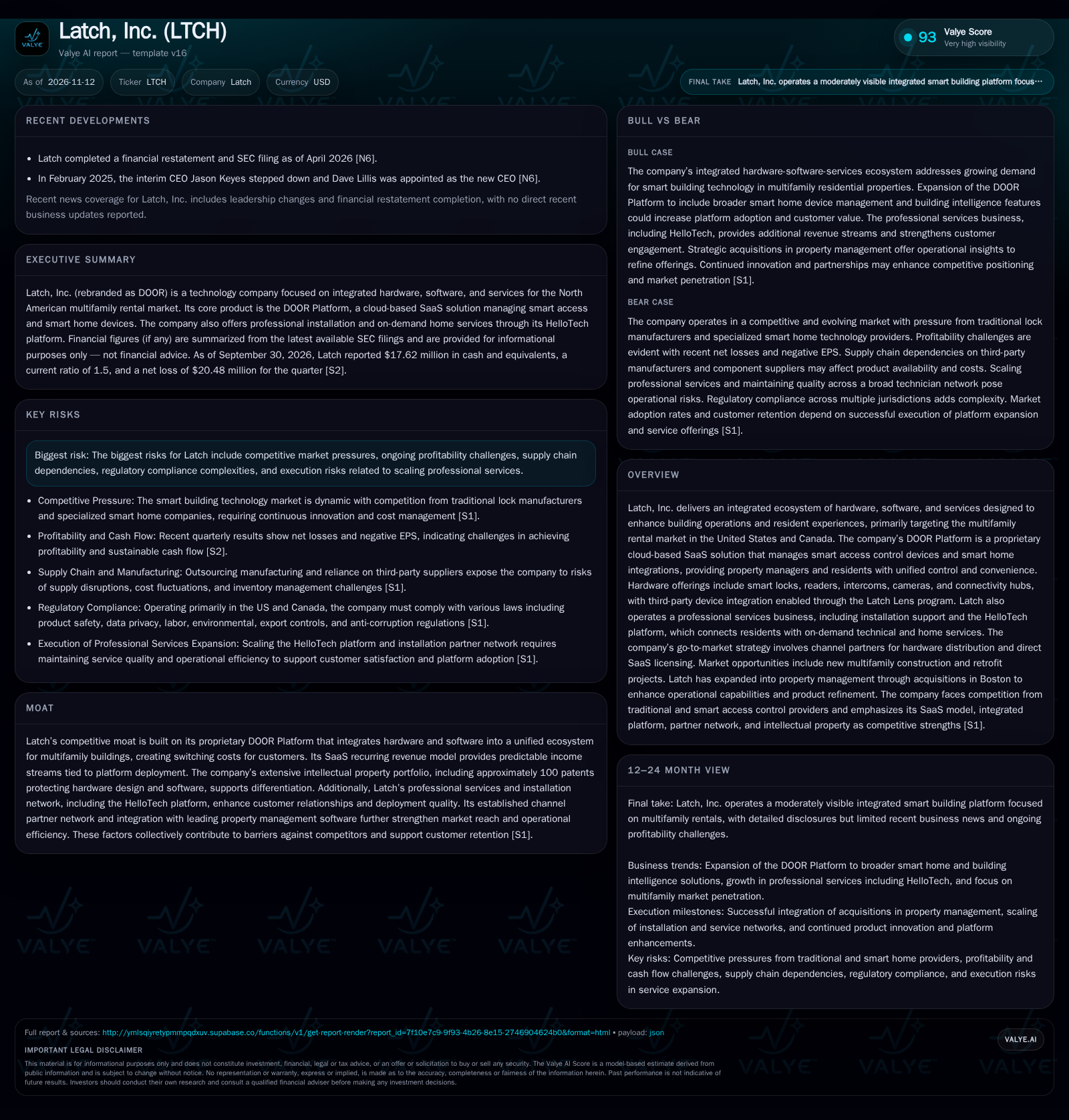
Latch (DOOR) delivers an integrated SaaS and hardware platform for smart access and home management in multifamily rentals, with a growing professional services arm and recent property management acquisitions. As of September 2026, the company reported $17.62 million in cash and a quarterly net loss of $20.48 million. The challenge is whether its ecosystem approach and service expansion can drive adoption and margin improvement fast enough to offset persistent losses and the realities of a competitive, cost-sensitive market. [S1] [S2]
Latch, Inc. (rebranded as DOOR) is attempting to carve out a defensible niche in the North American multifamily rental market by offering an integrated smart access and property management ecosystem. Its strategy blends proprietary hardware, a cloud-based SaaS platform, and a growing set of professional and on-demand services—recently expanded by acquisition.
Recent Moves: Integration, Expansion, and Persistent Losses
Latch (DOOR) continues to focus on the North American multifamily rental market, offering a unified platform that manages smart access devices (locks, readers, intercoms, cameras) and integrates with third-party property management software. The company operates through a combination of hardware, SaaS, and professional services, with the HelloTech platform providing on-demand technical and home services. Notably, Latch has expanded its operational footprint through the acquisition of property management businesses in Boston, aiming to refine its offerings and gain closer customer insight. [S1]
As of September 30, 2026, Latch reported $17.62 million in cash and equivalents, $44.52 million in current assets, and $29.62 million in current liabilities, yielding a current ratio of 1.5 and a cash ratio of 0.59. The company remains loss-making, with a net loss of $20.48 million and basic/diluted EPS of -$0.13 for the quarter. [S2]
These developments are significant because they signal a push to broaden platform adoption and deepen customer relationships, but also highlight the urgency of improving financial performance in the face of ongoing cash burn.
Ecosystem Economics: SaaS, Hardware, and Service Mix Under Pressure
Latch’s business model is built on layering recurring SaaS revenues atop an installed base of proprietary hardware, supplemented by professional services. The DOOR Platform is positioned as a cloud-based subscription management tool for smart access and home integrations, with direct licensing to property managers. Hardware sales—smart locks, intercoms, and connectivity devices—are distributed via channel partners, which may help reduce direct sales costs but can also compress margins if hardware is subsidized to drive SaaS adoption.
The addition of HelloTech and property management operations increases exposure to service revenues, which can be less scalable and more labor-intensive than pure SaaS but may improve customer retention and platform stickiness. If successful, this ecosystem approach could enable Latch to capture higher lifetime value per property by bundling device management, access control, and resident services.
However, the economics remain challenging: hardware is typically low-margin and capital intensive, SaaS requires a large installed base to generate meaningful operating leverage, and services risk margin dilution if not efficiently scaled. The company’s persistent losses reflect both the upfront costs of hardware deployment and the operational buildout of services, suggesting that achieving break-even will require either substantial top-line growth or significant cost controls.
Platform Integration and Differentiation Amidst Intense Competition
Latch competes in a crowded ecosystem that includes legacy lock manufacturers, dedicated smart access control providers, and broader smart home device companies. Its primary differentiation lies in the unified DOOR Platform, which offers integrated hardware, software, and third-party device support, and the ability to interface with leading property management software such as Yardi, RealPage, Entrata, and AppFolio. This integration could increase switching costs for property managers who value unified control and workflow automation.
The company’s intellectual property portfolio, with approximately 100 patents, provides some defensible differentiation, particularly around hardware design and software integrations. The professional services and HelloTech network offer a further layer of value-add—if successfully executed—by supporting installation, troubleshooting, and resident engagement.
However, these advantages are not insurmountable. Large security and hardware incumbents have scale and distribution reach, while nimble smart home startups may outpace Latch on innovation or cost. The real test will be whether Latch’s unified platform and bundled services can deliver enough incremental value (in operational efficiency, resident satisfaction, or cost savings) to justify switching and sustain premium pricing in a price-sensitive market.
If Ecosystem Adoption Accelerates: Pathways to Margin Expansion and Market Share Gains
The most favorable scenario for Latch involves rapid acceleration in DOOR Platform adoption, driven by new multifamily construction wins and successful retrofits in existing buildings. If property managers and owners increasingly demand unified smart access and home management—valuing integration, automation, and resident experience—Latch could see SaaS subscription growth outpace hardware revenue, driving higher gross margins and improved operating leverage.
Expansion of the HelloTech platform and property management operations could further entrench Latch in the day-to-day digital fabric of multifamily communities, creating high switching costs and enabling the company to bundle services for greater wallet share. In this scenario, Latch would demonstrate improving customer retention, rising SaaS ARPU (average revenue per unit), and a growing share of recurring revenues.
Evidence supporting this scenario would include: sustained SaaS revenue growth outpacing hardware sales, increasing gross margins, lower customer churn, successful integration of acquired property management businesses, and positive operating cash flow trends.
Steady Platform Adoption Offset by Cost and Execution Hurdles
A more probable middle path is that Latch continues to grow its installed base and SaaS revenues at a moderate pace, but faces persistent margin pressure from hardware subsidies, high service delivery costs, and the challenge of scaling a national technician network. While the company may achieve greater platform integration and some cross-sell of services, competitive pricing and customer acquisition costs could continue to dampen profitability.
The property management acquisition may yield valuable operational feedback and incremental service revenues, but is unlikely to transform the margin profile unless Latch can standardize and automate service delivery at scale. In this scenario, Latch narrows its losses but does not achieve break-even in the near term, with cash burn remaining a watchpoint.
Confirmation of this trajectory would come from flat or only modestly improving margins, continued net losses, and a reliance on external capital to fund operations, even as recurring SaaS revenues increase.
Execution Risks and Competitive Pressures Could Erode Platform Ambitions
The primary risk for Latch is that competitive intensity, supply chain disruptions, or execution missteps in service delivery undermine both growth and margin improvement. If property managers perceive limited differentiation versus larger or cheaper alternatives, or if integration and service quality fail to meet expectations, Latch could see slow adoption, elevated churn, and downward pricing pressure.
Cost overruns or bottlenecks in scaling the HelloTech network and property management operations could further erode margins. Regulatory or supply chain shocks—such as component shortages or increased compliance costs—could exacerbate financial stress.
Evidence of this downside would include declining gross margins, negative trends in SaaS retention or ARPU, operational disruptions in service delivery, or a shrinking cash balance necessitating urgent capital raises.
Milestones That Will Shape Latch’s Ability to Scale Its Smart Access Platform
Recurring SaaS revenue growth rate: Acceleration here would support the thesis that platform adoption is gaining traction; stagnation would raise red flags.
Gross margin progression (if disclosed): Improvements would indicate successful transition toward higher-value, less hardware-dependent revenue streams.
Customer retention and churn metrics: High retention or declining churn would suggest that the platform and services are sticky; rising churn would undermine the ecosystem thesis.
Integration and operating results from property management acquisitions: Evidence of cross-sell, improved operational efficiency, or service margin enhancement would support the logic of recent M&A.
Utilization and satisfaction metrics for the HelloTech platform (if disclosed): High usage and positive feedback from property managers and residents would validate the service expansion strategy.
Hardware-to-SaaS revenue mix: A shift toward SaaS would signal greater scalability and margin potential.
Evidence of competitive displacement or major new customer wins: Announcements of replacing incumbent systems or signing large multifamily portfolios would be strong signals of value proposition resonance.
Disclaimer: This is research-only, informational analysis and not investment advice. It may include AI-generated interpretation and general industry context. Always verify important details using primary sources.

Comments