
Southwest Airlines Advances Margins and Resilience Despite Rising Fuel Costs
Southwest Airlines delivered robust Q1 2026 financial results driven by operational discipline and strategic initiatives amidst elevated fuel expenses.
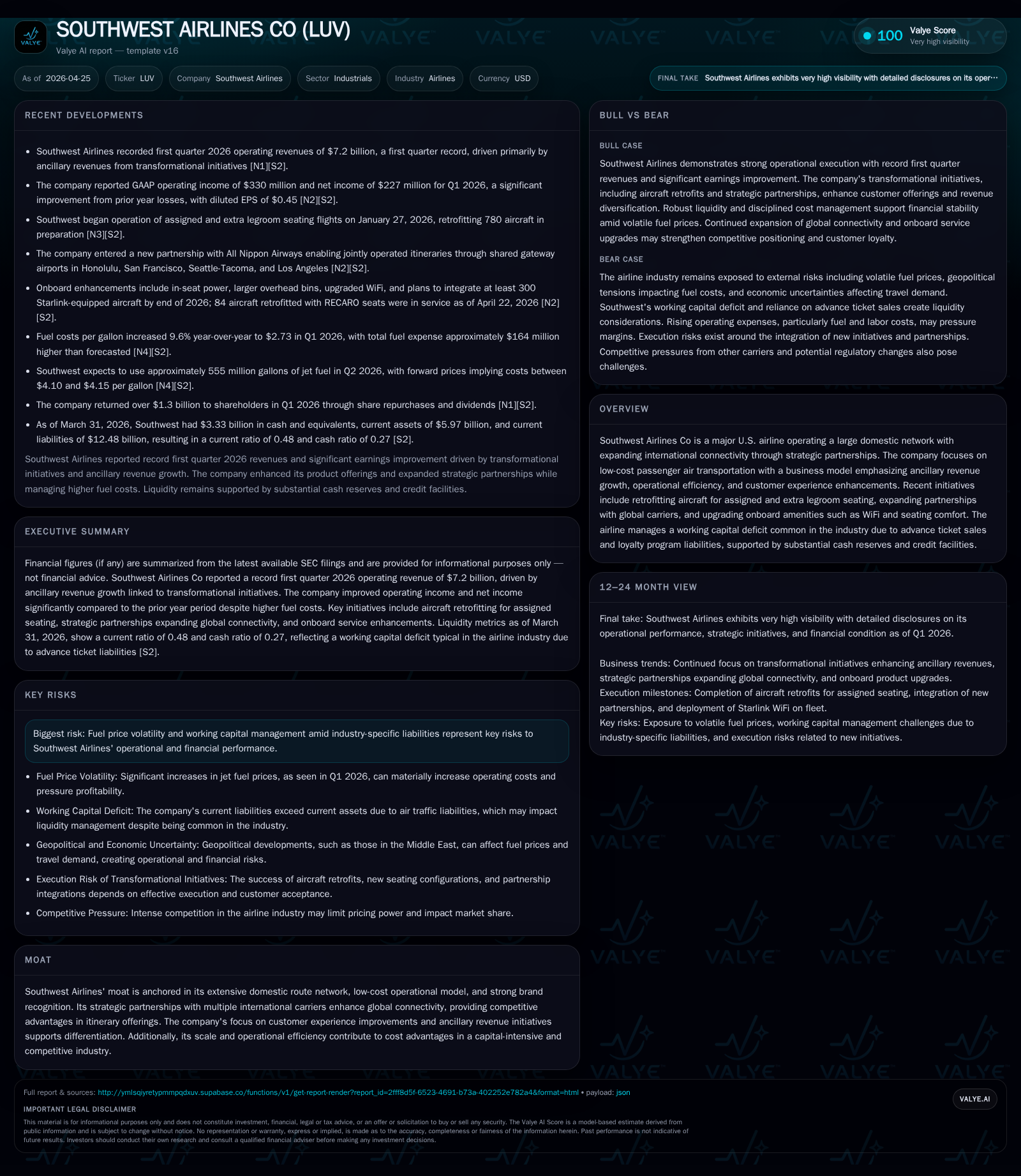
In Q1 2026, Southwest Airlines achieved significant margin expansion despite a nearly 10% increase in fuel costs per gallon, reflecting strong passenger demand, disciplined cost management, and progress on transformational initiatives. The rollout of assigned seating and extra legroom options, along with expanded global partnerships, contributed to ancillary revenue growth and enhanced customer experience. However, ongoing fuel price volatility and a working capital deficit rooted in advance ticket sales and loyalty liabilities pose challenges to sustained margin gains. Monitoring capacity deployment, yield trends, and further ancillary program execution will be critical in upcoming quarters.
Q1 2026 Performance Snapshot: Margin Expansion Amidst Cost Challenges
Southwest Airlines reported a materially improved operating performance for the three months ending March 31, 2026, with operating income turning positive to $330 million on a GAAP basis compared to an operating loss of $223 million in the year-ago period [S2][S12]. The company set a first-quarter revenue record at approximately $7.2 billion driven largely by higher ancillary revenues linked to its recent transformational initiatives [S2][N1]. These came despite a significant headwind from an unexpected $164 million rise in fuel expenses due to geopolitical tensions that sharply increased jet fuel prices in March [S2]. Fuel costs averaged $2.73 per gallon during the quarter versus $2.49 a year earlier (+9.6%), with market futures indicating an even higher expected average for Q2 near $4.10-$4.15 [S2].
Operational demand remained resilient as reflected by a slight year-over-year increase in Revenue Passenger Miles (RPMs) of +1.7% to around 31.15 billion miles flown; load factors improved marginally by +0.2 points to 74.1%. Available Seat Miles (ASMs) also increased by +1.5%, signalling modest capacity growth accommodating demand [S2][S17]. Encouragingly, passenger yield per RPM rose a robust +11.5% to 21.16 cents—largely tied to higher average fares which grew +16.6% to about $225 per ticket—indicating effective revenue management amid capacity discipline [S2]. Operating expenses per ASM rose only +2.6% despite fuel headwinds while excluding fuel costs expenses grew only +1.5%, underscoring disciplined cost containment measures [S2].
Southwest's Business Model: Low-Cost Leadership Meets Customer Experience Enhancements
Southwest Airlines monetizes its extensive domestic network primarily through low-priced passenger airfares augmented with ancillary revenues derived from product enhancements and fee structures [S1]. The company's hallmark has been delivering value through efficient operations coupled with simple fleet composition predominantly of Boeing 737 variants enabling cost advantages over peers [S1].
Recent initiatives reflect a shift toward enhancing customer choice and generating incremental revenue streams beyond base fares. Since early 2026, Southwest has retrofitted approximately 780 aircraft to introduce assigned seating along with extra legroom seating options using new RECARO seats—84 aircraft already service these configurations as of April—with plans for broader rollout including integration of Starlink WiFi across at least 300 fleet units this year [S2][S4]. These changes enable better segmentation yielding upsell opportunities especially among business travelers booking close-in flights [S4].
Further diversifying the product offering is management’s success in fostering international connectivity via strategic partnerships with seven global airlines such as All Nippon Airways, expanding Southwest's reach beyond the U.S domestic market through seamless itinerary connectivity at hubs like San Francisco and Los Angeles [S4]. Ancillary revenues driven by these upgrades are credited for much of the year-over-year revenue growth observed in Q1 [S12].
The company maintains a working capital deficit common in the airline industry due to liabilities related to advance ticket sales and loyalty programs—recognized as Air Traffic Liability on the balance sheet—which requires careful cash flow management but does not represent immediate cash outflows [F1].
Industry Context: Competitive Positioning within the U.S. Domestic Airline Market
Southwest’s moat is deeply rooted in its expansive domestic network that connects secondary cities often underserved by legacy carriers as well as primary hubs [S1]. This network scale combined with its low-cost operational structure—derived chiefly from fleet commonality focused on Boeing 737s—and strong brand recognition provides multilevel competitive advantages.
Cost efficiency relative to peers benefits from simplicity in operations reducing maintenance complexity and training expenses while enabling high utilization rates. The carrier sustains solid yields aided by disciplined capacity deployment strategies ensuring asymmetric load factor optimization.
Increased international connectivity through alliances enhances its itinerary offerings competing directly with global full-service airlines while preserving its brand authenticity as a value-driven domestic leader. Regulatory conditions in the U.S markets remain stable but ongoing litigation risks around alleged collusion to control capacity continue historically; still, Southwest has resolved large-scale lawsuits without material impact on trade dynamics to date [S8][S9][S23].
Growth Catalysts: Network Expansion, Ancillary Revenue, and Operational Efficiency
Transformational initiatives launched prior to or during Q1 continue fueling growth prospects for Southwest Airlines beyond structural demand recovery post-pandemic era.
Incremental ticket pricing power is anticipated from product enhancements such as assigned seats and premium extra-legroom offerings which began service January 27, 2026 after extensive retrofitting efforts [S4][S12]. These provide meaningful upsell potential particularly among the lucrative business traveler segment who value seat selection flexibility.
Network expansion includes new service launches at Cyril E King International Airport (St Thomas) starting early 2026 and McGhee Tyson Airport (Knoxville) begun March 5, broadening Southwest’s footprint into leisure-heavy Caribbean markets alongside emerging secondary US locales providing new passenger flows [S19].
Improved onboard amenities such as upgraded WiFi featuring Starlink satellite internet enhance customer experience fostering brand loyalty while technological modernization streamlines operations [S4]. Expanded partnerships also play an outsized role; Southwest’s code-share agreement with at least seven international carriers unlocks cross-selling access to foreign destinations integrating Southwest’s domestic reach into global travel itineraries [S4].
Operational discipline remains sharp with ex-fuel CASM increasing minimally despite wage inflation pressures signaling leveraged scale benefits translating into profit resiliency even under cost headwinds [S2].
Constraints on Growth: Fuel Price Volatility and Industry Working Capital Dynamics
Jet fuel price volatility emerges as the most conspicuous near-term risk based on recent filings where geopolitical developments in the Middle East abruptly propelled energy prices including crude derivatives upward during March affecting corporate forecasts materially [S2]. The first quarter fuel expense outpaced projections by about $164 million while forward contracts suggest persistent elevated price points potentially pressuring Q2 margins if prices do not abate quickly.
This external uncertainty compounds the structural industry-wide working capital deficit where current liabilities exceed current assets by a factor contributing to a sub-0.5 current ratio reflecting advance ticket sales liability recognition plus evolving loyalty program deferred revenue accounting—all requiring vigilant liquidity management though not immediate cash settlement obligations [F1][S5]. Maintaining adequate cash reserves ($3.3 billion as of quarter end) alongside available credit facilities is critical mitigating short-term solvency stress under volatile market scenarios.
Forward View: Key Metrics and Milestones to Monitor in Upcoming Quarters
Investors should closely track ongoing margin trajectory particularly how effectively Southwest navigates rising fuel costs vis-à-vis continued operational leverage gains ([N2],[S2]). Specific attention should be paid to:
- The pace of incremental rollout completion for assigned/extra legroom seats beyond currently retrofitted aircraft.
- Passenger yield consistency or improvement given fare hikes executed during Q1.
- Load factors management balancing between growth potential versus yield preservation amid shifting capacity stance.
- Execution of planned route expansions including South Atlantic leisure destinations supporting leisure segment growth.
- Progress integrating Starlink-enabled inflight internet services maintaining competitiveness against legacy broadband alternatives.
- Management commentary updates regarding additional strategic partnerships or shifts reflecting evolving global travel patterns.
- Shareholder return activities in context of liquidity stance acknowledging over $1.3 billion was returned via dividends/share repurchases already during Q1.
Financial Health: Balance Sheet, Liquidity, and Profitability Trends
Historical performance (annual)
|
| FY | Net ($mm) | CFO ($bn) | OpInc ($mm) | Net YoY |
|---|---|---|---|---|
| 2025 | 441 | 1.8 | 428 | -5.2% |
| 2024 | 465 | 0.5 | 321 | 0.0% |
| 2023 | 465 | 3.2 | 224 | +311.4% |
| 2022 | -220 | 3.8 | 1017 |
Source: SEC companyfacts cache [F1].
Capital returns and efficiency (annual)
|
| FY | Div ($mm) | Buybacks ($bn) | ROE% |
|---|---|---|---|
| 2025 | 399 | 2.5 | 5.5 |
| 2024 | 430 | 0.3 | 4.5 |
| 2023 | 428 | 4.4 | |
| 2022 | 0 | 0.0 | -2.1 |
Source: SEC companyfacts cache [F1].
The balance sheet reveals stark working capital tension typical for airlines: current assets were approximately $5.97 billion against current liabilities near $12.48 billion as of March 31, 2026 yielding a current ratio around 0.48 according to companyfacts data supported by quarter filings [F1][S2]. This deficit stems predominantly from air traffic liabilities linked to advance ticket collection rather than solvency distress.
Cash & equivalents remain robust at around $3.33 billion providing liquidity buffer amidst external shocks or operational demands [F1][S2]. Total debt levels although dated from older reports approximate $3.4 billion netting nearly zero given substantial cash holdings imply conservative net leverage near zero facilitating interest coverage strengths.
Profitability trends show substantial improvements led by operational execution with FY25 reporting operating income rising +33% year-over-year reaching $428 million after losses in prior years reflective of pandemic disruptions—a clear signal of business model recovery & resilience [F1]. Net income stabilized near $441 million demonstrating consistent bottom-line delivery while operating cash flow surged almost threefold relative to FY24 underscoring renewed free cash flow generation capability for reinvestment or shareholder returns.
Capital allocation remains disciplined with dividends totaling roughly $399 million paid last fiscal year complemented by aggressive share repurchase activity exceeding $2.5 billion indicating confidence in intrinsic valuation combined with ample liquidity cushion supporting pursuit of profitable growth initiatives consistent with recent quarterly disclosures [F1][S18].
Disclaimer: This report is for informational purposes only and does not constitute investment advice or recommendations regarding Southwest Airlines Co (LUV). It reflects analysis based strictly on public filings up to April 25, 2026 without speculative projections beyond sourced data.
Disclaimer: This is research-only, informational analysis and not investment advice. It may include AI-generated interpretation and general industry context. Always verify important details using primary sources.

Comments