
Applied Industrial Technologies Strengthens Credit Profile and Customer Stability in Q3 2026
Q3 2026 results showcase improved receivables quality, stable inventory turnover, and bolstered liquidity positions.
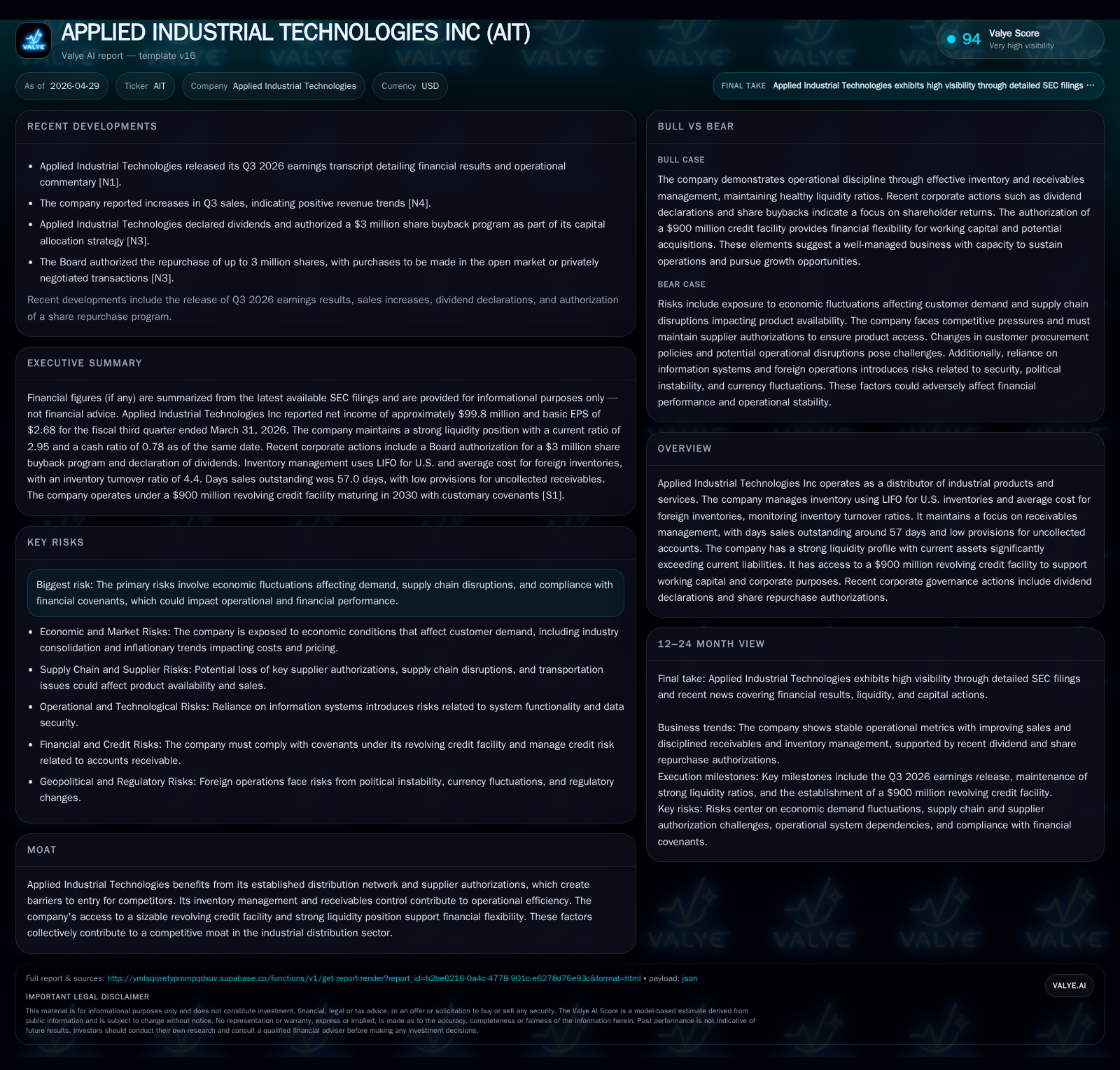
Applied Industrial Technologies' latest quarterly filing reveals enhanced credit management with a stable DSO of 57 days and a significant reduction in overdue receivables over 90 days past due. Inventory turnover remains steady, underpinned by robust operational controls using LIFO valuation domestically and average cost internationally. The company's extensive distribution network and supplier relationships support resilience amid sector cyclicality, reinforced by a strong liquidity profile highlighted by a current ratio near 3 and negative net debt. Headwinds include industrial demand sensitivities and supply chain risks, but the firm's cash flow capacity backs shareholder returns and acquisition optionality.
Q3 2026 Operating Highlights: Receivables and Inventory Metrics Underpin Stability
Applied Industrial Technologies reported a consolidated days sales outstanding (DSO) of 57.0 as of March 31, 2026, representing a slight increase from 56.6 days as of June 30, 2025 [S2]. This marginal uptick masks an important qualitative improvement in credit risk posture: the proportion of accounts receivable balances exceeding 90 days past due dropped significantly to approximately 1.2% from a prior 2.1% [S2]. Correspondingly, provisions for losses on uncollected receivables declined to an ultralow 0.03% of sales for the nine months ended March 31, 2026 compared to 0.08% in the prior year period [S2]. This indicates tighter receivables aging control primarily within the U.S.-based Service Center segment.
On inventory management, the company continues using last-in, first-out (LIFO) valuation for U.S. inventories while employing average cost methods for foreign inventories—a dual approach common among industrial distributors seeking judicious balance-sheet representation and analytical clarity [S2]. The annualized inventory turnover ratio based on average costs was stable at about 4.4 versus 4.3 in the comparable prior period [S2]. This consistency highlights disciplined stock management despite cyclical demand nuances.
Applied Industrial’s Business Model: Distribution Network and Product Offering Essentials
Applied Industrial Technologies functions chiefly as a distributor of industrial products encompassing bearings, power transmission parts, fluid power components, and related maintenance supplies across broad end markets including manufacturing and infrastructure sectors [F1], [S2]. Its value proposition hinges on providing immediate product availability through an extensive footprint combined with credit terms facilitating customer purchasing flexibility.
The company’s revenue drivers depend on volume throughput balanced with pricing moderated by competitive dynamics and cost pass-through capabilities given component inflationary pressures. Usage patterns tend to be repeat-purchase oriented given critical maintenance requirements among customers.
Inventory turnover ratios are a key performance indicator reflecting both service level efficacy and capital efficiency—metrics tightly monitored internally [S2]. Receivables management further ensures collection discipline preserving cash conversion cycles.
Sector Dynamics and Competitive Moat in Industrial Distribution
The industrial distribution sector is characterized by moderate fragmentation but high barriers to entry evidenced by supplier authorizations that confer exclusivity or preferred reseller status—parameters Applied leverages effectively. Its longstanding customer relationships generate considerable switching costs rooted in reliability assurances and credit extensions.
Pricing power is somewhat tempered by commodity inflation pass-through necessity but buttressed by supplier partnerships allowing some margin preservation during input cost volatility. Supply chain disruptions remain systemic threats; however, Applied mitigates these through diversified sourcing channels and efficient logistics.
Operational efficiencies reflect strongly in low historical bad-debt provision levels (often below industry averages) signaling prudent risk controls given sector cyclicality [S2]. Financial flexibility further fortifies competitive positioning through large revolving credit access enabling opportunistic responsiveness.
Growth Catalysts: Expanding Penetration and Financial Strategy
Growth potential lies primarily in deepening market penetration with existing products across geographic regions alongside selective product portfolio expansions aligned with customer adoption trends [N1], [N4]. Constant investments in service capabilities aim to differentiate Applied from lower-tier competitors.
A $900 million revolving credit facility secured recently triggers enhanced acquisition optionality which can accelerate inorganic growth modes while supporting working capital needs [S3], [S19]. Concurrently, management’s authorization of a $3 million share repurchase program alongside dividend declarations signals confidence in ongoing free cash flow generation and capital allocation discipline [S3], [N4].
Monitoring KPIs such as DSO stability serves as proxies for customer retention health; steady or improving inventory turns suggest supply chain robustness.
Risks and Constraints: Economic Sensitivities and Supply Chain Dependencies
Economic cyclicality stands as an inherent risk—industrial end markets’ capital expenditure patterns are highly sensitive to macroeconomic shifts potentially delaying purchases or reducing order frequency,[S2]. Supply chain challenges may prompt price escalations difficult to fully pass through despite sector relationships impacting margins.
Labor cost inflation remains another margin pressure vector amid tight industrial labor markets.
Geopolitical uncertainties affecting trade policies or tariffs could also influence supplier availability or pricing dynamics indirectly.
Upcoming Milestones and Key Execution Triggers
Investors should closely watch Q4 fiscal year earnings guidance updates disclosed through forthcoming MD&A commentary that may reflect evolving demand scenarios or margin outlooks [S2]. Progress against the share repurchase program authorized in April will serve as tangible evidence of free cash flow realization [S3].
Any announced acquisitions or major contract wins would further signal growth momentum [N4]. Additionally, trends in inventory turnover rates and DSO figures provide timely barometers of operational health under shifting macroeconomic conditions.
Latest Financial Snapshot: Capital Structure and Liquidity Review
Applied Industrial Technologies maintains a robust liquidity position with current assets nearly threefold current liabilities leading to a healthy current ratio of roughly 2.95 as of March 31, 2026 [F1]. Net debt is negative due to cash holdings exceeding total debt obligations—highlighting conservative leverage posture enabling strategic flexibility [F1]. Access to a substantial $900 million revolving credit facility provides additional financial agility to meet capital needs including working capital optimizations and investments [S19]. Recent corporate actions authorizing dividends and share buybacks underscore management’s commitment to balanced stakeholder returns while preserving operational funding capacity [S3].
This report synthesizes publicly filed regulatory disclosures up through April 28, 2026, alongside market commentary sources without making investment recommendations.
Disclaimer: This is research-only, informational analysis and not investment advice. It may include AI-generated interpretation and general industry context. Always verify important details using primary sources.

Comments