
Moleculin Biotech’s Pivotal Trial Progress and Financial Overview in Oncology Innovation
A comprehensive look at Moleculin Biotech’s clinical pipeline milestones alongside its financial position to evaluate near-term operational and funding dynamics.
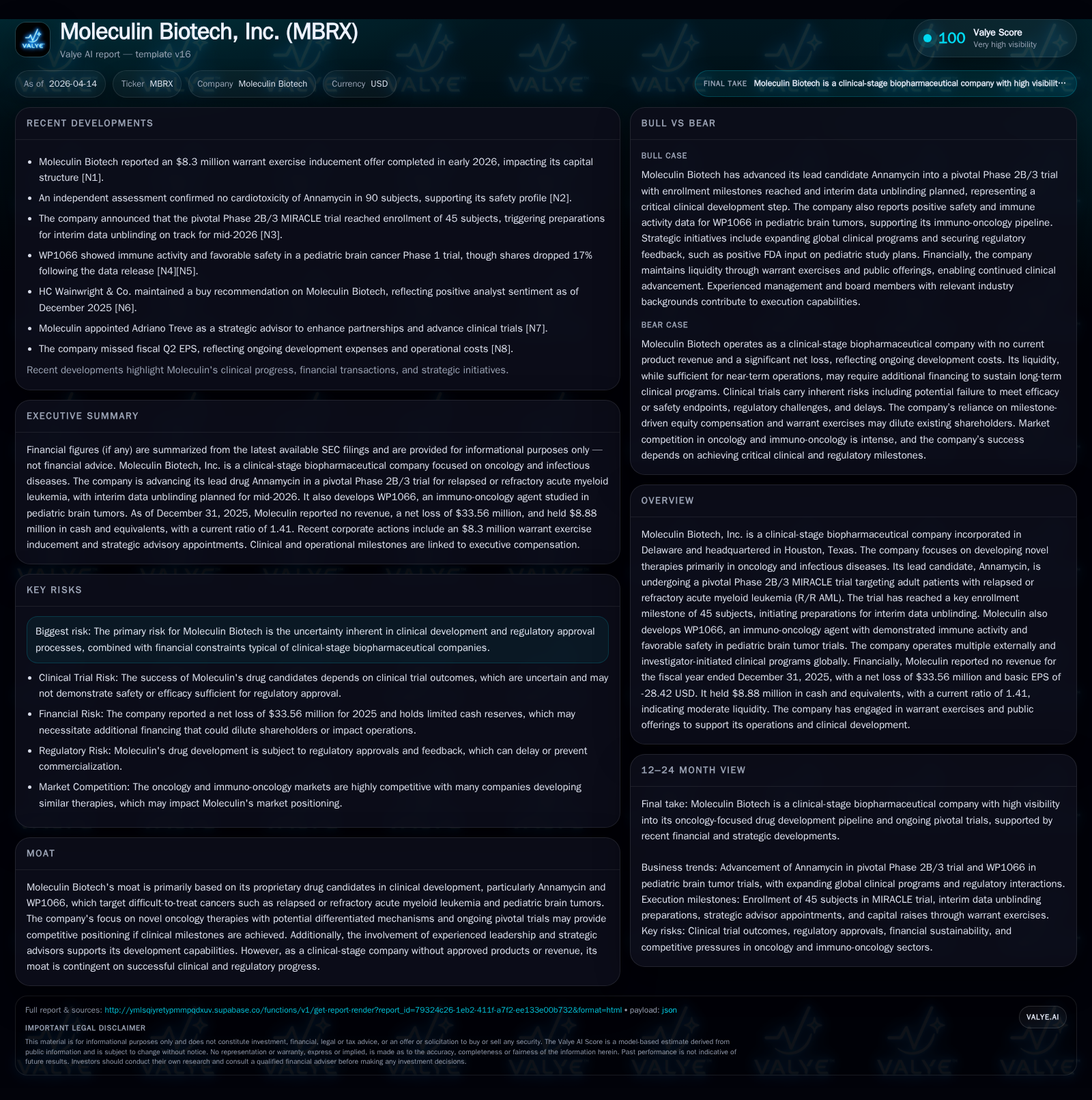
Moleculin Biotech has enrolled 45 subjects in its pivotal Phase 2B/3 MIRACLE trial assessing Annamycin combined with cytarabine for relapsed/refractory acute myeloid leukemia, with interim data unblinding anticipated mid-2026. The company’s immuno-oncology candidate WP1066 advances pediatric brain tumor programs, supporting pipeline diversification. Despite no revenues and ongoing operating losses driven by clinical development, the firm maintains a cash balance of $8.9 million at year-end 2025 and a current ratio of 1.41, reflecting constrained but sufficient near-term liquidity. Capital structure is equity-centric with recent fundraising bolstering the balance sheet, while no dividends or share repurchases have been declared. Upcoming data releases and regulatory feedback are key catalysts amid typical clinical-stage risks.
Clinical Progress: Key Milestones in R/R AML Treatment
Moleculin Biotech reached an important enrollment milestone with the inclusion of the 45th subject in its pivotal Phase 2B/3 MIRACLE trial evaluating Annamycin combined with cytarabine (AnnAraC) for adults with relapsed or refractory acute myeloid leukemia (R/R AML) [S3]. This enrollment completion sets the stage for an interim data unblinding expected around mid-2026, which will be vital for assessing early efficacy and safety signals.
The MIRACLE trial targets a patient population facing limited therapeutic options by leveraging Annamycin’s design as an anthracycline analog intended to overcome resistance mechanisms common in R/R AML. The combination with cytarabine aims to enhance treatment effectiveness.
Complementing this lead asset, WP1066 is under investigation as an immune-oncology agent in pediatric brain tumors and has demonstrated encouraging immune activity and safety profiles in early studies [S3]. This candidate adds diversification to Moleculin’s oncology pipeline, addressing challenging indications.
Additionally, the company supports multiple externally initiated clinical programs globally, broadening its developmental footprint beyond proprietary trials [S3].
Pipeline Overview: Novel Therapeutic Modalities
Moleculin’s portfolio centers on innovative molecules tackling aggressive cancers with unmet needs. Annamycin offers enhanced tumor penetration and reduced cardiotoxicity compared to traditional anthracyclines, specifically targeting resistant R/R AML cases. WP1066 modulates oncogenic signaling pathways while stimulating anti-tumor immunity—an approach aligned with advancing immuno-oncology trends.
Both candidates remain clinical-stage assets without approved products or revenue generation thus far, emphasizing the reliance on successful trial execution and regulatory pathways.
Historical Performance: Operating Losses and Cash Flow Trends
The company has generated no revenue over the past four fiscal years ending December 31, 2025 [F1]. Operating losses persist due to intensive clinical development investments:
Historical performance (annual)
| FY | Rev | Net ($mm) | CFO ($mm) | OpInc ($mm) | Net YoY |
|---|---|---|---|---|---|
| 2025 | 0 | -34 | -23 | -25 | -54.2% |
| 2024 | 0 | -22 | -24 | -27 | +26.9% |
| 2023 | 0 | -30 | -24 | -30 | -2.6% |
| 2022 | 0 | -29 | -28 | -31 |
Source: SEC companyfacts cache [F1].
Capital returns and efficiency (annual)
| FY | FCF ($mm) | ROE% |
|---|---|---|
| 2025 | -23 | -223.6 |
| 2024 | -24 | -364.0 |
| 2023 | -24 | -114.2 |
| 2022 | -28 | -55.6 |
Source: SEC companyfacts cache [F1].
Operating losses improved modestly by approximately 5.8% year-over-year from FY2024 to FY2025 despite a widening net loss primarily driven by other expenses [F1]. Operating cash flow deficits also moderated slightly (~4.7%), reflecting persistent high burn consistent with ongoing research activities.
Capital expenditures were minimal in recent years and zero in FY2025.
Financial Position: Liquidity and Capital Structure
As of December 31, 2025, Moleculin held approximately $8.88 million in cash and equivalents with current assets totaling about $9.69 million against current liabilities near $6.85 million—a current ratio of roughly 1.41 indicates sufficient short-term liquidity under prevailing conditions [F1]. However, the cash runway remains tight given negative operating cash flows exceeding $22 million annually without offsetting revenues.
Equity increased substantially to $15 million at year-end from approximately $6 million the prior year [F1], signaling recent capital raises that strengthen the balance sheet.
There is no indication of material long-term debt obligations; capital structure appears focused on equity financing without dividend payments or share repurchase programs reported [S10][S18][S19]. Recent warrant inducement agreements may provide additional funding avenues but imply potential shareholder dilution [S17].
Growth Outlook: Catalysts and Regulatory Pathways
With full enrollment achieved in the MIRACLE pivotal trial and interim data expected mid-2026 [S3], key upcoming catalysts will revolve around these results which could influence regulatory feedback or partnership opportunities.
Progression of WP1066 trials in pediatric brain tumors may further enhance pipeline value pending confirmatory outcomes.
No explicit guidance on future filings or commercialization plans has been disclosed; therefore, investors should monitor upcoming SEC filings and press releases closely for updates.
Capital Allocation Review: Focused Investment Without Shareholder Returns
Capital allocation remains focused on advancing clinical programs rather than shareholder distributions. No dividends or share buybacks occurred during FY2025 [F1][S10][S18]. Equity issuances have provided necessary funding support amid net losses.
Debt financing is minimal or absent based on disclosures; this aligns with typical early-stage biotech practices prioritizing research investment over returning capital to shareholders.
Risk Factors: Clinical Development Uncertainties and Funding Needs
Recent filings highlight risks common to clinical-stage biopharmaceutical companies including:
- Variability of clinical trial outcomes impacting approval prospects;
- Regulatory uncertainties affecting timelines;
- Potential intellectual property challenges;
- Funding requirements that may lead to further equity dilution;
- Operational risks associated with scaling development efforts [S4–S9][S12][S13][S15][S23][S26][S27].
These factors underscore the importance of monitoring progress on pivotal trials and financial health closely.
Disclaimer: This report synthesizes publicly available information from SEC filings as of April 14, 2026 ([F1],[S1],[S3]) without making investment recommendations. Readers should consider inherent risks involved in investigational therapeutic development when forming their own evaluations.
Disclaimer: This is research-only, informational analysis and not investment advice. It may include AI-generated interpretation and general industry context. Always verify important details using primary sources.

Comments