
SunPower Inc.'s Expanding Residential Solar Platform Amid Cost and Liquidity Challenges
SunPower Inc. leverages acquisitions and technology to drive rapid growth in residential solar but grapples with persistent operating losses and liquidity constraints.
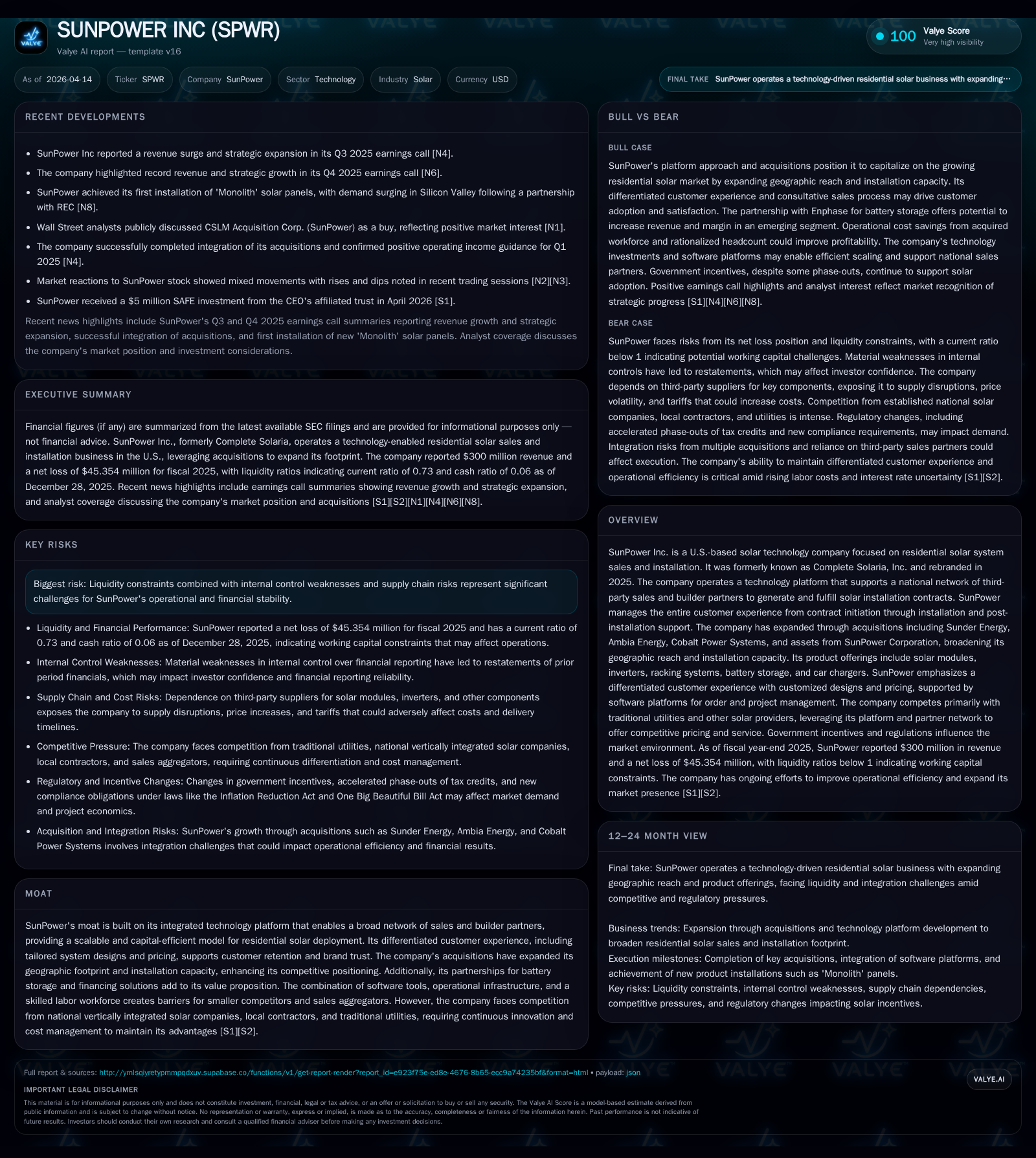
SunPower Inc., rebranded from Complete Solaria in 2025, has rapidly grown through strategic acquisitions including Sunder, Ambia, Cobalt Power Systems, and assets from SunPower Corporation. This has expanded its national footprint and installation capacity for residential solar systems, supported by a proprietary technology platform that optimizes sales partner integration and customer experience. Despite revenue surging nearly 176% to $300 million in fiscal 2025, the company continues to post operating losses (−$27 million) and net losses (−$45 million), compounded by weak operating cash flows and liquidity pressures. Capital allocation is constrained, relying on convertible debt and equity instruments for funding. Opportunities rest on scaling battery storage offerings and geographic expansion, while risks include supply chain issues, internal control weaknesses, regulatory shifts, and competition.
Company Overview and Business Model
SunPower Inc., formerly Complete Solaria until its rebranding in April 2025, operates as a U.S.-focused residential solar technology company headquartered in Orem, Utah [S1][S4][S13]. The company’s mission is to deliver energy-efficient solar solutions helping homeowners and small to medium businesses reduce energy costs and carbon footprints.
The business centers on a proprietary platform enabling a national network of third-party sales partners who generate residential solar installation contracts [S4][S6]. These partners receive software tools, brand support, and operational infrastructure to compete effectively with larger national providers. SunPower manages end-to-end fulfillment—from contracting through installation—via local builder partners and an in-house installation team [S6][S7].
Products include solar modules sourced from select distributors, inverters, racking systems, battery storage solutions through partnerships like Enphase, plus EV chargers where appropriate [S4][S11]. The company emphasizes differentiation through customized system designs tailored to each home’s specifics alongside pricing structures designed to deliver cost savings relative to traditional utility electricity [S4][S7].
Historical Financial Performance
Annual revenue more than tripled over two years: approximately $88 million in FY 2023 growing to about $109 million in FY 2024 (+24%), then surging ~176% to $300 million in FY 2025 [F1]. This growth aligns with key acquisitions including Sunder Energy (third-party sales), Ambia Energy (installer), Cobalt Power Systems (California installer), and assets acquired from SunPower Corporation's prior operations [S6][S16]. These deals have broadened SunPower’s geographic presence within the U.S. residential solar market.
Profitability remains challenged. Operating income improved from −$44 million in FY 2022 to −$52 million in FY 2023 then further narrowed losses by nearly two-thirds to −$27 million in FY 2025 [F1], suggesting scale benefits during rising labor costs.
Net income shows improvement but remains negative: a severe −$269 million loss in FY 2023 (likely impacted by restructuring or impairments) reduced to −$56 million loss FY 2024 and further improved to −$45 million loss FY 2025 [F1].
Operating cash flows are consistently negative but have improved significantly from around −$55 million in FYs 2023-24 to −$15 million in FY 2025 alongside minimal capital expenditures (~$35 thousand annually), indicating an asset-light model leveraging partner installations rather than heavy fixed asset investments.
Equity remains negative at about −$90 million at FY-end 2025 compared to −$97 million the prior year [F1], reflecting cumulative losses exceeding contributed capital.
Annual Financial Summary
Historical performance (annual)
| FY | Rev ($mm) | Net ($mm) | CFO ($mm) | OpInc ($mm) | Rev YoY | Net YoY |
|---|---|---|---|---|---|---|
| 2025 | 300 | -45 | -15 | -27 | +175.9% | +19.7% |
| 2024 | 109 | -56 | -55 | -69 | +24.1% | +79.1% |
| 2023 | 88 | -270 | -59 | -52 | -4605.8% | |
| 2022 | 6 | -1 | -4 |
Source: SEC companyfacts cache [F1].
Capital returns and efficiency (annual)
| FY | FCF ($mm) | ROE% |
|---|---|---|
| 2025 | 50.3 | |
| 2024 | -55 | 57.9 |
| 2023 | -59 | 350.9 |
| 2022 | -52.1 |
Source: SEC companyfacts cache [F1].
Note: CFO = Operating Cash Flow; Capex = Capital Expenditures; YoY percentages reflect change vs prior fiscal year.
Growth Drivers and Outlook
SunPower’s growth strategy includes:
- Acquisition-driven expansion: Sunder Energy extends sales reach nationwide; Ambia Energy and Cobalt Power Systems add regional installation capacity focused on key markets such as California [S16].
- Technology-enabled platform: Transitioning from legacy order management systems like Albatross toward Salesforce-based tools streamlines partner onboarding and lowers acquisition costs while expanding reach [S4][S6].
- Battery storage integration: Partnership with Enphase facilitates bundling battery storage with solar systems — an attractive margin opportunity amid rising energy prices [S5][S9].
- Geographic expansion: Builder-partner programs enable entry into new U.S. markets beyond traditional regions by converting sales contracts into installations internally or via contracted builders [S7].
- Differentiated customer experience: Customized designs/pricing combined with consultative sales support retention amid competitive utility alternatives [S4][S9].
Risks include supply chain disruptions affecting module availability or cost; rising labor expenses; regulatory uncertainty especially tax credit expirations accelerated by recent legislation; competition intensity; internal control weaknesses impacting operational execution [S8][S12][S15].
Capital Allocation & Returns
SunPower’s reported return on equity is distorted by negative equity balances (approximately −$90 million) due to accumulated losses; thus profitability metrics like ROE should be interpreted cautiously [F1].
Operating cash flow remains negative at about −$15 million for FY 2025 with negligible capital expenditures supporting an asset-light model but resulting free cash flow is also negative implying ongoing external financing dependence [F1].
Recent capital raises include issuance of a zero-coupon convertible debenture totaling $10 million maturing March 6, 2027, with escalating interest upon default events; stockholder approvals were obtained for share issuances related to acquisition considerations alongside equity incentive plans expansions [S19][S20][S21]. No dividends or share repurchases have been reported given continuing losses.
Industry Context & Competition
U.S. residential solar adoption benefits from federal incentives like the Inflation Reduction Act but faces countervailing headwinds due to accelerated phase-outs under the One Big Beautiful Bill Act effective after December 31, 2025 plus import tariffs raising component costs [S15].
Competitors include vertically integrated national solar firms offering proprietary financing bundles; smaller local contractors operating with low overhead but limited scale; third-party sales aggregators; traditional utilities limiting net metering incentives; finance-driven installers outsourcing construction work.
SunPower’s advantage lies in its scalable end-to-end technology platform enabling broad partner networks without heavy capital investment coupled with differentiated consultative service models delivering customized solutions attractive to homeowners seeking alternatives beyond standard utility offerings [S9][S10]. Continuous innovation will be essential amid market fragmentation.
Risks & Challenges Summary
SEC filings highlight:
- Material internal control weaknesses requiring restatements impacting investor confidence [S18][S23];
- Liquidity constraints exacerbated by negative cash flows necessitating refinancing or dilutive equity raises [F1][S17][S19];
- Supply chain or cost inflation pressures potentially compressing margins or slowing demand [S8][S11];
- Regulatory changes accelerating tax credit expirations plus import tariffs introducing cost volatility around critical components such as polysilicon modules [S15];
- Cybersecurity risks managed at Board level but relevant given technology dependency [S14];
- Competitive pressure from established integrators with proprietary financing capturing prime segments faster.
Conclusion
SunPower Inc.’s transformation post-rebranding into a scaled residential solar platform powered by multiple acquisitions has delivered robust topline growth demonstrated by near tripling revenue between fiscal years 2024 and 2025 [F1]. Its differentiated customer experience supported by proprietary software tools positions it ahead of smaller contractors or less integrated aggregators.
However, structural profitability remains challenged amid significant operating losses despite improvement trends. Liquidity constraints combined with material control weaknesses temper near-term financial stability requiring vigilant monitoring of refinancing activities including convertible debt maturities largely due within one year alongside successful acquisition integrations conducive toward margin expansion [F1]. Policy developments affecting tax incentives will critically influence economics going forward.
Investors should watch quarterly disclosures for restored financial clarity before drawing conclusions on sustainable economic returns.
This analysis synthesizes publicly filed financial data as of April 14th, 2026 without providing investment advice.
Disclaimer: This is research-only, informational analysis and not investment advice. It may include AI-generated interpretation and general industry context. Always verify important details using primary sources.

Comments