
Microchip Technology Advances Embedded Control Growth Supported by Stable Margins and Strategic Investments
Fiscal 2026 marks a recovery phase for Microchip with revenue growth and enhanced operational efficiency following prior inventory corrections.
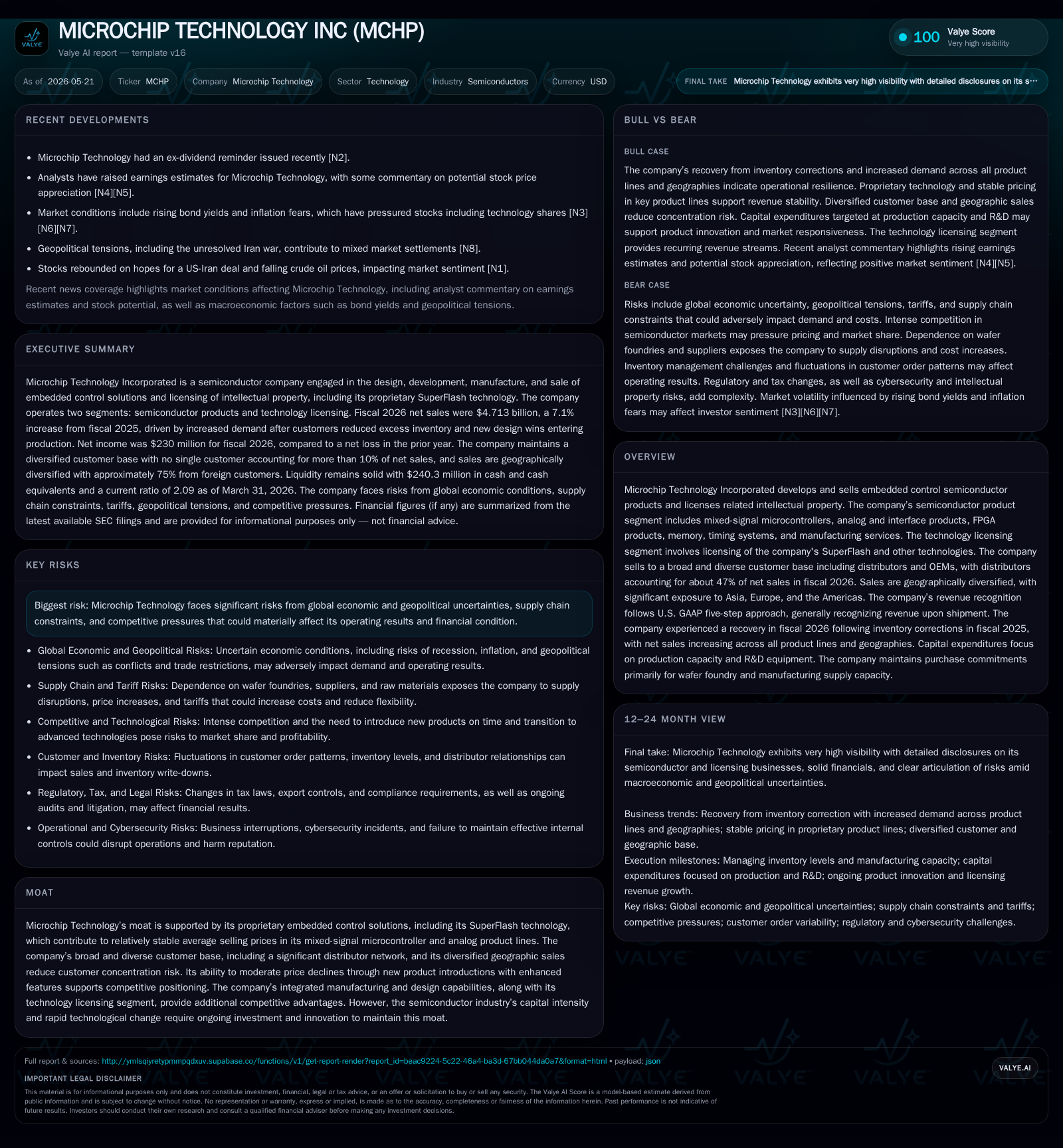
Microchip Technology reported meaningful revenue growth in fiscal 2026 driven by broad demand recovery and inventory management improvements after prior customer overstocking. The company’s business model leverages proprietary embedded control semiconductor products and licensing of key technologies like SuperFlash, benefiting from stable pricing trends despite industry cyclical pressures. Its diversified customer base across geographic areas and reliance on distributors underpin resilience. Key growth drivers include expanding application sectors for microcontrollers, continuous product innovation, and increased in-house manufacturing capacity. Risks include competitive pricing pressures, global economic uncertainties, and supply chain constraints. Monitoring upcoming product launches, capacity expansions, and macroeconomic developments will be critical for assessing trajectory.
Recent Operating Update
Microchip Technology's latest fiscal year ended March 31, 2026 (fiscal 2026) reflects a marked recovery after a weak fiscal 2025 precipitated by large inventory corrections across its customer base [S1], [S2]. Sales volumes increased broadly across all product lines and geographies following customers' reduction of excess stock levels. The company also strategically managed inventories downward while balancing manufacturing output to restore operational efficiency. This pivot into significant revenue growth mode underscores Microchip's ability to adapt to volatile semiconductor demand cycles [S1].
Management disclosed improvements in operating income of $490 million alongside a net income of $230 million during fiscal 2026—significant rebounds from losses recorded previously [F1]. Fiscal cash flow generation was strong at approximately $962 million from ongoing operations despite elevated non-cash adjustments [S16]. Capital expenditures were moderated around $91 million as the company suspended aggressive factory expansion plans earlier yet continues investing selectively in capacity enhancements crucial for future growth [S16].
Notably, Microchip maintains a solid liquidity profile with roughly $240 million in cash compared to $5.54 billion total debt outstanding at year-end [F1], ensuring sufficient resources for R&D investment, capacity build-out, dividend payments, and share repurchase flexibility [S4], [S6], [S21]. Credit covenants remain comfortably in compliance even under tightening thresholds slated through late 2026 [S5], [S7].
Business Model Overview
Microchip derives the majority of revenues from its semiconductor segment comprising mixed-signal microcontrollers (MCUs), analog & interface products, field-programmable gate arrays (FPGAs), memory components, timing systems, along with manufacturing services supporting these hardware lines [S1], [S8]. A smaller but strategic technology licensing division monetizes proprietary SuperFlash technology among others via license fees primarily from foundry partners and licensees.
Revenue recognition follows a shipment-based model per U.S. GAAP five-step guidelines—recognizing revenues predominantly when goods transfer to distributors or OEM customers post-shipment [S1]. Approximately 47% of net sales involve third-party distributors who enable wide global market penetration especially given diverse end applications ranging from industrial automation to automotive electronics.
Pricing dynamics reflect modest declines mainly in mature proprietary lines but are largely offset by new product introductions featuring enhanced functionality that commands relatively stable average selling prices (ASP) supported by differentiated embedded controller capabilities [S1]. This mix-driven mitigation is pivotal given intense competition prevalent in commoditized segments.
Microchip operates alongside peers offering microcontroller-heavy portfolios but differentiates via its proprietary IP assets such as SuperFlash technology which enhances non-volatile memory performance critical for embedded applications.
Customer diversity spanning OEMs across Asia-Pacific, Europe, Americas reduces concentration risk while heavy distributor engagement facilitates scale enabling breadth unmatched by smaller competitors yet faces competition from tier-one semiconductor conglomerates with integrated offerings including MCUs complemented by processors or sensors.
Continual innovation combined with design support for ease of adoption via development tools entrenches switching costs within ecosystems, enhancing customer retention prospects despite cyclicality inherent to end markets such as consumer electronics or automotive sectors.
Growth Drivers
Application Expansion & Market Penetration
Increasing penetration of embedded controls in expanding domains—industrial IoT automation, electric vehicles, healthcare devices—drives structural demand increase beyond traditional consumer cycles. Microchip’s broad product portfolio supports diverse control needs from low-power microcontrollers to sophisticated programmable logic arrays.
Product Innovation & R&D Investment
Fiscal 2026 R&D expenditure rose to nearly $1.09 billion (~23% of net sales), focused on advanced process technologies reducing manufacturing costs as well as software development tools fostering ecosystem lock-in—all critical for introducing higher-margin products supporting ASP stability [S12]
Manufacturing Capacity Optimization
Strategic investments aim at selective facility expansion coupled with bringing outsourced assembly/test processes internally enhances supply chain resilience amid recent global disruptions while improving margins through economies of scale.
Distribution Network Strengthening
Nearly half of revenues flow via established distributors allowing Microchip agility in balancing supply-demand fluctuations globally ensuring broad market access without elevated receivables risk [S8].
Risks and Constraints
Macroeconomic & Geopolitical Volatility
Exposure to global economic slowdowns or recessions could meaningfully disrupt order momentum given cyclical industry nature. Compounding risks arise from geopolitical tensions (e.g., trade restrictions impacting China), potentially limiting market access or increasing costs through tariffs [S1]. Supply chain interruptions remain a concern.
Pricing Pressure & Product Lifecycle Dynamics
Competitive intensity fosters pricing erosion particularly on mature older-generation products necessitating continual innovation to buffer ASP declines; failure here could compress margins materially.
Capital Intensity & Execution Risk
Maintaining competitive technological edge requires sustained capital investment amid fluctuating demand environments posing forecasting challenges that could impair capital allocation efficiency.
Dependence on Distributors & Customers
Heavy reliance on distributors entails counterparty credit and inventory risks; any disruption or shift in distributor relationships can adversely impact sales flow or increase return liabilities.
What To Watch Next
- Execution timelines and outcomes of planned incremental capital expenditures aimed at capacity scaling efforts aligned with new product launches.
- Demand signals from key application sectors particularly industrial automation evolution and automotive electrification initiatives which underpin MCU adoption curves.
- Quarterly revenue growth momentum vis-à-vis inventory rebuilds indicating sustainability beyond one-off restocking benefits.
- Pricing trends monitored closely given embedded controller commoditization risks balanced against premium features introduction cadence.
- Progression of geopolitical developments impacting supply chains or trade policies influencing cost structures or market access.
- Updates on restructuring benefits realization focusing on operational efficiencies contributing to margin expansion.
- R&D pipeline news relevant to next-gen embedded control capabilities integrated with AI or cybersecurity functions addressing emerging customer requirements.
Financial Profile Summary
As of March 31, 2026, Microchip held approximately $240 million cash against $5.54 billion total debt resulting in net debt near $5.3 billion [F1]. The current ratio stood solidly above 2x reflecting liquidity adequacy for upcoming obligations including dividend commitments totaling nearly $985 million annually [F1], [S6], [S21].
Disclaimer
This report is for informational purposes only and does not constitute investment advice or research views. All analysis is based solely on public disclosures as cited without speculative assumptions or forecasts beyond provided evidence.
Disclaimer: This is research-only, informational analysis and not investment advice. It may include AI-generated interpretation and general industry context. Always verify important details using primary sources.

Comments