Meta Platforms Inc: Navigating AI-Driven Growth Amidst Expanding Infrastructure and Regulatory Challenges
Meta continues its strategic pivot towards AI and immersive technologies, balancing robust ad revenue with heavy capital investments and regulatory risks.
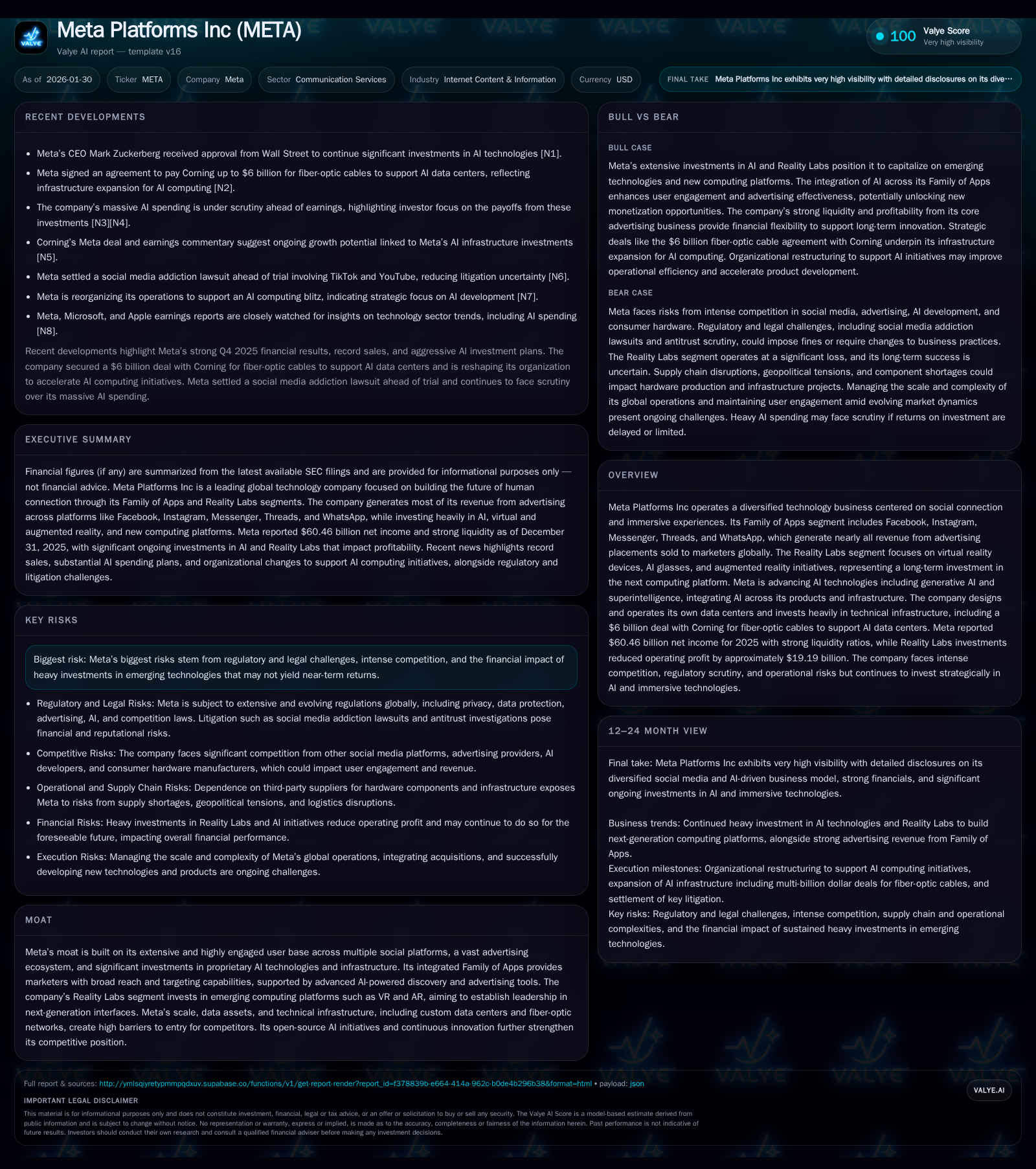
Meta Platforms remains a dominant force in social connectivity and digital advertising, supported by its expansive Family of Apps ecosystem. Recent earnings highlight strong profitability alongside unprecedented investments in AI infrastructure, including a $6 billion fiber-optic deal with Corning to support its AI data centers. The company’s Reality Labs segment embodies a long-term bet on virtual and augmented reality as the next computing platform, though it continues to operate at a loss. Meta faces intensifying competition, evolving user engagement patterns, and significant regulatory scrutiny, creating a complex operating environment as it pushes into generative AI and superintelligence.
What Changed Recently
Meta’s Q4 2025 earnings revealed a profitable yet highly capital-intensive phase, with a net income of $60.46 billion [N3]. The standout headline was Meta’s planned AI capital expenditure topping $135 billion for 2026, a scale that dwarfs prior years and underscores the company’s AI-first strategic pivot [N3, N4]. Key infrastructure investments include a $6 billion deal with Corning for fiber-optic cables to support massive AI data center build-out, signaling Meta’s push to own the backbone of AI compute capacity [N2, N12].
On the product front, Meta continues to integrate AI across its Family of Apps—Facebook, Instagram, Messenger, Threads, and WhatsApp—enhancing user engagement and advertising precision through AI-powered discovery and ad tools [S3, N1]. Reality Labs, Meta’s VR/AR and hardware research arm, remains a significant cash drain with operating losses expected to continue, reflecting the early-stage and long-term nature of this bet on the next computing platform [S6, S14].
Despite heavy spending, Meta’s revenue outlook remains strong, with Q1 2026 guidance above consensus, driven by the continued monetization of its advertising ecosystem and expanded AI capabilities [N5, N14]. Wall Street scrutiny remains focused on the payoffs from AI investments, balancing optimism on long-term platform leadership against near-term margin pressures [N1, N7, N8].
Business Model as a System
Meta’s business functions as a complex ecosystem centered on social connection, content discovery, and advertising. The Family of Apps segment generates nearly all revenue by selling advertising placements to global marketers across Facebook, Instagram, Messenger, Threads, and WhatsApp [S3, S12]. These platforms collectively provide vast reach and deep user engagement, enabling sophisticated ad targeting powered by AI models that recommend relevant content and ads.
Advertising revenue depends heavily on user engagement metrics and data signals, which are increasingly constrained by regulatory changes and platform policies, especially around privacy and data usage [S10, S13]. Meta invests heavily in AI to improve ad relevance, measurement, and delivery, which supports pricing power and attracts marketing budgets amid competitive pressures.
Parallel to its ad business, Meta pursues the Reality Labs segment focused on VR/AR hardware and software, including Meta Quest devices and AI glasses. Reality Labs is a long-term strategic investment aimed at establishing Meta leadership in immersive computing and the metaverse [S6]. Currently, Reality Labs operates at a substantial loss, funded by the profits from advertising [S14].
To support its AI ambitions, Meta designs and operates proprietary data centers and invests in technical infrastructure like high-speed fiber-optic networks, exemplified by the Corning deal [N12, S4]. These investments underpin advanced AI model training and real-time inference capabilities critical for content ranking, ad targeting, and emerging AI applications like generative AI and superintelligence [S3, S4].
Industry Map & Competitive Battlefield
Meta operates in the highly dynamic and competitive internet content and information industry, with its core competitive landscape spanning social media platforms, digital advertising networks, and emerging frontier technologies like AI and extended reality.
Its primary competitors include other major social platforms such as TikTok, YouTube, Snapchat, and Twitter alternatives, which vie for user attention and engagement, particularly among younger demographics [S20, S21]. In advertising, Meta competes with Google and Amazon for marketer spend, while also contending with shifts in ad measurement and targeting caused by ecosystem changes like Apple’s privacy policies [S10, S20].
In the AI domain, Meta faces competition from large cloud and AI service providers such as Microsoft, Google, and Amazon, as well as AI startups. The race to develop frontier AI models and superintelligence capabilities is a strategic battleground where scale, data access, and infrastructure investment are key differentiators [N1, S3, S4].
For Reality Labs and the metaverse vision, Meta competes with hardware companies like Apple and emerging VR/AR specialists, as well as gaming and content platforms. The field is nascent with uncertain user adoption curves and monetization models, making it a speculative but potentially transformative arena [S6].
Regulatory scrutiny is another critical competitive factor. Meta faces intense legal and regulatory pressures globally related to privacy, content moderation, youth protection, and antitrust concerns. These challenges can materially affect user engagement, data availability, and advertising operations, creating risks that are less pronounced for some competitors depending on jurisdiction and business model [S15, S17, S18, S19].
Where the Economics Become Real
Meta’s unit economics hinge on its ability to monetize user engagement through advertising while managing the escalating cost base driven by AI and Reality Labs investments. Advertising revenues benefit from scale, targeting precision, and engagement intensity across the Family of Apps, but face headwinds from privacy-driven data signal reductions and competitive ad inventory pricing pressures [S10, S13].
Operating margins are compressed by substantial R&D and capital expenditures. In 2025, Reality Labs alone trimmed operating profits by approximately $19.19 billion, and similar losses are expected in 2026 [S14]. AI infrastructure investments, including data centers and fiber-optic networks, represent another large fixed cost layer but are essential to maintain competitive AI capabilities and user experience quality [N2, S4].
Meta’s liquidity position remains robust, with a current ratio of approximately 2.6 and over $35 billion in cash and equivalents as of end-2025, providing financial flexibility to sustain heavy investment programs [derived from SEC XBRL].
Monetization beyond advertising is nascent, including hardware sales, digital goods, and payments within the Family of Apps and Reality Labs. These revenue streams remain small relative to advertising but represent important diversification as Meta builds the next computing platform [S12].
The effectiveness of AI in driving discovery, ad targeting, and engagement directly influences revenue yield per user and marketer ROI, making AI advancements a key lever for unit economics. However, these benefits must offset the rising operational complexity and cost [S3, S10, S11].
Diligence Questions / Disconfirming Signals
- How will evolving global privacy regulations and platform policy changes affect the availability of user data signals critical for AI-powered ad targeting and measurement?
- What are the realistic timelines and adoption curves for Reality Labs hardware and metaverse platforms to become material revenue contributors?
- Can Meta sustain its AI capital expenditure at the projected $135 billion in 2026 without adverse impacts on profitability or liquidity?
- How effective is Meta’s AI integration in improving ad relevance and marketer ROI compared to competitors’ AI capabilities?
- What contingencies does Meta have if its AI infrastructure investments face supply chain disruptions or cost overruns, especially given reliance on partners like Corning?
- How is Meta adapting user engagement strategies to counter shifts in demographics and competition from emerging social platforms?
- Given escalating legal and regulatory challenges, what is the potential impact of adverse rulings or regulatory actions on Meta’s business practices and financials?
- How is Meta managing internal complexity and talent acquisition to maintain innovation velocity amid scale and organizational changes?
Meta Platforms occupies a uniquely complex position at the intersection of social connectivity, digital advertising, and frontier technologies. The company’s strategic pivot toward AI and immersive computing platforms involves massive investment and operational scaling, supported by a dominant advertising business that generates substantial cash flows. However, balancing innovation with regulatory pressures, competitive dynamics, and evolving user behaviors will be critical as Meta navigates the uncertain path toward the next computing era.
This analysis is based on public information and recent news disclosures and does not constitute investment advice.
Financial figures (if any) are summarized from the latest available SEC filings and are provided for informational purposes only — not financial advice.
Disclaimer: This is research-only, informational analysis and not investment advice. It may include AI-generated interpretation and general industry context. Always verify important details using primary sources.

Comments