
METTLER TOLEDO International: Precision Leadership Amid Global Trade Complexities
An in-depth look at Mettler Toledo’s enduring market dominance driven by innovation and strategic risk management amidst challenging geopolitical and economic conditions.
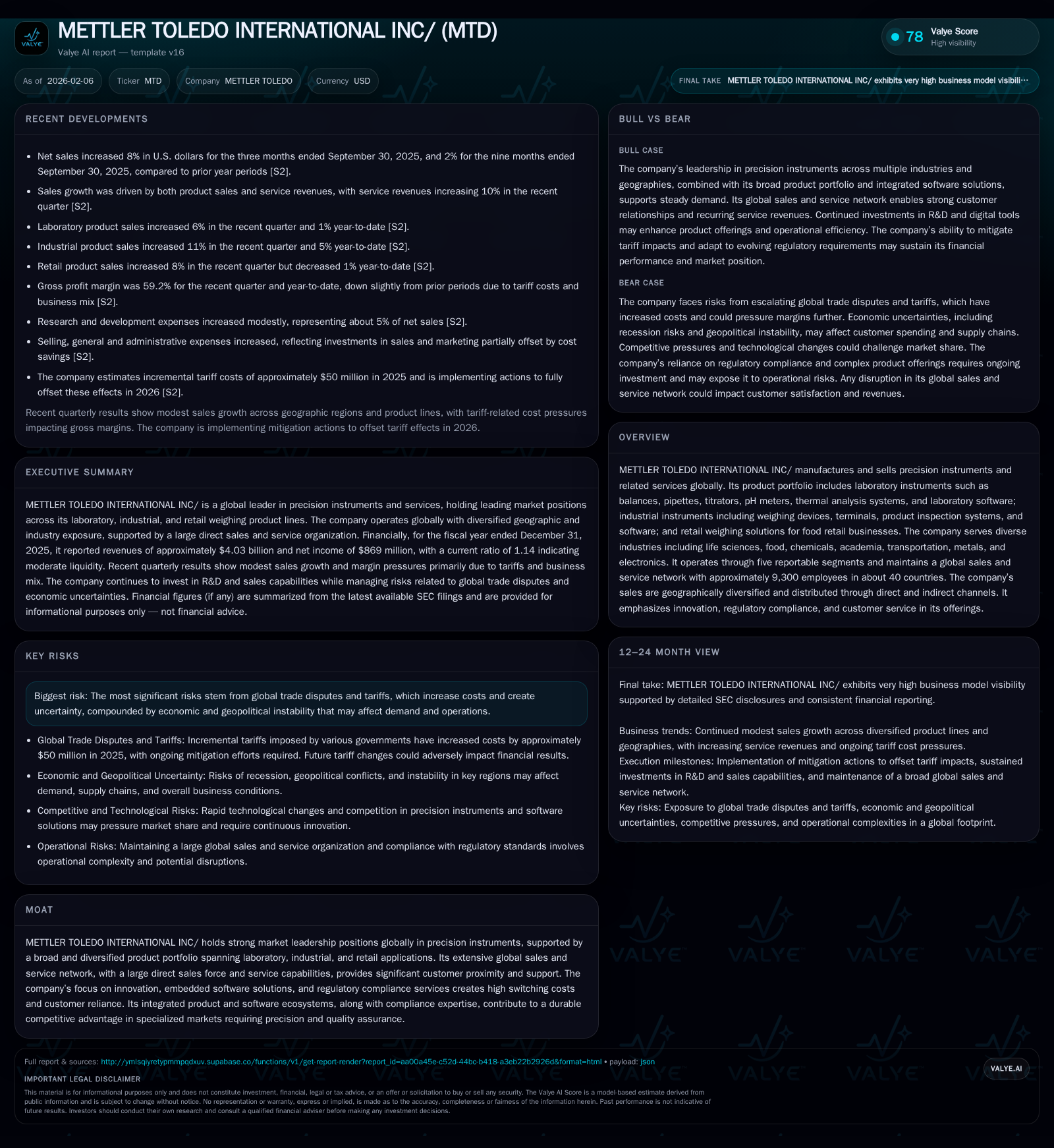
Mettler Toledo International Inc. maintains a commanding presence in the precision instruments market by leveraging an expansive and diversified product portfolio across laboratory, industrial, and retail sectors. The company faces meaningful headwinds from escalating global trade tensions, particularly tariffs involving China and the United States, which have introduced material cost pressures and supply chain uncertainties. Its embedded software platforms and integrated service ecosystems underpin high switching costs, sustaining customer loyalty. Despite geopolitical and economic uncertainties, Mettler Toledo’s recent financial results demonstrate resilient growth supported by proactive tariff mitigation measures and continued R&D investment.
Precision at the Forefront: METTLER TOLEDO's Industry Leadership
Mettler Toledo International Inc. stands as a beacon of precision engineering within the specialized instrument industry. With a history rooted in technological innovation dating back decades prior to its IPO in 1997[S1], the company commands global number-one market positions across its varied product categories. These include highly specialized laboratory instruments such as balances capable of measuring down to one ten-millionth of a gram, liquid pipetting systems pivotal in life sciences research, titrators for chemical analysis, thermal analyzers, and physical characterization tools. Complementing these are robust offerings for industrial weighing applications and retail food weighing systems.
This diversified portfolio serves a wide swath of industries—pharmaceuticals, biotechnology, food manufacturing, chemicals, materials testing, academia, transportation, metals production, and electronics manufacturing—underscoring the company’s deep integration across critical quality control and R&D workflows globally[S1]. Serving customers in over 140 countries with direct operations spanning roughly 40 nations ensures both expansive market reach and localized customer support capabilities.
Navigating a Complex Global Trade Landscape
However, Mettler Toledo's global footprint introduces significant exposure to geopolitical friction manifesting most notably through tariffs imposed during escalating trade disputes. In 2025 alone, the U.S. government raised tariff rates drastically on imports from various foreign jurisdictions—including Switzerland (39%), Mexico outside USMCA (25%), China (30%), the EU (15%), and the UK (10%)—which collectively imposed an estimated $50 million of additional costs before any mitigation actions[S2]. Retaliatory tariffs from China further complicate cross-border trade dynamics.
China's outsized role—with approximately 16% of external sales but nearly 29% of segment profits coming from this market—makes tariff impacts more acute here[S1]. Alongside tariffs come challenges linked to local purchasing mandates favoring domestic competitors and regulatory uncertainties that periodically disrupt supply chain fluidity.[S1] In response, many companies including Mettler Toledo are seeking to diversify supply sources or increase flexibility to shield against sudden policy shifts.
Innovation as a Linchpin: Embedded Software & Service Ecosystems
A cornerstone of Mettler Toledo’s moat is its sophisticated integration of hardware with embedded software platforms like LabX[S1]. This software manages data generated by their laboratory instruments and automates complex workflows—a necessity given increasing regulatory demands in sectors like pharma manufacturing.
By offering tightly coupled hardware-software bundles that streamline compliance documentation, data integrity assurance, and operational throughput improvements, Mettler Toledo imposes high switching costs on customers who have deeply embedded these systems into their processes[S1]. This ecosystem approach extends to predictive maintenance services and calibration management that enhance product lifecycle value.
Segment Deep Dive: Laboratory, Industrial, and Retail Instruments
Laboratory instruments remain the dominant revenue driver at approximately 56% of net sales[S1]. Their portfolio encompasses analytical balances spanning an exceptionally wide weighing range; automated liquid handling tools ideal for biotechnology labs; titration systems for precise analytical chemistry tasks; pH meters; spectrophotometers; moisture analyzers; density measurement devices; thermal analysis systems; and cell counters.
Industrial weighing devices constitute another substantial segment addressing needs such as freight inspection scales, metal weighing solutions, and process analytics instrumentation critical for manufacturing quality assurance.[S1] Retail instruments predominantly serve the food sector via weighing scales integrated into supermarket checkout lanes or food production lines.
Each segment offers tailored value propositions but collectively they reinforce METTLER TOLEDO’s ability to cross-sell integrated solutions that enhance reliability while simplifying compliance reporting across supply chains.
Geographic Mosaic: Balancing Growth Across Developed and Emerging Markets
Geographically, sales distribution reveals balanced exposure: roughly 42% stems from North America (including South America), about 29% from Europe (Western operations principally), and roughly another 29% from Asia including China[S1][F1]. Notably China commands nearly a third of total segment profit disproportionate to its revenue share(S1), highlighting profitability derived perhaps from scale production efficiencies or premium pricing power gained through established customer relationships.
The Chinese market has encountered a visible slowdown since mid-2023 attributable primarily to economic headwinds affecting pharmaceuticals/biopharmaceuticals—the company's core customer base—and food manufacturing subsegments within China[S1]. Local currency weakness along with inflationary pressures challenge operational leverage even as government stimulus efforts attempt stabilization. These regional complexities necessitate vigilant supply chain adjustments alongside granular local marketing strategies.
Risk Under the Microscope: Tariffs, China Exposure, and Economic Headwinds
Mettler Toledo explicitly flags multiple operational risks connected to international trade frictions including increased tariffs that escalate costs materially[S1][S2]. Beyond direct monetary impacts ($50 million incremental cost estimated in 2025), concerns span demand contraction if end-markets reduce capital expenditure during continuing economic uncertainty especially in developed economies suffering inflationary interest rate cycles[S1].
Additional risks include possible asset impairments tied to geopolitical uncertainties or nationalization threats relating particularly to Chinese assets where the company holds $19.2 million cash reserves among other property/emerging market exposures[S1]. Regulatory complexity looms large with potential changes on intellectual property protections or taxation regimes creating uncertain cost structures.
Furthermore credit risk intensifies amid tighter financing environments impacting distributors or downstream customers internationally. Foreign exchange volatility compounds unpredictability in reported earnings impacting cash flow management. Taken together these factors underscore a latent vulnerability despite generally strong fundamentals.
Financial Performance Amid Volatility: A Closer Look at Recent Results
Despite these headwinds Mettler Toledo’s three-quarters ended September 30th 2025 results portray resilience[S2][F1]. Net sales reached $3.0 billion annualized (Q3 alone $1.03 billion), up approximately 7.9% year-over-year at constant currencies when stripping out FX effects.[S2]
Gross margin remained stable near historical norms (59%) reflecting effective cost controls amidst higher import tariffs. Operating expenses grew moderately due to strategic investments including R&D which represented about 5.1% of sales showing commitment towards sustained innovation capacity.[S2]
Interest expense declined slightly benefiting from debt management even as restructuring charges modestly increased during targeted efficiency programs.[S2] Earnings before taxes maintained double-digit margins (25%), delivering $217 million net earnings in Q3 representing steady profitability,[F1][S2] highlighting operational discipline despite environmental turbulence.
Strategic Responses: Mitigation Tactics and Future Outlook
Critically the company is not passively absorbing tariff impacts but aggressively pursuing mitigation strategies intended to neutralize incremental costs entirely by fiscal year 2026[S2]. This includes supply chain reconfigurations possibly shifting procurement away from higher-tariff jurisdictions; price adjustments where feasible; productivity enhancements internally; product mix optimization; and enhanced localization initiatives within key markets.
Research & development efforts continue unabated aiming to refine product functionality while expanding software-driven services that deepen customer engagement limits competitive alternatives.[S1][S2] However management prudently acknowledges potential for further tariff policy changes injecting future volatility potentially impacting results beyond current forecasts.
Continued vigilance against macroeconomic risks such as possible recessionary cycles in core developed markets remains integral alongside maintaining agility amid fluctuating currency landscapes.[S1]
Disclaimer: This analysis is based solely on publicly available information including recent SEC filings as of February 6th, 2026. It does not represent investment advice or recommendations but seeks to provide comprehensive insight into METTLER TOLEDO INTERNATIONAL INC.'s business environment and strategic positioning within its industry landscape.
Disclaimer: This is research-only, informational analysis and not investment advice. It may include AI-generated interpretation and general industry context. Always verify important details using primary sources.

Comments