
Micware Co., Ltd. Advances Automotive IVI Software Amid IP and Customer Concentration Constraints
Micware’s recent fiscal results confirm growth driven by proprietary IVI software licensing and development, tempered by intellectual property limits and geographic concentration.
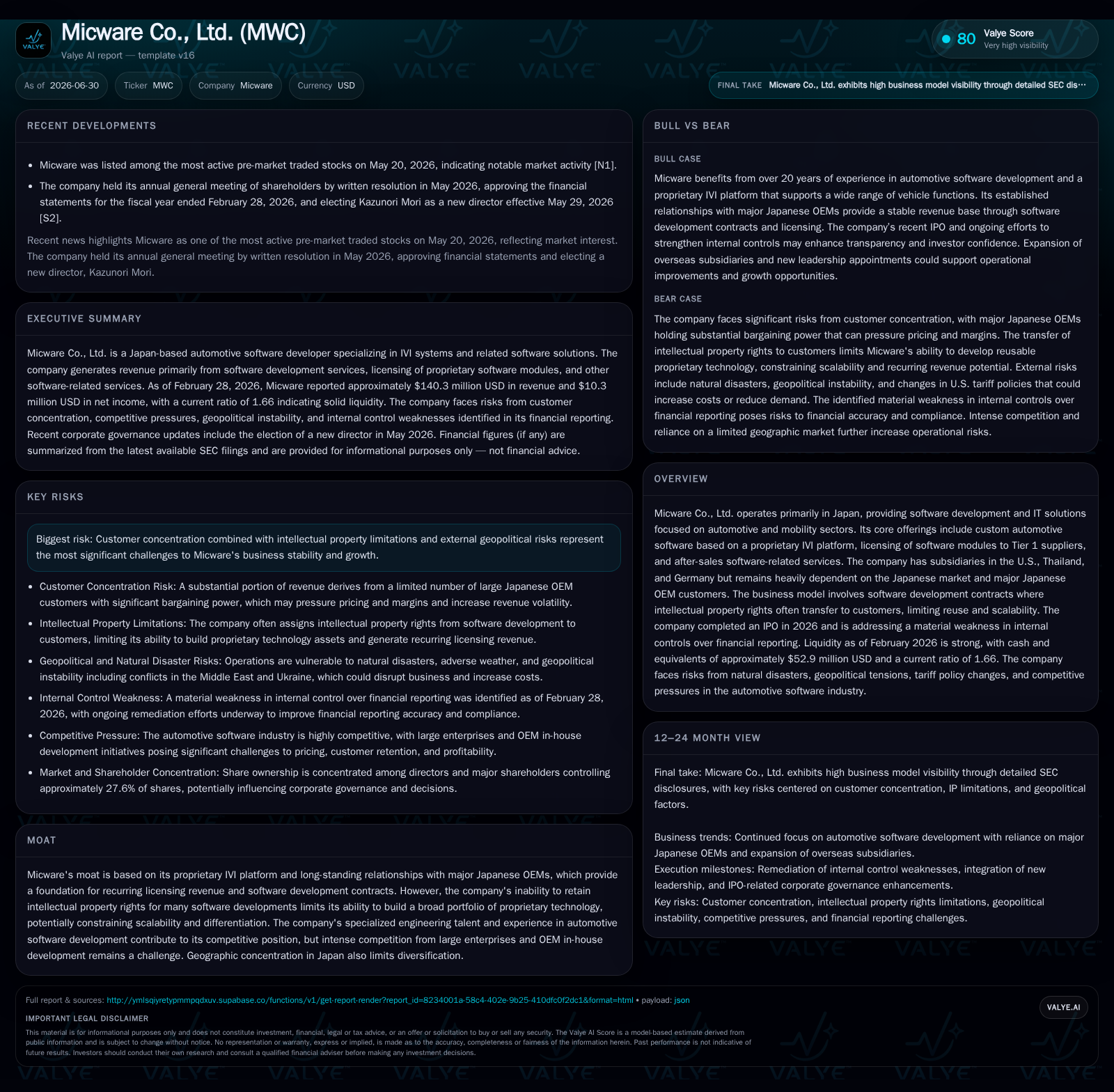
Micware Co., Ltd., a Japan-based automotive software developer specializing in In-Vehicle Infotainment (IVI) systems, reported steady revenue growth of approximately $140 million in FY2026, supported by expansion in software development services and licensing. However, its business model hinges heavily on contracts where intellectual property rights transfer to customers, limiting scalability and recurring revenues. The company remains concentrated in the Japanese market with major OEMs as primary customers. Continuous R&D investments, notably around the DynaPlanet project, underpin future growth prospects but come with execution risks. Liquidity remains robust, with a strong current ratio and manageable debt levels supporting operational stability.
Recent Operating Update
Micware Co., Ltd.’s fiscal year ended February 28, 2026 marked continued growth with total revenues reaching approximately $140 million (JPY21.9 billion), up modestly from prior year levels [F1]. The latest 6-K disclosures dated June 30, 2026, confirmed the official press release publication of these financial results along with an investor presentation [S2]. Revenue contributions were primarily from software development services (80% of total revenue), licensing (14.8%), and other software-related services (5.2%) [S1]. Notably, licensing revenue increased slightly driven by expanded adoption within the company’s Location-Based Services (LBS) segment despite some project completions reducing connected service sales under SDV. Software-related services grew nearly 50%, attributed largely to recent business acquisitions and ad hoc projects [S13].
Operating income stood at around $15 million with net income at $10.3 million for FY2026 [F1], reflecting ongoing profitability amidst reinvestment in R&D activities. The company also addressed internal control improvements following its IPO earlier in 2026 [S1]. Financial governance received shareholder approval at the May 2026 Annual General Meeting including election of new director Kazunori Mori bringing industry experience from Toyota Tsusho [S3].
Business Model Analysis
Micware operates as a specialized developer of embedded automotive software and IT solutions focused mainly on modern In-Vehicle Infotainment (IVI) systems serving Japanese OEMs through both direct contracts and Tier 1 supplier channels. Its proprietary IVI platform supports modular development across Android and Linux environments enabling navigation, multimedia, telematics connectivity, human-machine interface features, and driver assistance functions [S1].
Revenue is generated primarily through:
- Software Development Services: Custom engineering projects for OEMs based on their specifications often result in transferring intellectual property rights (IPR) developed during projects to the customer. This model limits Micware’s ability to reuse or license proprietary code beyond individual contracts.
- Licensing: Per-unit licensing fees for proprietary modules such as navigation engines provided to Tier 1 suppliers who integrate these into vehicles; this stream generates recurring revenue but is presently constrained due to limited IP ownership.
- Other Software-Related Services: After-sales maintenance, support agreements with prior clients, and B2C mobile app services unrelated directly to vehicle navigation.
This IP arrangement curtails scalability since most developed software cannot be monetized repeatedly across different customers or platforms without renegotiation. The company acknowledges this risk openly as it restricts building a substantial portfolio of reusable assets that many global peers leverage for recurring revenue streams [S1]. Mitigating this structural challenge involves balancing customer demands for IP ownership with strategic investments like DynaPlanet—a next-generation data platform designed for broader location-based service applications—which could facilitate proprietary offerings if successfully commercialized [S15].
Staff utilization management through selective talent hiring and project allocation remains a core operational focus affecting margins given the labor-intensive nature of custom software engineering [S1]. Outsourcing plays a role in capacity augmentation but can pressure gross margins when scaled abruptly.
Industry Structure and Competitive Position
Operating within the automotive software sector places Micware at the intersection between automotive OEM product mandates and Tier 1 supply chain integration. This niche requires deep industry-specific know-how alongside robust R&D capabilities given rapid technological evolution toward Software Defined Vehicles (SDVs) featuring complex embedded systems.
Competition is intense from diversified players including large multinational Tier 1 suppliers like Continental or Bosch which bundle hardware/software solutions, specialized automotive software developers such as Elektrobit or Harman International, as well as OEMs internalizing more software capabilities—for example Toyota and Volkswagen intensifying in-house IVI efforts. Relative to these players Micware benefits from long-standing relationships with major Japanese OEM customers lending credibility and repeat business but suffers scale constraints from geographic concentration predominantly in Japan.
Its proprietary IVI platform provides some differentiation through modularity that supports various operating environments critical for customization demands. However, lacking extensive IP ownership limits leverage against larger firms possessing broad technology portfolios they can license globally [S1]. Customer demands coupled with bargaining power enforce tight pricing structures reducing margin expansion potential.
Growth Drivers
Several structural industry dynamics fuel long-term growth prospects for companies like Micware:
- Rising Vehicle Software Content: Increasing integration of IVI systems, telematics connectivity, navigation enhancements, ADAS features require sophisticated embedded system software continually updated.
- Growth of Connected Cars & Mobility Solutions: Expanding demand for location-based services creates opportunities especially with Micware’s DynaPlanet initiative aiming at advanced geographic data platforms [S15].
- OEM Outsourcing Trends: Many OEMs prefer specialized vendors over building all capabilities internally due to cost or speed-to-market considerations.
- Licensing Model Expansion: Per-unit licensing tied to vehicle production volumes grows naturally with steady OEM vehicle rollout cycles.
- Regulatory Advances: Push towards higher safety standards drives demand for enhanced driver assistance functionalities embedding new software layers.
The company plans sustained R&D investment particularly boosting DynaPlanet-related activities expecting continued expenditure growth beyond FY2027 aiming toward platform commercialization though scale remains uncertain initially [S15]
Risks and Watchpoints
Major constraints shadow Micware’s operational landscape:
- Customer Concentration Risk: Dependency on few large Japanese OEMs concentrates negotiation leverage against Micware potentially limiting pricing power or resulting in sudden order pipeline changes if customer strategies alter[S24].
- Intellectual Property Ownership Limitations: Contractual assignment of developed IP reduces potential recurring licenses for existing products constraining scalable business expansion.[S1]
- Geographic Concentration: Heavy reliance on Japan curbs exposure to faster-growing emerging markets or broader global automotive production growth creating vulnerability to domestic economic cycles.[S17]
- Competitive Pressures: Large incumbents’ scale advantages plus OEM internalization threaten market share.[S1]
- Operational Integration Risks: Recent group reorganization merging acquired entities along functional lines may increase complexity leading to inefficiencies or cost overruns.[S16]
- R&D Execution Risks: Delays or technical obstacles related to pioneering projects like DynaPlanet can affect timelines or expense profiles negatively.[S15]
- Cybersecurity & Regulatory Compliance: As connected vehicle deployments expand global regulations tighten requiring nimble adaptations.[S1]
- External Geopolitical Uncertainty: Ongoing regional conflicts could disrupt supply chains or capital markets affecting investment capacity.[S17]
What to Watch Next
Investors should monitor several key indicators reflecting execution momentum:
- Adoption rates and licensing uptake stemming from newly developed modules especially linked with DynaPlanet service rollout timelines post-FY2027.
- Shifts in customer mix indicating diversification outside core Japanese OEM base or broader Tier 1 partnerships.
- Staff utilization trends reflecting operational efficiency amidst labor market tightness.
- Progress reports on post-merger integrations influencing operating cost trajectories.
- Developments addressing material weaknesses in internal controls disclosed following IPO completion [S2].
- Gross margin recovery trends as outsourcing reliance balances with internal productivity gains.
Financial Profile Discussion
Micware’s balance sheet as of February 28, 2026, shows cash and equivalents of approximately $53 million USD and total debt near $29 million USD, resulting in a net cash position of about $23.5 million USD [F1]. The current ratio stood at 1.66, indicating comfortable short-term asset coverage against liabilities [F1].
In summary, Micware’s financial profile reflects sound stewardship balancing growth reinvestment with operational profitability underpinning its technology leadership position within its niche market segment.
Disclaimer: This analysis is based purely on publicly available filings and recognized industry context without any form of investment advice or research views.
Financial position in context
As of 2026-02-28, companyfacts shows $53mm in cash and equivalents and $29mm of total debt [F1]. The same snapshot implies net debt of roughly $-24mm, keeping balance-sheet context relevant but secondary to the operating story [F1]. Current assets of $93mm and current liabilities of $56mm imply a current ratio near 1.66x for 2026-02-28 [F1].
Disclaimer: This is research-only, informational analysis and not investment advice. It may include AI-generated interpretation and general industry context. Always verify important details using primary sources.

Comments