
MaxCyte Advances Cell Engineering Platform While Managing Customer Concentration Risks
MaxCyte’s proprietary Flow Electroporation technology underpins a scalable platform advancing cell and gene therapy development, with recent quarterly updates highlighting strategic progress and operational challenges.
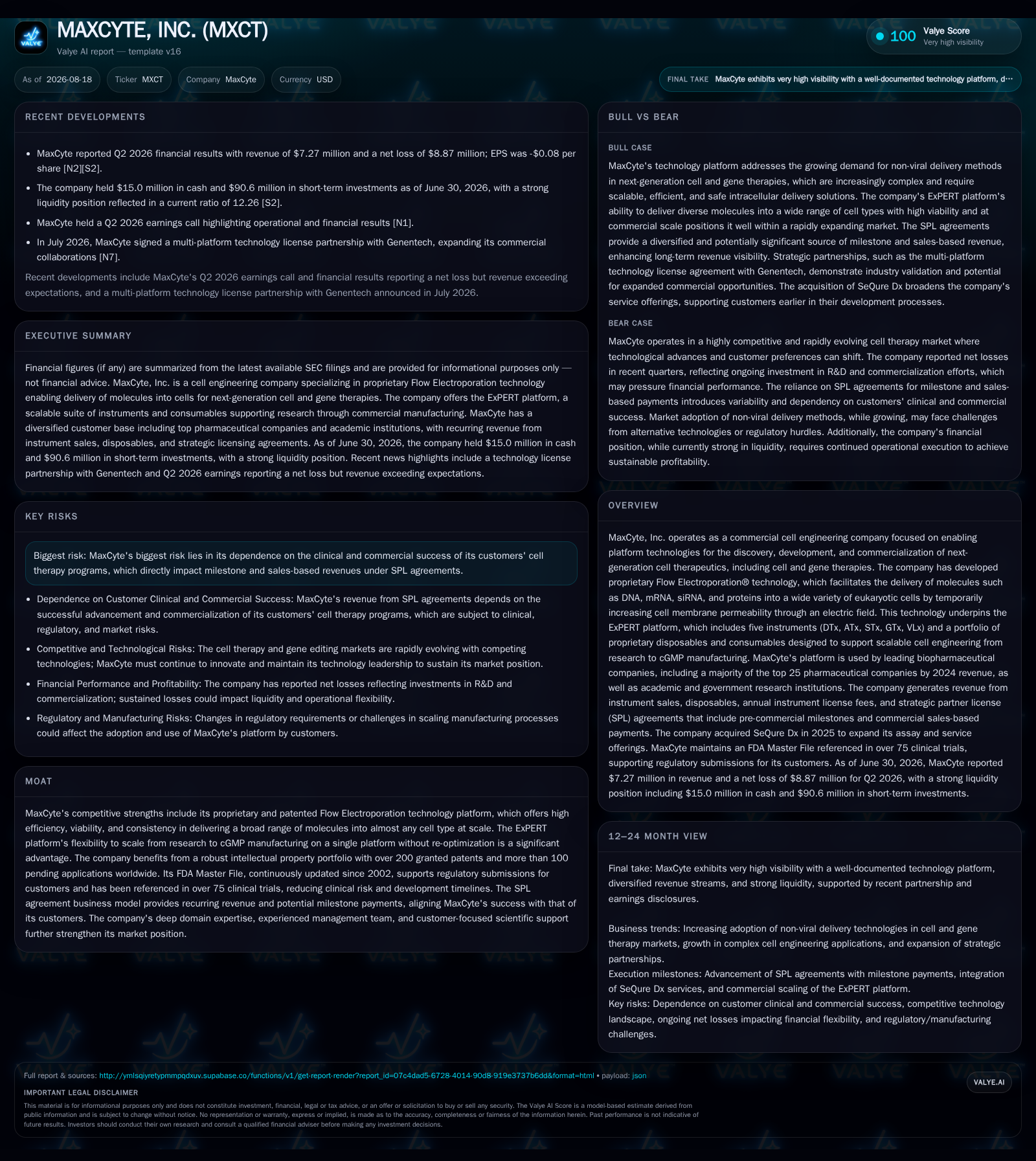
In its latest 10-Q filing for Q2 2026, MaxCyte reported continued growth in its cell engineering platform, driven by instrument sales, consumables, and clinical license fees to leading biopharma customers. The company maintains a strong intellectual property moat with its patented Flow Electroporation technology and leverages an FDA Master File to facilitate regulatory processes for customers. However, dependency on milestone and royalty payments tied to customers’ clinical success and high customer concentration remain notable risks. MaxCyte’s financial position reflects solid liquidity and capital resources supporting ongoing R&D investments and platform expansion.
Recent Operating Update
MaxCyte filed its Q2 2026 results on August 13, highlighting continued execution within its core cell engineering technology segment [S2]. Revenue streams principally arise from sales of proprietary instruments (the ExPERT family), processing assemblies (PAs), consumables designed for single use with these instruments, clinical license fees, as well as milestone and royalty revenues linked to the clinical progress of strategic product licenses (SPLs). The company maintains a unified reporting segmentation given the similarity in operational economics across instrument sales and licensing agreements.
Notably, all lease agreements where MaxCyte acts as lessor are short-term (one year or less), indicating minimal deferred revenue recognition risk from long-term leases. Conversely, the company’s lessee arrangements involve assessing whether contracts contain leases at inception [S2]. Such clarity in lease accounting supports transparent cost recognition.
Financially, MaxCyte reported cash and equivalents totaling $15.0 million at quarter-end June 30, 2026 [F1], alongside current assets standing at approximately $121.3 million versus current liabilities near $9.9 million—a current ratio of 12.26 that underscores robust liquidity able to support ongoing R&D intensity and operations scaling.
Business Model
MaxCyte operates within the biotechnology tools and services sector as a pure-play cell engineering company leveraging its patented Flow Electroporation® technology. This core platform facilitates precise electric-field mediated transfection enabling high-viability delivery of DNA, mRNA, siRNA, proteins, and other molecules into virtually any eukaryotic cell type [S1].
Its ExPERT platform comprises five categories of instruments—the DTx™, ATx™, STx™, GTx™, and VLx™—each tailored to different stages of research or manufacturing scale from discovery through cGMP production [S1]. Proprietary single-use disposables (PAs) integrate seamlessly with each instrument facilitating robust reproducibility critical for regulated therapeutic production
MaxCyte monetizes via multi-stream revenue: direct instrument sales; ongoing sales of PAs and consumables that generate significant recurring revenue due to their single-use nature; clinical licenses granting customers rights to use platforms under regulatory dossiers (FDA Master File since 2002) which also yield annual license fees (~$250K per instrument/year typical); plus milestone-based payments linked to commercial products developed using MaxCyte platforms [S1]
Critically, the FDA Master File serves as a regulatory risk mitigant for customers by consolidating platform validation data referenced across over 75 clinical trials—the broad uptake signals strong industry acceptance that accelerates customer time-to-market for engineered cell therapies [S1]. This integration between platform utility and regulatory facilitation establishes a durable moat reinforced by more than 200 granted patents globally plus additional filings pending.
The strategic acquisition of SeQure Dx in early 2025 expanded MaxCyte’s capabilities into gene-editing assessment services essential across ex vivo/in vivo therapy development lifecycles—bridging early R&D investigative assays through late-stage clinical deployment [S1]. This complements the electroporation platform by addressing emerging needs in off-target/on-target editing quantification.
Industry Structure & Competitive Position
MaxCyte sits upstream in the biopharmaceutical value chain supplying enabling platform technologies essential to cell therapy developers—including top-tier biotech firms and leading pharma companies pursuing gene therapies, immuno-oncology products, or advanced regenerative medicines. Its primary competitors are platform providers such as Lonza (with CMO capacities) and Miltenyi Biotec offering hardware/consumables bundles; while supplier peers like Sartorius or Thermo Fisher Scientific compete mainly on lab instrumentation or reagent consumables.
Unlike purely reagent suppliers or CDMOs engaged in actual therapy manufacturing services downstream, MaxCyte focuses on delivering flexible transfection solutions that scale seamlessly from bench research through commercial GMP manufacturing without re-optimization—a critical advantage minimizing technical transfer risk for customers [S1].
The SPL business model uniquely aligns MaxCyte’s financial success with that of its customers’ development programs via royalties/milestones but conversely concentrates revenue risk. Customer concentration metrics show one large customer accounted for ~35% of sales in Q2 2026 compared with ~27% during the previous year [S2]. While indicative of strong penetration among top-tier accounts—likely global pharma leaders—this concentration necessitates close monitoring of individual program progress in clients’ pipelines.
Growth Drivers
Growth is driven structurally by rapid expansion across global ex vivo cell therapy pipelines supported by rising demand for scalable platforms capable of high-efficiency transfection with consistent viability outcomes [S1]. Increasing regulatory approvals referencing MaxCyte’s FDA Master File accelerate customer confidence while spurring wider adoption embedded within manufacturing workflows.
Recurring revenue growth from consumables usage volumes is expected as installed base utilization expands; new instrument launches like the DTx platform introduced in early 2026 target discovery-stage researchers intensifying early-stage application coverage [S1]. Additionally, enhanced service offerings post-SeQure acquisition address growing specialized analytic needs tied to gene-editing quality control—expanding cross-selling opportunities within existing accounts.
Strategic multi-platform license partnerships with major biopharma increasingly scaffold steady contract renewals generating dependable annual licensing income beyond direct product sales [N7]. Furthermore, milestone payments under SPL agreements incent MaxCyte based on partner clinical/regulatory milestones achieved—a lever amplifying upside if commercial launches succeed.
Risks & Growth Constraints
Key risks stem from MaxCyte's heavy reliance on its customers’ clinical development success given the SPL-related milestone/royalty structure; delays or failures in pivotal trials can materially depress those revenue streams [S1]. Customer concentration similarly exposes earnings volatility should any large client change procurement strategies or experience trial setbacks.
Technological innovation pace mandates continuous R&D investment to sustain competitive advantages against alternative delivery modalities such as viral vector-based platforms or emergent non-electroporation methods. Regulatory compliance risks persist both internally (manufacturing quality systems) and externally (platform validations applicable across jurisdictions).
Supply chain vulnerabilities for proprietary PAs could disrupt consumable availability given their single-use design criticality—a factor especially salient amid ongoing global logistical uncertainties affecting specialty materials.
Long sales cycles accompanied by complex training requirements limit rapid instrument penetration but reinforce switching costs once embedded due to customer reliance on specialized protocols ensuring safety/effectiveness [S21]. Operational scaling challenges must be managed prudently balancing capital expenditures without excessive cash burn given ongoing losses recorded in recent years [F1].
What To Watch Next
Upcoming milestones include quarterly bookings/installation rates for instruments reflecting broader adoption beyond key anchors; consumables volume growth serving as proxy for platform engagement intensity; expansions or new licensing deals increasing recurring fee streams; material milestone receipts evidencing partner trial advancement; and integration progress post-SeQure acquisition signaling service extension success.
Management commentary regarding pipeline diversification efforts aimed at mitigating concentration risk will be key alongside any disclosures about enhancing manufacturing capacity reliability or new product introductions sharpening competitive differentiation.
Key market signals also derive from number of active clinical trials globally utilizing MaxCyte technology referencing FDA Master File updates—a proxy for underlying therapeutic innovation velocity favorably impacting long-term licensing income potential.
Financial Profile Discussion
MaxCyte exhibits a financially conservative profile characterized by modest operating losses reflecting heavy investment phases rather than mature profitability [F1]. As of June 30, 2026, cash & equivalents totaled $15.0 million with current assets vastly exceeding current liabilities ($121.3 million vs. $9.9 million), yielding an exceptionally strong current ratio of approximately 12.26 supportive of near-term liquidity needs [F1],[S2].
Operating losses persist given sustained R&D spend necessary to fuel platform enhancement along with general administrative expenses typical for public life sciences firms continuing infrastructure buildout [F1],[S2]. Milestone payments remain lumpy due to inherent timing uncertainty tied to heterogeneous partner clinical programs aligned under SPLs.
Capital allocation priorities emphasize balancing R&D progression against prudent expenditure management while maintaining capacity flexibility evidenced through relatively stable inventory levels including raw materials ($3.6 million) and finished goods ($3.6 million) facilitating scaled instrument assembly without overstretching working capital demands [S2],[F1].
No material debt obligations appear disclosed increasing financial stability though reliance on equity raises dilution considerations long term [F1],[S2]. Continuing evaluation of cash flow conversion from expanding recurring consumable/licensing streams will be instrumental in determining pathway toward sustainable profitability benchmarks.
This analysis synthesizes MaxCyte’s most recent publicly available SEC filings supported by contemporary industry context without offering investment research views or projections. It focuses strictly on factual interpretation relevant to business operational dynamics, competitive positioning, growth prospects, risks inherent within the biotechnology tools sector specializing in cell engineering technologies.
Disclaimer: This is research-only, informational analysis and not investment advice. It may include AI-generated interpretation and general industry context. Always verify important details using primary sources.

Comments