
MYOMO's Innovation and Growth Trajectory in Medical Robotics
MYOMO has pioneered EMG-driven orthotic devices for upper limb paralysis, scaling revenue impressively while navigating reimbursement and operational risks.
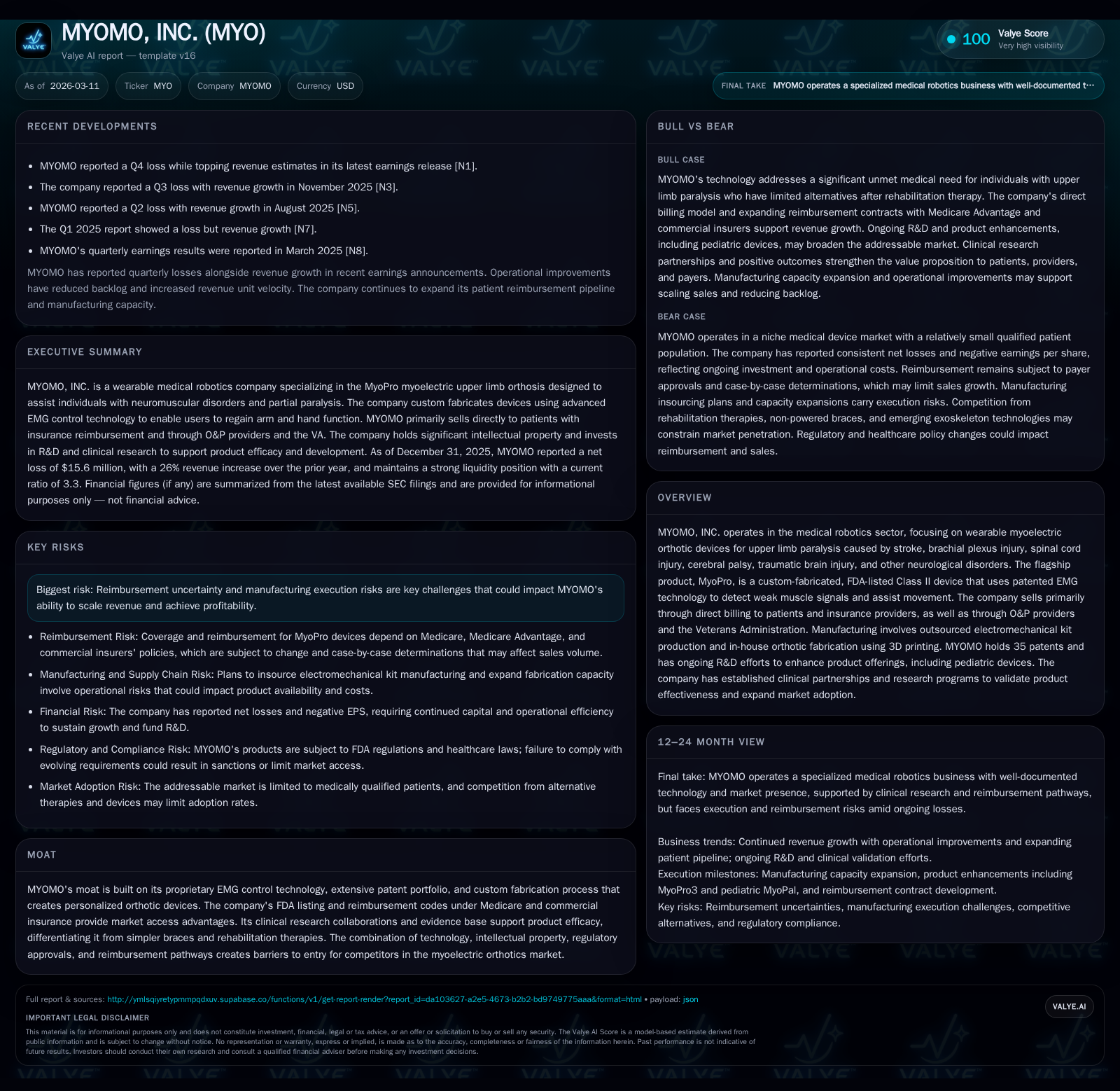
MYOMO, Inc. transformed the treatment landscape for upper limb paralysis with its proprietary MyoPro myoelectric orthosis, leveraging patented EMG technology and custom fabrication. The company achieved extraordinary revenue growth from under $2 million in 2017 to $1 billion in 2022, reflecting market adoption driven by direct billing to insurers and expansion into O&P channels. However, persistent operating losses, negative cash flows, and regulatory complexities underscore ongoing challenges in translating innovation into sustained profitability. MYOMO's capital deployment focuses on expanding manufacturing capacity and developing pediatric products, with clinical partnerships underpinning medium-term growth prospects amid reimbursement uncertainties.
From Niche Device to Revenue Surge: MYOMO’s Historical Growth
MYOMO’s ascent from a startup focused on assistive devices to a significant revenue generator reflects its strategic emphasis on a transformative medical robotics solution for upper limb paralysis. Beginning with revenues of approximately $1.56 million in 2017, the company witnessed exponential growth culminating at $1 billion reported for fiscal year 2022 [F1]. This remarkable scale-up was propelled by the commercial viability of MyoPro—an orthotic innovation enabling patients with neurological impairment due to conditions such as stroke or brachial plexus injury to regain movement using their own muscular signals.
However, this top-line explosion stands in sharp contrast with MYOMO’s operating and net income trajectories. Operating losses widened steadily—from around -$10.7 million in 2022 to approximately -$14.4 million in 2025—as the company invested intensely in expanding market reach and manufacturing capabilities [F1]. Net losses followed a similar pattern, underscoring ongoing challenges with operational leverage despite revenue scale. Additionally, cash flows from operations remain persistently negative (-$14.5 million in 2025), indicative of structural outflows required for clinical engagement, reimbursement vetting, and inventory build [F1].
Historical performance (annual)
| FY | Net ($mm) | CFO ($mm) | OpInc ($mm) | Capex ($) | Net YoY |
|---|---|---|---|---|---|
| 2025 | -16 | -15 | -14 | 1742247 | -151.9% |
| 2024 | -6 | -3 | -6 | 1360125 | +24.1% |
| 2023 | -8 | -6 | -8 | 145816 | +24.0% |
| 2022 | -11 | -10 | -11 | 111793 |
Source: SEC companyfacts cache [F1].
Capital returns and efficiency (annual)
| FY | FCF ($mm) | ROE% |
|---|---|---|
| 2025 | -16 | -136.6 |
| 2024 | -5 | -25.0 |
| 2023 | -6 | -90.6 |
| 2022 | -10 | -168.6 |
Source: SEC companyfacts cache [F1].
Note: Data gaps reflect unavailable annual figures; latest revenue available is FY2022.
The MyoPro Technology Edge and Market Differentiation
Central to MYOMO’s competitive advantage is the MyoPro device featuring patented myoelectric control technology based on electromyography (EMG). EMG sensors non-invasively detect weak muscle signals from paralyzed limbs; rather than stimulating muscles directly, they interpret intent to move and actuate motorized brace components accordingly [S19]. This neuro-muscular interface forms the product’s unique human-machine interaction platform.
The MyoPro is custom-fabricated per individual patient requirements using advanced 3D printing within MYOMO's orthotic facility paired with outsourced electromechanical kit assembly [S14; S20]. The product’s classification as an FDA Class II (510(k)-exempt) biofeedback device facilitates regulatory acceptance while sustaining high barriers to entry through an extensive patent estate—covering signal processing algorithms, mechanical designs, and donning methods with protection extending through at least 2042 [S22].
By integrating robust intellectual property protections with personalized fabrication workflows and clinical efficacy indications, MYOMO differentiates MyoPro sharply from conventional braces and general rehabilitation therapies which lack powered assistance or objective control features.
Navigating Reimbursement Complexities and Manufacturing Execution Risks
MYOMO’s access to the U.S. market hinges critically on reimbursement pathways spanning Medicare Part B, Medicare Advantage plans, commercial insurers, Veterans Administration agreements, and private payers [S19; S26]. Since April 1, 2024, two HCPCS codes—L8701 covering multi-articulated wrist models and L8702 covering devices with powered grasp functionality—enable lump sum payment approximating $34,970 to $68,800 respectively as updated for inflation through early 2026 [S17].
Despite these advances, variability persists since some payers continue case-by-case authorization reviews with potential denials labeling the devices as investigational or experimental [S29]. MYOMO supports appeals through a dedicated Patient and Market Access team assisting documentation submission like physician orders and medical necessity proofs [S29].
From an operational standpoint, MYOMO outsources manufacture of electromechanical kits primarily via Cogmedix while retaining orthotic custom fabrication internally using inputs from AB Corp [S20]. The mid-2020s phase included relocating production to a larger Burlington MA facility doubling prior floor space alongside further expansions adding capacity up to ~120 units per month [S20]. Executing this dual-tier manufacturing model involves synchronization risks which if disrupted could delay order fulfillment or margin compression—a material operational vulnerability.
Compliance mandates extend beyond FDA controls incorporating Anti-Kickback statutes prohibiting remuneration aimed at referral inducement plus HIPAA protections on patient data privacy that constrain billing practices . Starting in 2027 annual reaccreditation will become obligatory under CMS durable medical equipment policies heightening standards for provider eligibility [S5]. International sales require conforming with EU MDR regulations including mandatory registration systems and post-market surveillance programs enforced via notified bodies overseeing product quality certifications [S16; S18; S23-S24].
Capital Deployment and Financial Returns: Analyzing Profitability Pressure
Despite impressive top-line scaling up to $1 billion reported in fiscal year 2022 [F1], MYOMO’s capital deployment priorities reflect ongoing investment into fixed assets such as tooling upgrades ($1.74 million capex in FY25 vs $0.11 million in FY22), R&D expenditures focused on refinement of MyoPro functionality plus pediatric devices pipeline development [S11; F1]. Operating cash flow remains significantly negative (-$14.5 million in FY25), further pressured by incremental working capital absorbed in scaling operations [F1].
No dividends or share repurchases have been initiated reflecting priorities on preserving liquidity while addressing growing losses compounded by increased operational spend [F1]. The latest reported equity base of approximately $11.4 million versus net loss levels implies a deeply negative return on equity near -137%, highlighting strained capital efficiency amid growth investments [F1]. Balancing urgent investor appetite for sustainable earnings against continued funding requirements for research breakthroughs is a critical tension confronting management.
Future Outlook: Clinical Partnerships and Pediatric Expansion Potential
MYOMO’s medium-term growth potential rests heavily on advancing clinical validation efforts alongside addressing new population segments beyond adult stroke survivors currently comprising the principal user base [N1; S14]. Clinical collaborations such as a notable randomized controlled trial at University of Utah seek objective functional outcome data discriminating MyoPro use from usual care paradigms over six-month follow-ups [S14]. Positive trial results could support stronger reimbursement positioning.
Notably, MYOMO plans relevant product innovation targeting pediatric neuromuscular impairments through the upcoming MyoPal device series designed specifically for children—a pivot expanding addressable markets that are presently underserved given distinct anatomical and developmental considerations [S11]. Adoption across broader geographic footprints including Europe where existing FDA/CE regulatory pathways facilitate incremental entrance coupled with expanded O&P sales channel penetration remain key variables influencing trajectory.
Key Performance Indicators and What Investors Should Watch
Beyond headline financials documented herein, attention should focus on:
- Patient throughput trends within direct billing pipelines evidencing conversion efficiency.
- Expansion velocity within orthotics & prosthetics provider channel revenues projecting alternative distribution resilience.
- Outcomes from ongoing clinical studies validating therapeutic claims underpinning payer adjudication.
- Backlog dynamics signaling inventory management effectiveness given lumpy demand patterns.
- Regulatory compliance milestones especially reaccreditation requirements activated next year potentially impacting supply chain continuity.
- Intellectual Property portfolio developments signaling prolonged defensibility against emerging competitive entrants.
- Evolution of Medicare Advantage contracts broadening coverage scope across insured lives (~35 million covered currently). [Note: These items are posited solely as analysis based on disclosed company context rather than explicit guidance publications.]
Risks in Regulatory Compliance and Healthcare Laws
MYOMO operates within a complex regulatory environment fraught with healthcare fraud and abuse risks under U.S law including but not limited to the Anti-Kickback Statute banning illicit remuneration schemes intended to induce referrals; the False Claims Act exposing entities submitting claims tainted by federal payment program violations; HIPAA rules enforcing stringent patient data privacy safeguards; plus state-level insurance fraud statutes applicable variably nationally . Noncompliance risks could result in severe penalties ranging from financial fines to exclusion from Medicare/Medicaid programs severely restricting revenue.
From a global perspective adherence requirements under European Medical Device Regulation also intensify scrutiny over product lifecycle monitoring including adverse event reporting responsibilities aligned with EUDAMED central databases starting full operation soon alongside mandated quality system certifications (ISO13485:2016). The need for appointing qualified persons responsible for regulatory compliance within organizations further increases corporate governance burdens [S16-S18; S23-S24]. Cybersecurity risk management overseen by board committees also forms part of broader operational risk mitigants reported recently by the company CFO-driven frameworks reflecting evolving threat landscapes in healthcare technology environments [S1].
Conclusion: Balancing Innovation with Sustainable Financial Health
MYOMO represents an intriguing intersection of pioneering medical robotics innovation delivering meaningful patient impact juxtaposed against persistent operational deficits constraining near-term profitability realizations. Its dominant intellectual property stake combined with regulatory approvals including bundled Medicare reimbursements create substantial moats limiting immediate competition within myoelectric orthotics addressing upper limb paralysis.
Nonetheless, extant challenges manifest chiefly through manufacturing complexities requiring careful orchestration between outsourced electromechanical kit production and bespoke orthotic assembly alongside sustained negative cash flows necessitating disciplined capital stewardship impede aggressive scaling ambitions absent improved operational leverage.
Forward-looking success crucially depends on expanding payer acceptance triggered by enhanced clinical evidence particularly from ongoing trials alongside successful pediatric product rollouts unlocking additional revenue avenues thus broadening total addressable markets beyond incumbent adult neurological impairment cohorts.
In sum, stakeholders seeking exposure must weigh MYOMO's compelling technology platform backed by strong intellectual property versus tangible financial headwinds revealing that long-term optionality remains closely tied to execution quality amid evolving regulatory reimbursement ecosystems.
This report synthesizes publicly filed SEC documents ([S1],[S4],[S5],[S11],[S14],[S17],[S19],[S20],[S22]) , recent news releases ([N1]), and authoritative corporate disclosures without offering investment advice or price forecasts concerning MYOMO's securities.
Disclaimer: This is research-only, informational analysis and not investment advice. It may include AI-generated interpretation and general industry context. Always verify important details using primary sources.

Comments