
nCino Strengthens AI-Driven Cloud Banking Platform Backed by Robust Q1 Results
nCino’s latest quarterly reporting highlights operational resilience and strategic momentum in embedding AI across its cloud banking suite.
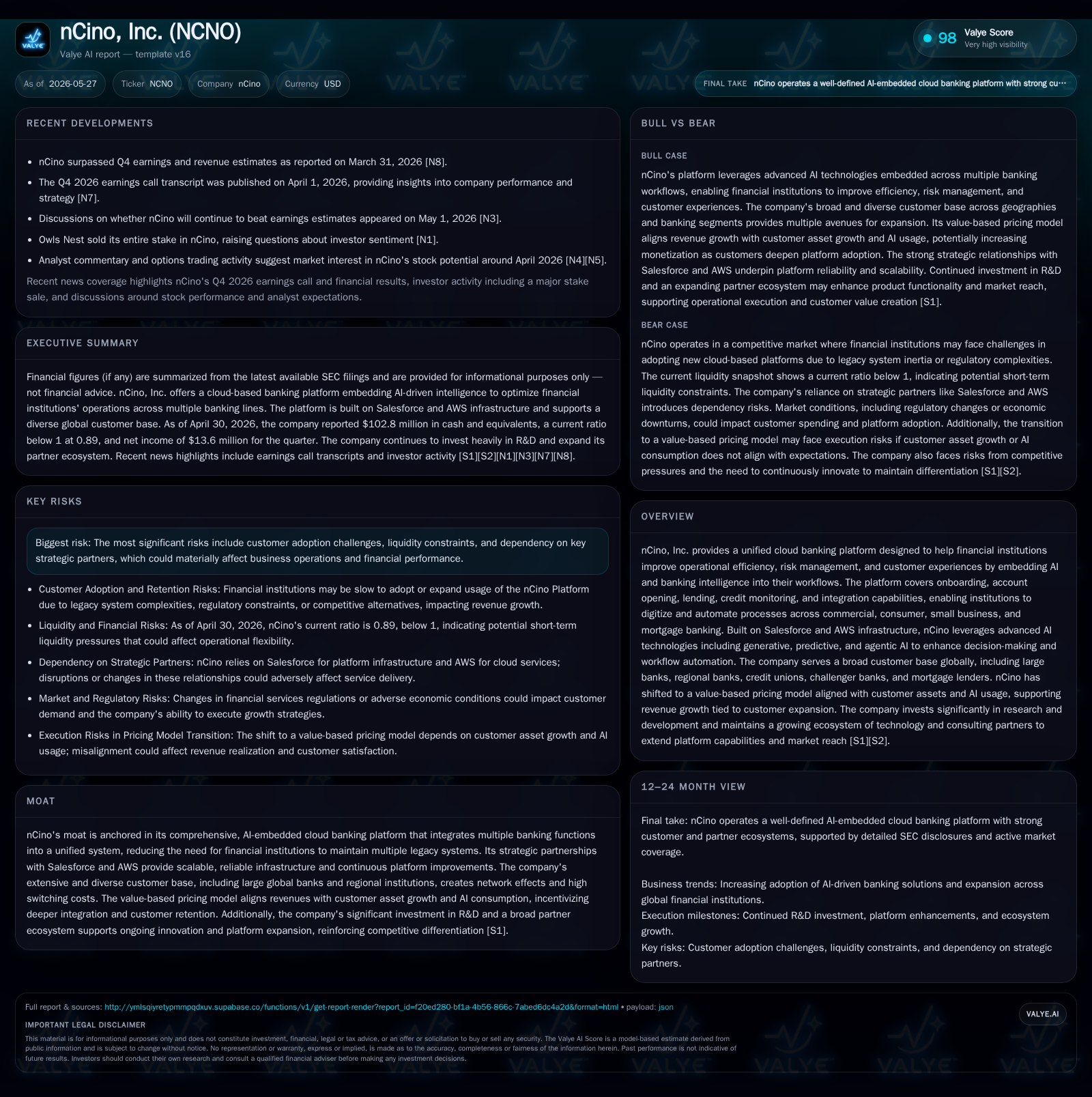
In its Q1 fiscal 2027 update, nCino demonstrated continued progress in integrating AI capabilities within its unified cloud banking platform, reinforcing its competitive stance. The company’s value-based pricing tied to customer assets and AI usage aligns growth incentives with financial institution partners. While risks around customer AI adoption and partner dependencies remain, nCino’s extensive market footprint and technology partnerships support its path forward. Solid liquidity paired with manageable net leverage frames a cautiously optimistic near-term outlook.
Latest Quarterly Performance and Operational Highlights
nCino's most recent quarterly filing (10-Q dated May 27, 2026) presents a snapshot of cautious optimism as the company reported its first quarter ended April 30, 2026 without material changes to previously disclosed risk factors [S2][S6]. Although detailed revenue or profitability metrics for Q1 fiscal 2027 are not explicitly stated in the public excerpts, management’s accompanying press release incorporated into the May 27, 2026 Form 8-K affirms continued financial discipline and progress on strategic objectives [S3][S5]. The absence of new risk disclosures suggests stable operating conditions relative to prior periods.
On the balance sheet front, nCino holds approximately $103 million in cash and equivalents against $263.5 million in total debt as of April 30, 2026; yielding a net debt position of about $161 million and a current ratio slightly below one at 0.89 [F1]. This liquidity profile supports ongoing R&D investments essential for sustaining their AI innovation pipeline while managing working capital demands inherent to subscription SaaS models. Overall, the Q1 update underscores operational continuity amidst an evolving competitive landscape.
Business Model and Platform Differentiation
nCino generates revenue primarily through subscription licensing fees for its cloud-native banking platform that embeds artificial intelligence deeply into financial institution workflows [S1]. The core offerings digitize and automate key functions including customer onboarding, account opening, lending origination (across commercial, consumer, small business), credit monitoring, and mortgage processing. Revenue progression is closely linked to customers’ assets under management measured through a value-based pricing framework that also factors in AI consumption volume — incentivizing clients to expand platform usage alongside scaling their portfolios.
Built atop robust Salesforce and AWS architectures, nCino benefits from scalable infrastructure proven capable of enterprise-grade security, reliability, and integration flexibilities [S1]. This synergy enables rapid feature deployment through continuous integration/delivery (CI/CD) practices coupled with automated testing frameworks supporting mission-critical banking demands. The company refers to a “Dual Workforce” concept wherein automation tackles routine tasks thus amplifying employee productivity — a key selling point enabling clients to improve efficiency without proportionate headcount increases.
Switching costs are substantial given nCino's platform replaces fragmented legacy systems across multiple banking lines of business; entrenched integrations plus specialized AI algorithms tailored for risk compliance further cement client retention. The firm’s investment focus on machine learning via its Digital Partners framework enhances predictive underwriting and operations analytics which are integral to modern banking risk frameworks.
Competitive Environment and Industry Dynamics
The cloud-based financial services software market is notably fragmented yet intensely competitive with players ranging from traditional banking system vendors to emerging fintech SaaS providers increasingly incorporating AI features [S1]. Within this context, nCino’s comprehensive platform approach — unifying disparate workflows under one architecture — distinguishes it from competitors offering more modular or point solutions.
Its broad global customer base spanning large multinational banks to regional community banks and credit unions accords network effects that amplify product utility from aggregated data insights. However, reliance on strategic alliances with Salesforce and AWS introduces dependencies whose disruption could impair service delivery or innovation tempo if not well managed. Pricing pressures are ever-present given competitive bids for accounts but nCino’s value-based model partially mitigates pure discounting by aligning charges with measurable client growth metrics.
Technology evolution pacing especially relating to AI/ML is a double-edged sword: it necessitates heavy R&D investment but also offers opportunities for differentiation if executed effectively. Market demand cycles tied to financial institutions’ IT budgets impose some cyclicality risk though pressing regulatory compliance needs create sustained baseline demand for automation tools.
Growth Drivers: AI Adoption, Market Expansion, and Pricing Strategy
Three principal drivers underpin nCino’s growth trajectory:
- AI Integration: Increasing client adoption of embedded AI modules enhances process automation depth enabling faster loan decisions or risk assessments which translates into higher usage metrics driving recurring fees under the value pricing scheme [S1].
- Geographic Expansion: Steady penetration beyond the U.S., notably into Europe, Middle East, Japan, and APAC regions where digital transformation in banking accelerates presents sizeable incremental markets [S1].
- Value-Based Pricing: Aligning revenues not only with subscription seat counts but also client asset size and AI consumption promotes mutually beneficial growth incentives promoting platform stickiness as financial institutions scale operations.
These drivers correlate with KPIs such as customer asset growth rates accompanied by expanded usage footprints across banking verticals: commercial lending is typically highest in transaction volume but consumer mortgage digitization is rapidly rising driven by regulatory push for transparency. Continuous R&D funneling advances machine learning capabilities fosters innovation arms race essential to maintaining leadership.
Risks and Execution Challenges
Key risk vectors include:
- AI Adoption Variability: Success depends materially on how swiftly banks incorporate advanced AI features into production; lagging uptake could slow revenue ramp or dampen renewals [S1].
- Partner Dependency: Heavy reliance on Salesforce CRM ecosystem and AWS infrastructure exposes nCino to operational or contractual disruption risks affecting availability or upgrade cadence.
- Competitive Intensity: Fragmented vendor landscape coupled with escalating entrants embedding next-gen ML models heightens pressure on pricing margins and client loyalty [S1].
- Financial Liquidity Constraints: Net leverage near $161 million must be managed prudently alongside cash flow generation given ongoing investment needs for product enhancement [F1].
- Regulatory Sensitivities: Evolving compliance regimes could impose unanticipated product adaptation costs or impact data privacy considerations related to AI use within banking workflows.
Near-term Outlook and Key Milestones
Investors should monitor several milestones that will indicate sustained execution momentum:
- Future earnings releases outlining specific revenue growth trends correlated with expanding asset-linked billing metrics.[S3]
- Announcements of major new contracts particularly those involving deep integration of AI modules with large-scale financial institutions remain critical demand markers.
- Signals of margin improvement through automation-driven operational efficiencies or economies of scale within hosting/maintenance functions.
- Expansion progress into international territories including regulatory approvals or partnerships unlocking new geographies.
- Updates on renewal rates reflecting client satisfaction amidst renewed macroeconomic uncertainty affecting tech spend decisions.
Summary Financial Profile
As of the end of April 2026, nCino holds approximately $103 million in cash against $263.5 million total debt leading to a net debt level near $161 million while current assets stand at $267 million versus current liabilities just shy of $300 million yielding a current ratio below unity at about 0.89 — indicating some working capital pressure but typical for a high growth SaaS firm investing heavily in R&D yet managing subscriptions receivables consistent with industry norms [F1]
Operating income was positive in recent periods reported earlier this year signaling profitable unit economics despite prior history of losses; however quarterly net income details remain limited leaving room for scrutiny on sustainability going forward [F1]
This analysis synthesizes publicly filed SEC documents as well as company disclosures as of May 27, 2026. It does not provide investment advice but aims to furnish an informed perspective on nCino’s evolving business dynamics anchored primarily on the latest quarterly update integrated with longer-term strategic context.
Disclaimer: This is research-only, informational analysis and not investment advice. It may include AI-generated interpretation and general industry context. Always verify important details using primary sources.

Comments