
Nordson Corp Advances With Broad Industrial Portfolio and Strategic Growth Moves
Nordson's Q2 2026 results reflect operational resilience amid acquisition integration costs and evolving trade dynamics.
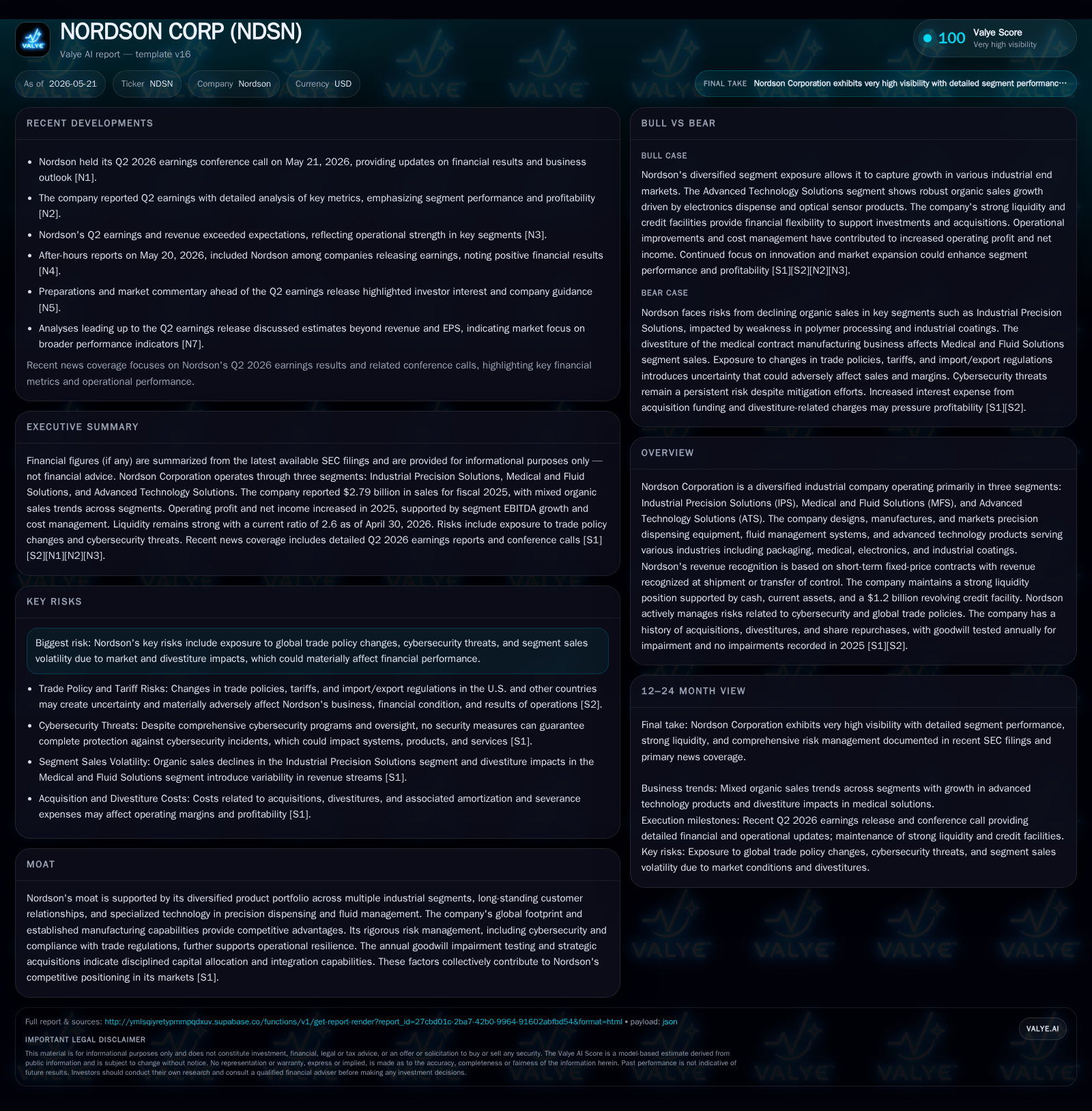
In Q2 2026, Nordson Corporation reported stable revenues sustained by favorable product mix within its diversified Industrial Precision Solutions, Medical and Fluid Solutions, and Advanced Technology Solutions segments. Operating margins faced modest pressure from acquisition-related expenses, notably from recent ARAG and Atrion integrations, though gross margins improved with mix benefits. The company's global footprint, strong manufacturing capabilities, and risk management strategies underpin its competitive advantages. Key growth drivers include medical device market expansion and cross-segment synergies, while risks center on trade policy shifts and cybersecurity threats. A healthy liquidity position supports ongoing strategic initiatives.
Latest Quarterly Operating Update: Key Developments from Q2 2026
Nordson's Q2 2026 results detailed in the May 21 filing highlight stable revenue dynamics supported by beneficial product mix shifts across their diversified portfolio despite near-term margin pressures attributable to first-year acquisition costs stemming chiefly from ARAG (Industrial Precision Solutions) and Atrion (Medical and Fluid Solutions) [S2]. Revenue recognition remains consistent, leveraging short-term fixed-price contracts with point-in-time recognition at shipment or control transfer—a model suited to their product distribution in capital equipment and consumables [S1]. While revenue grew modestly compared to prior quarters, operating margin declined slightly as acquisition-related expenses offset gains from favorable product mix effects. Recent disclosures emphasize operational resilience amidst these integration costs balanced by efficiencies in inventory step-up amortization relative to previous years [S3].
Business Model and Segment Overview: Precision Dispensing and Fluid Management
Nordson's business is organized into three core segments: Industrial Precision Solutions (IPS), Medical and Fluid Solutions (MFS), and Advanced Technology Solutions (ATS). Each segment centers around highly specialized dispensing equipment and fluid management systems targeting diverse end markets including medical device manufacturing, food packaging, electronics assembly, industrial coatings, and test/inspection applications [S1]. Customers typically engage through short-term fixed-price contracts whereby revenue is recognized once products ship or control transfers.
The company’s products integrate precision technology crucial for controlled dispensing of adhesives, coatings, fluids, or other materials within manufacturing processes that require accuracy to ensure quality output—a key differentiator fostering switching costs due to technical specificity. This expertise creates embedded value in high-volume consumables sales complemented by capital equipment penetration across industries marked by structural demand from regulatory standards (medical), automation trends (electronics), or consumer-driven innovation (packaging) [S1]. Moreover, Nordson’s global manufacturing footprint enables scalability while maintaining responsiveness to localized customer needs.
Competitive Positioning and Industry Dynamics
Nordson’s competitive moat stems from its diversified industry exposure combined with entrenched customer relationships cultivated over decades. Its specialized technology platforms provide differentiation difficult to replicate quickly given the R&D intensity involved in precision dispensing mechanisms and fluid management system design. Manufacturing capabilities span multiple global sites offering scale advantages while mitigating single-source risks in supply chains.
Externally, evolving U.S. and global trade policies pose complexity risks as tariff regimes or import/export regulations affect raw material sourcing costs and logistical agility. Nordson manages these through robust compliance frameworks alongside active risk mitigation via supply chain diversification [S10]. The company's pricing power appears relatively durable thanks to product specialization; however, unit economics can be sensitive to volume fluctuations amid cyclical industrial demand shifts.
Sector-wise peers operate in adjacent markets but few maintain equivalent breadth across precision dispensing for industrial coatings plus medical fluid solutions concurrently. This breadth cushions against segment cyclicality contributing to operating stability throughout economic cycles [S1].
Growth Catalysts and Strategic Pathways
Strategic acquisitions like ARAG (in IPS) and Atrion (in MFS) act as growth levers augmenting product portfolios aligned with expanding markets such as advanced medical devices requiring specialized fluid handling solutions. These acquisitions provide avenues for cross-selling opportunities leveraging combined customer bases while enhancing technological depth [N5][N7].
Emerging applications in electronics manufacturing—particularly in semiconductors—and increasingly stringent regulation around medical device assembly quality standards underscore structural demand growth potential. Additionally, new product innovations improving dispensing precision or system automation promise improved operating leverage via higher incremental margins.
Ongoing investments focus on integrating acquired businesses efficiently while managing initial acquisition-related expenses to realize synergies progressively. The firm’s disciplined capital allocation emphasizes both organic R&D plus targeted bolt-on acquisitions to sustain innovation leadership.
Risks and Potential Constraints: Trade, Acquisitions, and Cybersecurity
Trade policy volatility remains a material risk factor given Nordson's substantial exposure through international operations affecting sourcing channels as well as regional customer demand patterns. Tariff adjustments or new regulatory barriers could increase costs or disrupt supply continuity impacting profitability [S10][S27].
Acquisition integration complexity poses margin headwinds in the near term especially related to absorption of operating expenses distinct from organic operations—as illustrated by current quarter results where first-year expenses weighed on margins despite top-line growth [S2]
Cybersecurity threats are increasingly pertinent given the digitization of manufacturing controls embedded within Nordson’s equipment platforms. The company maintains comprehensive governance structures overseen by dedicated executives reporting regularly to the Board Audit Committee. However, no security framework is impermeable; potential breaches could lead to operational disruptions or reputational damage [S10].
Monitoring Forward: Upcoming Milestones and Performance Indicators
Attention should focus on Nordson’s third-quarter earnings guidance disclosure for clarity on the trajectory of acquisition cost absorption versus ongoing margin recovery efforts [N1][N3]. Progress against milestones in new product launches particularly within fluid solutions aligned with medical device markets will serve as barometers of organic growth momentum.
Monitoring backlog trends across segments—especially IPS where industrial capital equipment is more cyclical—and tracking regional demand signals will indicate resilience versus macroeconomic headwinds. Cash flow generation metrics remain critical given elevated net debt levels requiring disciplined liquidity management.
Financial Snapshot: Liquidity, Debt, and Profitability Trends
As of April 30, 2026, Nordson held approximately $102 million in cash equivalents against total debt near $1.9 billion resulting in net debt around $1.79 billion with a current ratio of approximately 2.6 indicating solid near-term liquidity coverage capacity [F1]. Operating profit rose moderately before acquisition-related charges reflecting underlying business strength but margin contraction during integration phases underscores the need for ongoing efficiency optimization post-acquisition [S2][S11]. Interest expense has increased due to higher debt levels tied to acquisitions but remains manageable under current cash flow generation.
This analysis synthesizes publicly disclosed SEC filings combined with contextual industry knowledge to provide an informed perspective on Nordson Corp's operational profile without investment research views.
Disclaimer: This is research-only, informational analysis and not investment advice. It may include AI-generated interpretation and general industry context. Always verify important details using primary sources.

Comments