
Nine Energy Service Rebuilds Post-Bankruptcy with Restructured Leadership and Capital Base
Following Chapter 11 emergence, Nine Energy Service transitions leadership and strengthens financial structure amid ongoing NYSE listing challenges.
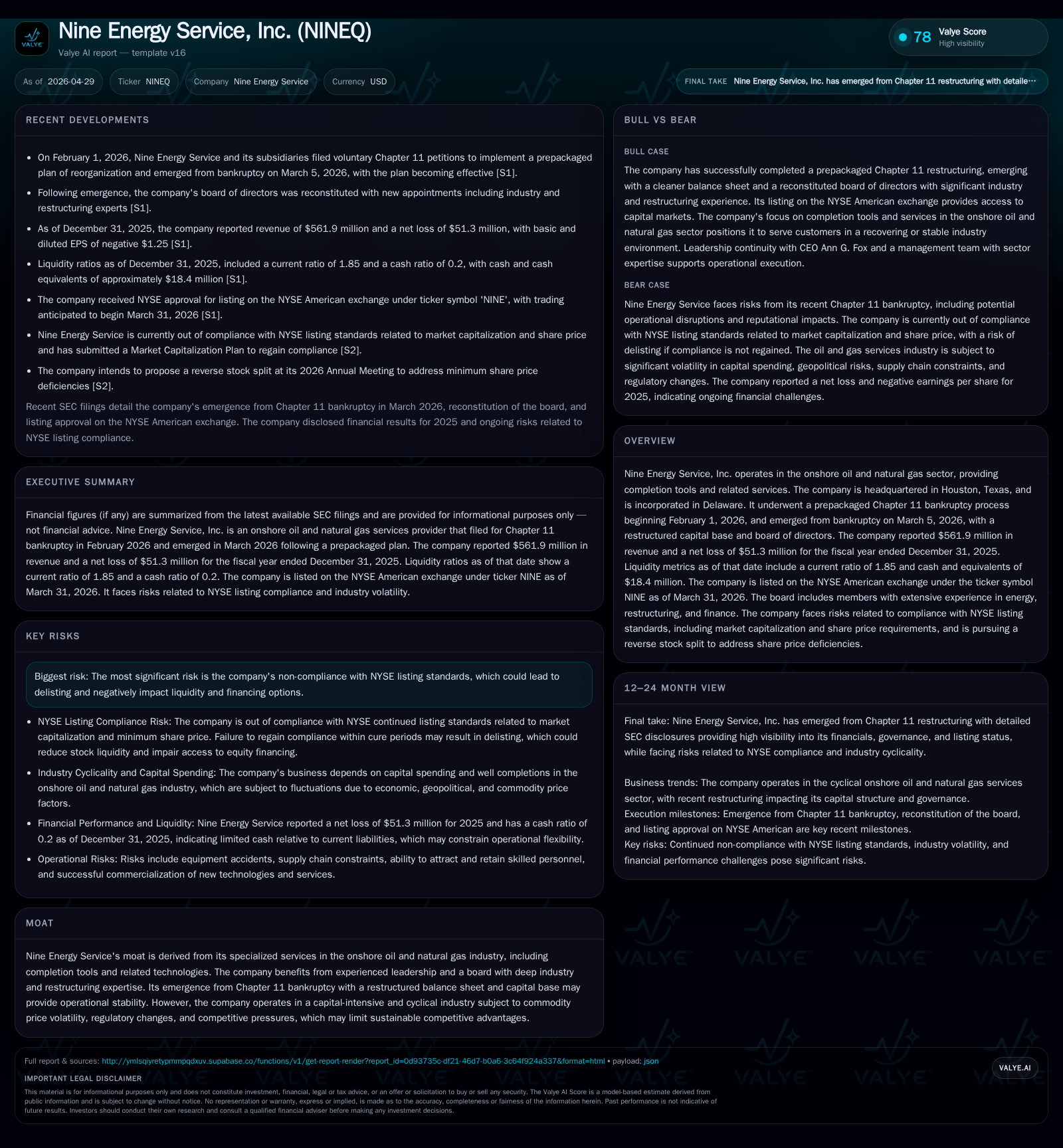
Nine Energy Service, Inc. emerged from prepackaged Chapter 11 bankruptcy in early March 2026, resetting its capital base and governance with a new board. The company operates primarily in onshore oilfield completion tools and services, a sector marked by cyclicality and capital intensity. Recent CFO resignation underscores near-term executive transition risks. NYSE compliance remains critical due to market capitalization and share price deficiencies, while the restructured balance sheet provides operational runway. Key growth drivers hinge on upstream drilling activity resumption and technological adoption in completions.
Recent Event Filing Highlights and Leadership Transition
Nine Energy Service announced on April 20, 2026, that Executive Vice President and Chief Financial Officer Guy Sirkes will resign effective May 11 to pursue an external opportunity [S3]. This departure comes on the heels of the company's emergence from Chapter 11 bankruptcy on March 5, 2026 after executing a prepackaged plan approved by the Bankruptcy Court in early March [S7]. The restructuring reset Nine Energy’s capital structure and replaced much of its board with members bringing deep energy and restructuring experience [S1][S7].
The timing of the CFO resignation introduces a potential disruption risk to near-term financial planning and reporting during this sensitive phase of operational reboot. Management's ability to stabilize access to capital markets and execute turnaround plans will be tested amid leadership transition.
Business Model Overview: Completion Tools and Service Economics
Nine Energy Service operates within the onshore oil and natural gas sector as a provider of completion tools and related services integral to well completions—especially hydraulic fracturing. The company generates revenue mainly through leasing or rental fees for completion equipment combined with related service contracts supporting well stimulation operations [S1][F1].
This business relies heavily on upstream operators undertaking capital-intensive drilling campaigns where completion technology enhances well productivity and reduces costs. Margins are influenced by equipment utilization rates, contract terms (often term-based or volume-linked), pricing power in competitive tenders, and efficient fleet deployment.
Capital intensity stems from maintaining technologically advanced fleets capable of meeting operator demands across major US shale basins. Customer profiles largely consist of exploration & production companies focused on tight oil/gas plays requiring hydraulic fracturing completion solutions.
Competitive Position within the US Onshore Oil and Gas Services Sector
Within the highly cyclical US land-based completion services market, Nine Energy faces competition from larger integrated oilfield service firms alongside specialist technology providers. Commodity price volatility directly impacts customers’ capex budgets which translates into fluctuating demand for completion equipment rentals.
The firm's moat rests on technical specialization in certain dissolvable plug technologies and proprietary equipment that provide differentiation amid intense pricing pressures [S1]. Switching costs for customers may be moderately high due to integration complexities but are not insurmountable given alternative service options available.
Supply chain constraints including materials availability can also affect capacity utilization amid broader inflationary cost pressures seen industry-wide. Regulatory requirements create both compliance overheads but also serve as entry barriers supporting incumbents like Nine Energy.
Board composition post-bankruptcy reflects strategic intent to leverage expertise in energy sector turnarounds enhancing competitive management alignment [S1].
Growth Prospects and Demand Drivers for Completion Technologies
Future growth is structurally tied to recovery in shale drilling/frac completions across prolific basins such as Permian, Eagle Ford, Haynesville, among others [S2]. As operators increasingly seek efficiency gains via advanced completion tools and technologies that minimize downtime and environmental footprint, Nine Energy can capitalize on specialized product penetration.
Consolidation trends among downstream service providers may present opportunities for strategic partnerships or acquisitions enhancing scale economies. Geographic expansion beyond core basins remains a potential avenue but execution capability will be key.
Liquidity availability post-bankruptcy through the $135 million exit asset-based revolving credit facility underpins operational continuity enabling contract fulfillment even during volatile pricing environments [S14][F1]. Maintaining this financial flexibility is essential amidst patchy upstream capex patterns.
Key Risks: NYSE Listing Compliance and Industry Cyclicality
The company is currently non-compliant with NYSE continued listing standards due to average global market capitalization below $50 million coupled with share price persistently under $1 per share as notified by NYSE during calendar year 2025 [S2]. This raises delisting risk which would severely restrict common equity liquidity impacting investor appeal and long-term capital access.
Management plans a reverse stock split proposal at the upcoming 2026 Annual Meeting aimed at rectifying minimum share price requirements; approval uncertainty persists given shareholder base composition [S2].
Industry cyclicality linked to commodity price swings continues to impose demand volatility impacting equipment utilization rates and pricing power. Operating leverage constraints combined with elevated net debt position (~$351 million net debt as of December 31, 2025) elevate financial risk metrics in downturn scenarios [F1]. Cost inflation pressures especially labor/materials also constrain margin expansion.
Upcoming Catalysts and Monitoring Points
Key near-term milestones include:
- Shareholder vote on anticipated reverse stock split proposal planned for 2026 Annual Meeting aimed at regaining NYSE listing compliance [S2]
- Appointment(s) following CFO resignation critical for financial strategy execution [S3]
- Regular quarterly earnings releases providing clarity on revenue stabilization/recovery trajectory post-bankruptcy
- Progress against Market Capitalization Plan milestones mandated by NYSE reviews
- Operational metrics such as contract backlog wins or fleet utilization improvements signaling demand pickup
- Potential equity raises or refinancing moves contingent upon successful delisting risk mitigation
Close observation of these developments will indicate whether Nine Energy can sustain its transformation momentum amid external pressures.
Latest Financial Snapshot and Liquidity Overview
Latest financial snapshot
| Metric | Value | Period |
|---|---|---|
| Cash & equivalents | $18mm | |
| 2025-12-31 | ||
| Total debt | $370mm | |
| 2025-12-31 | ||
| Net debt | $351mm | |
| 2025-12-31 | ||
| Current assets | $169mm | |
| 2025-12-31 | ||
| Current liabilities | $91mm | |
| 2025-12-31 | ||
| Current ratio | 1.85x | |
| 2025-12-31 |
Source: SEC companyfacts cache [F1].
| Metric | Value (USD) |
|---|---|
| Revenue | 561,911,000 |
| Operating Income | 2,348,000 |
| Net Income | -51,322,000 |
| Cash & Equivalents | 18,449,000 |
| Total Debt | 369,621,000 |
| Current Ratio | 1.85 |
Cash balances near $18.4 million provide limited liquidity buffer but when combined with current assets exceeding liabilities by nearly double yields a current ratio of about 1.85 indicating adequate short-term solvency capability [F1]. However elevated total debt approaching $370 million underscores heavy leverage requiring disciplined cash flow management going forward.
In sum, Nine Energy Service must balance rebuilding customer confidence post-bankruptcy alongside addressing pivotal corporate governance reforms mandated by exchange listing rules while navigating intrinsic cyclicality headwinds inherent in US land-based oilfield services.
Disclaimer: This analysis is for informational purposes only based on publicly filed documents as of the dates cited; it does not constitute investment advice or recommendations.
Disclaimer: This is research-only, informational analysis and not investment advice. It may include AI-generated interpretation and general industry context. Always verify important details using primary sources.

Comments