
NIQ Global Intelligence: Harnessing AI to Transform Consumer Insights and Drive Subscription Growth
NIQ’s AI-powered consumer intelligence platform drives growth through robust subscription renewals, geographic expansion, and capital-efficient leverage management.
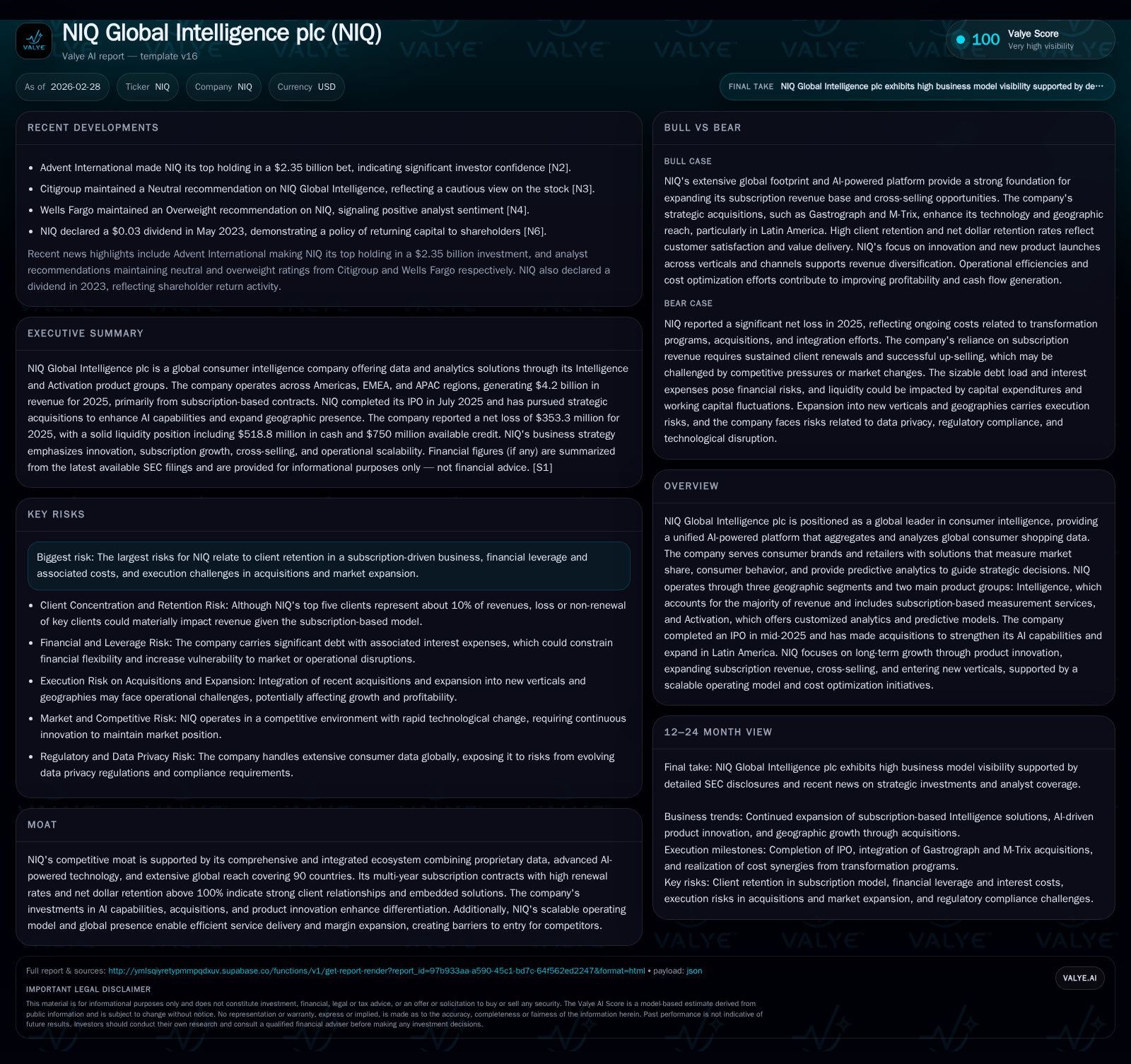
Following its IPO in mid-2025, NIQ Global Intelligence plc has established itself as a global leader in consumer data analytics by leveraging a unified AI platform and comprehensive proprietary data. The company’s subscription-dominant revenue model, anchored by multi-year contracts with net dollar retention of 105%, underpins stable cash flows and supports ongoing innovation. NIQ’s geographic diversification across Americas, EMEA, and APAC complements strategic acquisitions that bolster AI capabilities and expand Latin American presence. Despite a net loss reflecting transformation costs and leverage expenses, positive free cash flow and disciplined capital allocation position NIQ for measured growth amid execution and client retention risks.
Foundation of Growth: Evolution Through Acquisition and IPO
NIQ Global Intelligence plc traces its lineage to a transformative acquisition completed on March 5, 2021, where funds managed by Advent International acquired subsidiaries from Nielsen Holdings plc. This acquisition consolidated several units into what became the NIQ ecosystem – an integrated platform combining proprietary data sets, advanced AI technology applications, human expertise, and sophisticated analytics software. Following a strategic reorganization completed in July 2025 [S1][S4], NIQ emerged as a public entity through an IPO that closed on July 24, 2025. This milestone solidified NIQ’s status as an independent global consumer intelligence provider [S25].
The company's evolution marks a shift from traditional market research methods toward an AI-powered platform delivering omnichannel consumer shopping insights across 90 countries [S1]. The reorganization streamlined ownership under NIQ Global Intelligence plc which now directly oversees key operating subsidiaries previously held under intermediate entities [S4]. This structural clarity supports scalability and governance suitable for a public company environment.
Revenue Streams Dissected: Subscription Dynamics and Product Mix
NIQ’s revenue model prioritizes recurring subscription contracts underpinning predictability and client embeddedness. For the year ended December 31, 2025, total revenues reached approximately $4.2 billion with the Intelligence product group accounting for nearly 81% ($3.39 billion) of this figure [F1][S5]. Intelligence solutions encompass retail measurement services offering granular omnichannel data that capture market share dynamics and consumer behavior patterns.
Importantly, about 84% of Intelligence revenue originated from long-term subscription agreements characterized by annual contract price escalations tied to product enhancement features [S1]. These contracts yielded a notable net dollar retention rate of 105%, indicating not only stable renewals but also expansion within existing client accounts via up-selling or cross-selling [S1]. Activation offerings—customized analytics and predictive modeling services—contributed roughly $804 million to revenue in 2025 and typically build upon initial Intelligence relationships [S1].
Revenue recognition practices incorporate both over-time (approximately $3.48 billion) and point-in-time ($715 million) methods reflective of multi-year service delivery versus discrete analytics projects respectively [S5]. This segmentation reflects the blend between subscription-based measurement services and bespoke analytic engagements.
Historical performance (annual)
| FY |
|---|
| 2025 |
Source: SEC companyfacts cache [F1].
Figure: Annual financial performance highlights derived from [F1]
Geographic Expansion and Segment Profitability Analysis
NIQ operates through three core reporting segments: Americas (encompassing North America and Latin America), EMEA (Europe, Middle East, Africa), and APAC (Asia-Pacific) [S4][S6]. In terms of revenue contribution for calendar year 2025:[S5]
- EMEA led with $1.86 billion,
- Americas followed with $1.63 billion,
- APAC contributed $702 million.
While revenue expanded organically across all regions—with organic constant currency revenue growth rates of approximately 6% in Americas and EMEA but only ~1.7% in APAC—the profitability profile diverges [S11][S21]. Adjusted EBITDA margins highlight regional cost structures with APAC experiencing margin compression due to higher personnel-related expenses despite scale gains [S21]. The company’s scalable “build once, deploy everywhere” model enables leveraging fixed costs across markets but local dynamics such as wage inflation can impact margins differentially.
Latin America expansion notably benefits from acquisitions enhancing data coverage breadth amid ongoing integrations [S4][S23]. This geographic positioning complements broader penetration strategies into adjacent verticals including tobacco, pet care, beauty products plus emerging sectors like financial services and media advertising where targeted consumer insights are increasingly demanded.
AI-Driven Innovation as a Catalyst for Market Differentiation
At the core of NIQ’s competitive advantage lies its unified AI-powered technology platform branded internally as "The Full View™." It systematically gathers diverse datasets spanning point-of-sale transactions from brick-and-mortar retailers to eCommerce channels globally [S1]. The platform harmonizes these heterogeneous inputs into proprietary reference data enriched by machine learning models capable of nuanced behavioral segmentation and predictive forecasting.
This omnichannel measurement capability facilitates deeper understanding not just of what consumers buy but why they do so — fueling Activation offerings centered around actionable intelligence such as pricing elasticity models or promotion targeting strategies [S1][F1]. Recent strategic acquisitions focused on augmenting NIQ’s AI competency have reinforced this technological edge [F1], further embedding solutions within client enterprises which translates into elevated net dollar retention metrics above industry norms.
Firm-wide cross-selling uptake substantiates the network effect: approximately 78% of Activation revenues come from existing Intelligence clients demonstrating success penetrating installed bases while expanding wallet share [S23]. Additionally, the proportion of clients purchasing eCommerce modules climbed from single digits in prior years to nearly a third by end-2025—a vivid indicator of evolving demand patterns captured early through innovation-led offerings.
Financial Health Snapshot: Profitability, Cash Flow and Balance Sheet Leverage
Despite an operating income tallying roughly $85 million in FY2025 indicating positive core earnings generation capacity [F1], NIQ reported a net loss near $353 million resulting in an approximate return on equity (ROE) of negative 35.7% for the period [F1]. This loss reflects substantial non-cash amortization related to intangibles recognized during earlier acquisitions alongside interest expense stemming from significant leverage levels associated with historical buyout financing structures [S1][F1].
Liquidity remains robust post-IPO with cash and equivalents more than doubling year-over-year to approximately $519 million at year end while current assets narrowly exceed current liabilities creating a current ratio slightly above parity at ~1.03x [F1][S26]. Free cash flow rebounded strongly to roughly $264 million driven primarily by operating cash flow improvement (approaching $299 million) combined with controlled capital expenditures near $263 million—as capital investment focuses on internal software development sustaining product innovation momentum [F1][S20].
Long-term debt stood near $3.53 billion after repayments using IPO proceeds totaling over $985 million including revolver elimination valued at over $533 million along with partial term loan paydowns assisting covenant compliance posture [F1][S7][S9]. Interest rates on outstanding term loans declined following refinancing actions during mid-2025 amendments reducing spreads close to market benchmarks enhancing cost efficiency going forward although absolute leverage remains high relative to EBITDA multiples common across the sector [S14][S15].
Capital Allocation Strategy: Debt Reduction, Dividend Policies, and Equity Incentives
Capital deployment priorities emphasize deleveraging while supporting operational scaling; proceeds from the July 2025 IPO were materially applied toward repaying revolving credit facility balances totaling approximately $533 million alongside principal amortization on term loans estimated around $686 million including Canadian dollar denominated debt retirements reflecting prudent balance sheet stewardship post-listing [S7][S9][S15].
NIQ currently does not distribute dividends nor has it commenced share repurchase initiatives consistent with management’s stated focus on reinvestment for growth and transformation [F1][S1]. From a governance lens, the public company adopted a comprehensive Equity Incentive Plan (the ‘‘2025 Plan’’) aligned with long-term employee performance incentivization featuring restricted stock units among other vehicles aimed at fostering executive retention without immediate dilution pressures reported at year-end disclosures [S1].
This deliberate restraint evidences commitment toward balancing leverage reduction needs alongside necessary investments commoditized through internally developed software capitalization upward of $217 million in FY25—underscoring technological differentiation investment imperatives [F1][S20].
Risks in Execution and Subscription Retention Amid Scaling
As outlined explicitly within risk disclosures accompanying recent filings [S1][S2][S27], subscriber attrition represents primary business risk given the reliance on multiyear contract renewals that carry embedded price escalators yet expose NIQ to potential churn if competitive offerings or client budgets shift adversely.
Execution risks compound challenges related to successfully integrating acquisitions aimed at elevating AI capabilities or expanding regional coverage—particularly Latin America—where cultural nuances or regulatory regimes could delay value realization relative to expectations [S27]. Concurrently, financial leverage introduces vulnerability toward macroeconomic shifts affecting borrowing costs; though interest coverage improved post-refinancing efforts execution demands vigilance amid covenant thresholds imposed within revolving credit agreements accompanied by mandatory prepayment clauses linked to excess cash flow metrics monitored quarterly [S7][S9]. Regulatory uncertainties inherent when dealing with consumer data privacy across multiple jurisdictions also pose latent operational risks impacting client confidence.
Forward-Looking Indicators: Milestones and What Investors Should Monitor
While NIQ has not provided explicit quantitative guidance beyond reported results for FY2025 [N1][S3], several leading indicators merit attention going forward:
- Subscription revenue trajectory including net new bookings growth rate crucial given Intelligence subscriptions form majority revenue base;
- Pace of AI product enhancements improving predictive accuracy influencing Activation attach rates;
- Successful expansion outcomes in Latin America following recent acquisitions pivotal for broadening geographic footprint;
- Debt covenant ratios especially consolidated first lien debt relative to adjusted EBITDA signaling sustained financial flexibility;
- Cross-selling metrics particularly penetration into adjacent verticals such as media advertising vis-à-vis historical baseline adoption statistics.
The interplay between these operational KPIs against backdrop of sustained free cash flow generation would shape balance sheet strengthening opportunities or discretionary capital returns strategy potential beyond current reinvestment emphasis.
This analysis relies exclusively on publicly available filings from NIQ Global Intelligence plc through February 28, 2026 ([F1],[S#]) plus related verified news where cited ([N#]). It is intended solely for informational purposes without any expressed or implied investment recommendations.
Disclaimer: This is research-only, informational analysis and not investment advice. It may include AI-generated interpretation and general industry context. Always verify important details using primary sources.

Comments