
Nektar Therapeutics Advances Rezpegaldesleukin Phase 3 Amid Financial Pressures
Nektar focuses on immunomodulatory therapies with a lead candidate progressing to pivotal trials while managing operational costs and litigation risk.
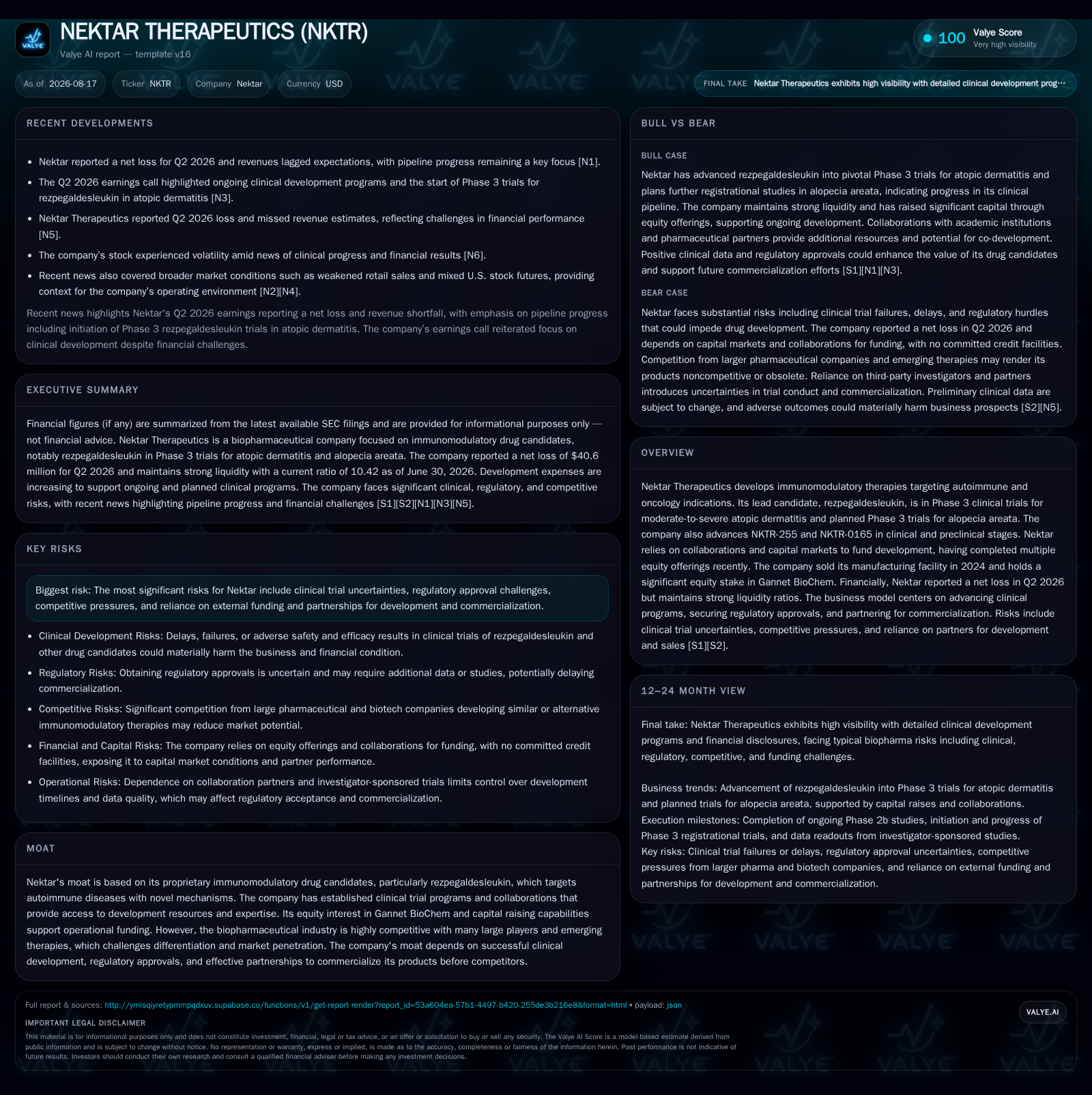
Nektar Therapeutics is progressing its lead drug candidate, rezpegaldesleukin, into Phase 3 global registrational trials targeting moderate-to-severe atopic dermatitis, marking a pivotal shift in its clinical pipeline. The company’s business model hinges on advancing immunomodulatory therapies in autoimmune and oncology indications funded principally through capital markets and collaborations. Recent quarterly results highlight continued net losses and tight liquidity, underscoring dependency on successful trial outcomes and partnerships to drive value. Key risks include trial uncertainties, regulatory challenges, ongoing litigation with Eli Lilly, and the need to secure additional funding as R&D expenses rise with late-stage development.
Recent Operating Update: Phase 3 Launch and Financial Results
Nektar Therapeutics' latest quarterly report dated August 14, 2026 ([S2]) confirms key developments in its clinical pipeline centered around rezpegaldesleukin (formerly NKTR-358), an IL-2 receptor agonist designed to modulate immune responses in autoimmune diseases. In July 2026, Nektar announced the initiation of two global Phase 3 registrational trials—ZENITH AD-1 and ZENITH AD-2—for moderate-to-severe atopic dermatitis patients aged 12 years or older [S2][S3]. This advancement marks a strategic pivot from earlier Phase 2b studies conducted since late 2023 (the REZOLVE-AD trial), showing progression toward seeking regulatory approval.
Financial disclosure indicates continuing net losses driven by increased research investment required to support these late-stage trials. R&D expense is set to climb significantly throughout 2026 as the company accelerates rezpegaldesleukin's development programs [S1]. Despite this ramp-up in investment pressure, Nektar maintains roughly $39 million in cash and equivalents as of June 30, 2026, supported by previous equity raises under ATM agreements realized earlier this year generating over $100 million net proceeds combined [S5][F1]. The current ratio stands at a healthy 10.42 given current assets relative to liabilities; however, elevated net debt of around $94 million signals underlying leverage concerns possibly limiting financial flexibility without further funding or partnership inflows [F1].
Business Model: Clinical Development-Focused Biotech
Nektar operates as a clinical-stage biotechnology developer specialized in immunomodulatory agents targeting both autoimmune disorders and oncology. Its commercial model revolves around discovering proprietary drug candidates such as rezpegaldesleukin (IL-2 pathway modulator), NKTR-255 (IL-15 agonist), and NKTR-0165 (tumor necrosis factor receptor type II agonist) [S1]. Revenue generation during this phase is minimal or negative; income mainly derives from upfront payments, milestone fees from collaborations (e.g., with Merck KGaA), royalties if any approved products exist through partners, and capital market financing.
The company's channel involves conducting phased clinical trials—often investigator-sponsored or collaborative—and leveraging licensing agreements with larger pharmaceutical firms for late-stage development or commercialization support. For example, Nektar has completed its alliance with Lilly on rezpegaldesleukin rights after Lilly ceased its lupus program post-failure in Phase 2; the full rights reverted back to Nektar who now bears all developmental expenses moving forward [S2]. The business model thus entails high R&D spend-to-cash burn ahead of any potential product commercialization.
Post-sale of Nektar’s own manufacturing facility in late 2024 ([S1]), the firm utilizes contract manufacturing solutions aligned with industry norms for capacity scalability. It holds an equity interest in Gannet BioChem arising from that transaction which may provide some strategic benefits but no direct manufacturing control.
Industry Structure and Competitive Positioning
As a biotech entity primarily engaged in developing novel immunomodulators for autoimmune diseases and cancer indications, Nektar sits upstream in the pharmaceutical value chain focusing on discovery through mid-to-late clinical stages. This position demands navigating intense scientific uncertainty due to inherent risks of clinical failures or regulatory denial.
Peers include mid-size biotechnology firms specializing in immunology such as Regeneron Pharmaceuticals—known for immunomodulatory biologics—and emerging developers like Moderna leveraging innovative platforms. Compared globally among peers like Amgen or Gilead Sciences who command substantial commercial scale, Nektar is smaller but follows a typical pathway relying heavily on partnerships and investor capital.
Competitive pressures arise from numerous investigational mechanisms attacking similar autoimmune targets plus established therapeutics entrenched via commercialized biologics. Differentiation depends on novel mechanisms of action (e.g., selective T regulatory cell modulation by rezpegaldesleukin), improved safety/efficacy profiles demonstrated through pivotal studies, and regulatory endorsements which create intellectual property moats.
Growth Drivers
Nektar’s immediate growth vector hinges on positive clinical progression of rezpegaldesleukin. The shift into Phase 3 registrational trials aims to substantiate efficacy sufficient for FDA/EMA approvals which would unlock commercialization potential and subsequent revenue streams including product sales or lucrative partnership/licensing agreements [S2]
Additional growth may be fostered by expanding indications such as alopecia areata where Phase 2b evaluation began in early 2024; successful agility towards label expansions could amplify addressable patient populations. Oncology-focused NKTR-255 retains relevance within ongoing collaboration frameworks evaluating it post-CAR-T therapy maintenance regimens—a niche that could diversify risk away from sole reliance on rezpegaldesleukin outcomes.
Also pivotal is continued access to capital markets evidenced by ATM equity offerings executed recently generating critical funds sustaining operations during expensive trial phases. Strategic collaborations aiming for milestone payments remain important supplementary financial channels accelerating sustained pipeline advancement.
Risks and Watchpoints
Primary risks stem from clinical development uncertainties—rezpegaldesleukin trials might fail endpoints or reveal adverse safety signals potentially derailing approval timelines or market entry prospects [S16]. Regulatory pathways themselves remain unpredictable; agencies may impose restrictive labeling even post-approval limiting commercial attractiveness.
Financially, despite solid short-term liquidity ratios, dependency on external financing remains acute since no committed credit facilities exist—heightening vulnerability to capital market volatility affecting financing terms or availability when necessary before generating meaningful revenues [S5][F1]. Manufacturing outsourcing also introduces execution dependencies possibly impacting supply continuity if contract manufacturers face disruption.
Watch areas include milestones concerning interim and final data readouts from the ZENITH AD Phase 3 studies which will carry substantial influence over subsequent partnering discussions or market preparations. Monitoring cash burn rates against financing inflows is critical given escalating R&D commitments expected into late-stage development cycles.
What To Watch Next
Key near-term execution points:
- Progression updates from ZENITH AD Phase 3 trials including enrollment pace and interim efficacy/safety data releases.
- Outcomes of ongoing litigation with Eli Lilly culminating around early September jury phase impacting legal contingencies.
- Any new collaboration agreements or licensing milestones secured for rezpegaldesleukin or other pipeline candidates enhancing non-dilutive funding sources.
- Quarterly cash flow statements evidencing sustainable liquidity buffer relative to rising operational expenditures.
- Regulatory engagement progress such as FDA communications regarding trial design acceptability potentially influencing approval speed post-trials.
Financial Profile Discussion
As of June 30, 2026, Nektar held approximately $39.3 million in cash and equivalents against current liabilities near $71 million yielding a strong current ratio above ten—a reflection largely attributable to deferred revenue recognition structures common in biotech contract accounting rather than pure liquidity surplus [F1]. Total debt estimates remain elevated at about $133 million historically but seem partly offset by cash holdings resulting in about $94 million net debt exposure requiring close management especially amid negative cash flows driven by surging R&D spend accompanying transitional Phase 3 activations ([F1]).
Operating losses widened compared to prior periods as expected given intensified clinical commitments around rezpegaldesleukin's late-stage push ([F1]). The company has no committed credit lines making equity issuances via ATM programs or secondary offerings essential financing tools supplementing collaboration-derived milestone receipts until profitable product sales manifest [S5][F1]. This reinforces the significance of successful trial progressions as catalysts not only for valuation appreciations but also enabling improved capital raising terms.
This analysis draws solely upon public SEC disclosures dated up to August 14, 2026 ([S1]-[S29]), associated earnings press releases ([N1]-[N11]), companyfacts snapshots ([F1]), and sector knowledge framing relevant for biotechnology companies developing immunomodulatory therapeutics. No specific investment advice is expressed herein.
Disclaimer: This is research-only, informational analysis and not investment advice. It may include AI-generated interpretation and general industry context. Always verify important details using primary sources.

Comments