
Neptune Insurance Holdings Unlocks AI-Driven Growth in Private Flood and Parametric Insurance
Q2 2026 results highlight Neptune’s accelerating organic growth fueled by AI underwriting, expanded agent engagement, and parametric product innovation.
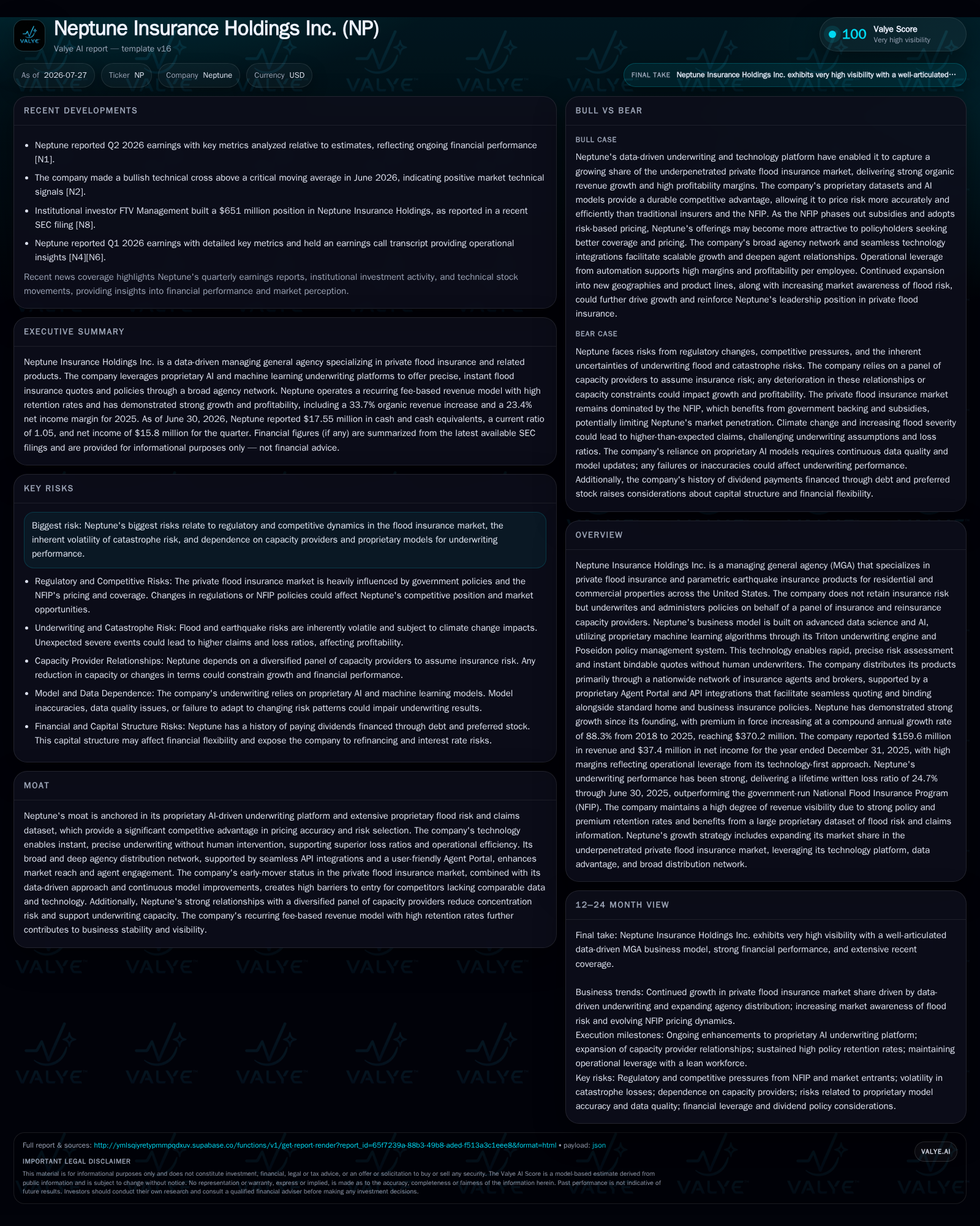
Neptune Insurance Holdings reported strong second-quarter performance marked by significant growth in written premiums and commission income, driven by its proprietary AI-based underwriting platform, Triton. The company’s technology-enabled distribution network, including a scalable Agent Portal and API integrations, supports increased policy volumes and high renewal rates despite challenging industry dynamics. Neptune also benefits from diversification through its parametric earthquake insurance products gained via the Jumpstart acquisition. While regulatory shifts such as NFIP’s Risk Rating 2.0 create opportunities for private flood insurers like Neptune, risks remain around catastrophe volatility and capacity provider dependence. The latest filings confirm robust margins and operational leverage as Neptune scales rapidly without retaining insurance risk.
Q2 Operating Momentum Validates Proprietary AI Underwriting Advantage
The significance lies in Neptune's model for instantaneous risk assessment without human intervention—a capability that allows rapid quoting and binding critical in private flood insurance where time-sensitive acquisition affects conversion rates. The proprietary Triton engine also feeds into improved renewal offers, yielding enhanced policy retention rates reported at around 86%, with premium retention exceeding 96% for recent years [S1]. These metrics underscore how data science underpins durable recurring revenue streams without increased balance sheet risk exposure since policies are underwritten on behalf of capacity providers who assume claims risk.
Maintaining favorable loss ratios delivered to capacity partners remains pivotal for sustaining this virtuous cycle. Neptune has disclosed a lifetime written loss ratio of just 24.7% for capacity providers since inception [S1], implying highly selective underwriting made possible by detailed flood risk data sets coupled with continuous model refinement. Any material deterioration here would challenge future commission growth; however, current indications suggest underlying risk selection resilience.
Technology-Driven Policy Administration Enhances Agent Experience & Distribution
Beyond underwriting precision, Neptune’s differentiated value sits in its proprietary policy administration platform Poseidon combined with an Agent Portal and broad API integration framework [S1]. These tools streamline quoting and binding processes for insurance agents across a wide national network supporting residential and commercial lines.
The Q2 filings note an expanding engagement from a growing agent count driving higher policy sales velocity reflected by commission expense rising in line with premium volumes rather than increasing commission rates themselves [S2]. This signals solid agent adoption without margin erosion. The seamless digital interface lowers friction for agents accustomed to cumbersome legacy flood insurance workflows often associated with the NFIP program.
Given distribution channel dynamics serve as critical competitive moats in MGA models—where agents choose platforms offering ease and speed—the sustained enhancement of this ecosystem is essential. Any disruption or competitor offering superior integration might challenge market share gains if not countered by ongoing innovation or incentives.
Positioning Against NFIP and Specialty MGAs in the Private Flood Market
The broader private flood insurance market remains heavily influenced by the U.S. government’s National Flood Insurance Program (NFIP), which historically dominated flood coverage but has recently updated its Risk Rating 2.0 pricing [S1]. This regulatory evolution increases premiums towards actuarially sound levels, indirectly encouraging private insurers like Neptune to pursue market share previously unattainable.
Neptune leverages its early-mover advantage as one of the few scaled MGAs specializing exclusively in private flood insurance distributed via advanced tech platforms to differentiate itself from both traditional carriers and emerging specialty MGAs such as American Modern Insurance Group. Unlike legacy insurers hampered by manual workflows or limited data access, Neptune's full AI stack enables precise risk pricing aligned with new regulatory dynamics.
Nevertheless, competitive pressures may intensify as incumbents upgrade technology or regulations tighten oversight on private flood participation. Success depends partly on managing pricing discipline while preserving attractive renewal terms favored by customers—a balance delicately maintained through ML-driven renewal optimization.
Growth Catalysts: Product Innovation & Expanding Agent Network
Neptune’s portfolio expansion beyond flood insurance into parametric earthquake coverage marks another distinct growth vector following its acquisition of Jumpstart in late 2021 [S1]. Parametric insurance leverages pre-defined triggers rather than indemnity claims adjusting to cover earthquake risks swiftly—an underserved segment in California, Oregon, Washington states currently.
This product innovation complements core flood offerings by diversifying risk exposures across catastrophe types while addressing significant protection gaps post-major seismic events. The technological foundation acquired through Jumpstart integrates into Triton/Poseidon facilitating unified policy management within the MGA platform [S3].
Additionally, continued investment in digital marketing strategies targeting agents and consumers aims to steadily broaden the agent base nationwide alongside geographic expansions within regulated jurisdictions supportive of private flood participation [S1]. Improved data sets enrich underwriting accuracy further enabling tighter pricing bands that can accelerate new business wins.
Risks Around Regulation, Capacity Concentration, and Catastrophe Volatility
While Neptune operates without balance-sheet risk retention—outsourcing claims handling fully to a diversified panel of capacity providers—the inherent volatility of catastrophe losses remains a systemic risk affecting reported loss ratios passed downstream [S1]. Large-scale flooding or earthquakes could stress these arrangements impacting renewal pricing cycles or capacity availability adversely affecting commission trajectories.
Regulatory uncertainty persists around evolving state guidelines governing private flood authorizations that could restrict product offerings or impose pricing constraints [S1]. Capacity provider concentration is another exposure whereby over-reliance on limited reinsurers could magnify counterparty risks should those firms curtail capital deployment into flood lines [S1].
Continuous monitoring of claims frequency/severity trends reported by partners along with proactive engagement on regulatory developments are thus vital for sustainable operations.
Key Milestones to Monitor for Execution & Market Penetration
To evaluate Neptune’s ongoing execution efficacy, several near-term performance markers warrant close scrutiny:
- Quarterly tracking of written premium volumes across both flood and parametric lines as indicators of demand expansion [S2]
- Stability or improvement in policy retention rates exemplifying customer satisfaction amid pricing changes [S2]
- Agent network size increments alongside portal/API usage metrics signaling distribution depth enhancement [N1]
- Uptake acceleration of parametric earthquake products supporting diversification efforts [S3]
- Any company disclosures around technological platform uptime reflecting operational reliability critical for agent trust.
Collectively these KPIs will validate whether current AI-driven advantages translate into deepening market penetration amid competitive headwinds.
Financial Profile Discussion: Solid Margins Amid Efficient Scale-up
Neptune’s financial results demonstrate effective scalability facilitated by technology-enabled operations. For the year ended December 31, 2025, total revenues rose to $159.6 million representing a 33.7% increase leveraging organic policy count growth alongside stable average fees per policy [S1]. Adjusted EBITDA held steady near a high margin at approximately 59.5%, evidencing operating leverage amid increasing scale [S1].
The Q2 report reflects continued margin stability driven by consistent commission rates despite volume gains and rising agent commissions tied strictly to premium inflows rather than rate hikes [S2]. Employee compensation cost increases relate primarily to investments in data science teams enhancing AI capabilities—a strategic usage of resources expected to sustain long-term growth.
Balance sheet liquidity remains adequate with cash & equivalents at $17.5 million as of June 30, 2026 against current liabilities around $84.5 million yielding a current ratio slightly above unity at 1.05; total debt stood near $264 million last reported in late 2025 reflecting sizable borrowings against assets [F1]. No recent major debt refinancing risks were flagged [S2].
Overall, financial discipline combined with incremental technology investment supports positive free cash flow potential as scale accelerates further.
This analysis synthesizes all publicly available SEC filings up to July 27th, 2026 alongside corroborating recent news coverage but does not constitute investment advice or specific forecasts. It is intended solely as an informed internal research memo exploring operating trends within Neptune Insurance Holdings’ specialized MGA niche.
Disclaimer: This is research-only, informational analysis and not investment advice. It may include AI-generated interpretation and general industry context. Always verify important details using primary sources.

Comments