
Nexscient’s Strategic AI Acquisitions Heighten Technology Pipeline but Face Liquidity Challenges
Recent acquisitions and alliances strengthen Nexscient’s AI capabilities amid customer concentration and financial constraints.
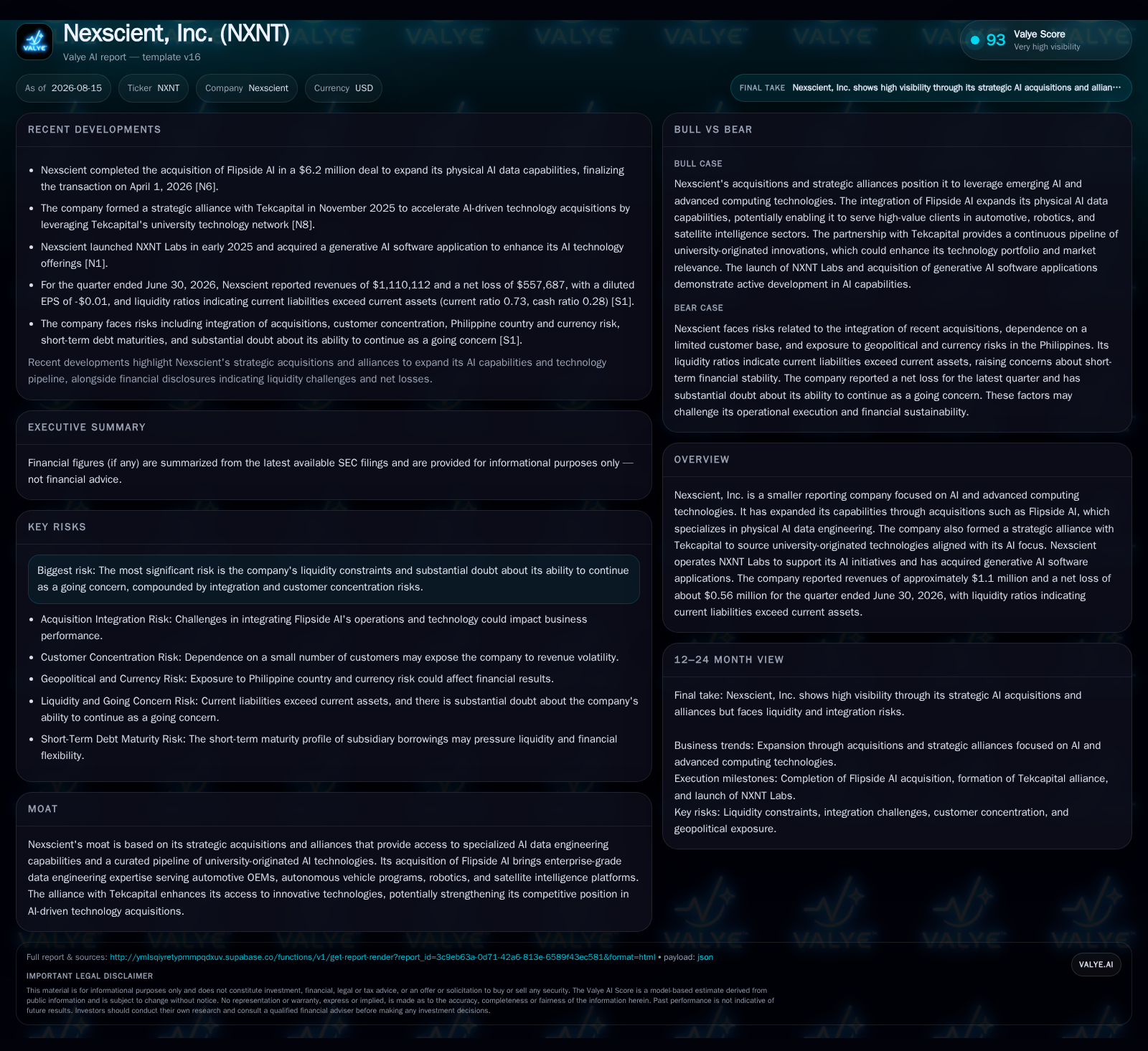
Nexscient, Inc. has expanded its artificial intelligence technology portfolio through its acquisition of Flipside AI and a strategic alliance with Tekcapital, positioning itself at the nexus of AI software development and enterprise data engineering services. Despite these advances, the company reported modest revenues of approximately $1.1 million and a net loss of about $0.56 million for the quarter ended June 30, 2026, while facing liquidity constraints with a current ratio below 1.0. High customer concentration, integration complexities, and short-term debt maturities compound its substantial going concern risk. Monitoring successful integration of acquisitions and progress in building recurring revenue streams will be critical to assessing Nexscient’s viability and growth trajectory.
Recent Operating Update
Nexscient, Inc.’s latest quarterly filing dated August 14, 2026 signals ongoing transformation through acquisition and strategic partnerships focused on expanding its footprint in artificial intelligence (AI) technologies [S2]. The recent acquisition of Flipside AI completed in April 2026 represents a major step toward diversifying into enterprise AI data engineering services. This deal involved an aggregate consideration exceeding $6 million in stock, cash, and convertible notes [S6], bringing to Nexscient specialized capabilities serving automotive OEMs, autonomous vehicle developers, robotics firms, and satellite intelligence platforms.
Alongside this acquisition, Nexscient executed a strategic alliance with Tekcapital in November 2025 designed to tap into university-originated technologies aligned with Nexscient’s advanced computing ambitions [S5]. This structured pipeline aims to accelerate access to innovative generative AI applications and related technologies through licensing or acquisitions.
However, despite strengthening its technological arsenal, Nexscient's financial disclosures reveal ongoing operating losses with net losses standing near $0.56 million for the quarter ended June 30, 2026 [F1]. Revenues totaled approximately $1.1 million but remain modest relative to expenses associated with integration efforts and research & development (R&D). The company also disclosed total debt amounting to roughly $114 thousand versus cash reserves close to $489 thousand as of quarter-end [F1]. These figures underscore notable liquidity pressures that contribute to substantial doubt regarding Nexscient’s ability to continue as a going concern [S2].
Leadership turnover adds another layer of operational dynamics: the Chief Operating Officer resigned effective June 30, 2026 without disagreement on strategy but signaling potential transitional challenges [S22]. To anchor technology integration tighter into corporate strategy, the founder and CEO of Flipside AI was appointed as Nexscient’s Chief Technology Officer concurrently with the acquisition closing [S16]. This dual role is crafted to foster synergy between acquired technology assets and Nexscient’s broader platform.
Business Model Analysis
Nexscient operates primarily as an integrator at the intersection of artificial intelligence software development and data engineering services. It enlarges its technological scope through acquisitions like Flipside AI—an enterprise-grade data engineering firm specializing in physical AI data pipelines for high-complexity environments such as autonomous vehicles, robotics platforms, and satellite intelligence systems.
Revenue generation hinges on licensing AI software products combined with bespoke professional services tailored to these industries’ demanding workflows. Monetization encompasses up-front licensing fees potentially supplemented by professional services revenue related to deployment and maintenance. The Tekcapital partnership supplements this model by sourcing cutting-edge intellectual property from academic institutions—technology which can be licensed or acquired outright to maintain an innovation pipeline.
The ability to convert these innovations into sustainable recurring revenue streams is critical but remains nascent given reported quarterly revenues near $1.1 million [F1]. High customer concentration—common among specialized AI service providers—exposes Nexscient to volatility if key contracts are lost [S2]. Margins are currently pressured by integration costs and R&D investments that do not yet produce scale economies.
The leadership structure reflects an emphasis on blending technical mastery with commercial strategy; appointing Flipside AI's CEO as CTO ensures deep domain expertise drives product development while maintaining operational oversight over both entities [S16]. Yet transitional risks are inherent during such integration phases.
Industry Structure and Competitive Position
The artificial intelligence software and services market is intensely dynamic, characterized by rapid innovation cycles demanding frequent technology acquisitions or partnerships for competitive parity. Firms like Palantir Technologies or C3.ai showcase models with robust recurring revenue bases from large enterprise clients; smaller players like Nexscient often pursue concentrated niches leveraging university partnerships or specialized competencies like physical AI data engineering.
A key industry differentiator is the quality and depth of the innovation pipeline supported by R&D expense levels relative to revenue. Access to university-originated IP via Tekcapital provides Nexscient with a vital channel for early-stage technologies that competitors without such alliances lack [S5]. However, ability to commercialize rapidly impacts time-to-market KPIs critical for sustained growth.
Customer dependency magnifies risk in this sector; specialized contracts driving Flipside AI business further increase exposure to client attrition or renegotiation pressure [S2]. Integration success rate following acquisitions also weighs heavily on future margin improvement potential.
Growth Drivers
Nexscient's growth ambition rests on several pillars:
- Strategic Acquisitions: Adding Flipside AI's enterprise-grade capabilities allows penetration into lucrative sectors like autonomous systems where demand for sophisticated data engineering is rising sharply.
- Innovation Pipeline: The alliance with Tekcapital opens continuous access to cutting-edge university research that could spawn generative AI applications enhancing product breadth.
- Market Trends: Growing enterprise adoption of AI tools paired with expansion in autonomous vehicles and robotics sectors increases addressable market size requiring complex data engineering solutions.
- Leadership Alignment: Appointment of domain-expert CTO aligned underpins technical integration enabling faster time-to-market.
These drivers contribute positively but depend on achieving meaningful revenue growth while managing integration costs effectively.
Risks and Constraints
Key concerns include:
What To Watch Next
Investors should monitor:
- Quarterly revenue trends post-Flipside acquisition demonstrating commercial scale-up or improved contract diversification.
- Progress towards reducing customer concentration through new client wins or contract renewals.
- Cash burn rates relative to liquidity reserves signaling sustainability horizon.
- Updates on integration milestones including organizational alignment under CTO governance.
- Any refinancing or capital raising transactions addressing short-term maturity profile of borrowings.
- Developments from Tekcapital-sourced technology commercialization boosting product pipeline velocity.
Financial Profile Discussion
As of June 30, 2026, Nexscient held cash and equivalents approximating $489 thousand against total debt near $114 thousand—a relatively low leverage level—but current liabilities around $1.78 million considerably outweighed current assets totaling about $1.29 million [F1]. Operating loss stood at around $380 thousand for the quarter with net losses nearing $530 thousand [F1], reflecting early-stage commercialization costs exceeding revenues near $1.1 million recorded for the period. Such financial results align with typical profiles seen among emerging AI technology integrators investing heavily before scalable recurring revenues materialize.
Overall leverage is moderate but short maturity profiles on subsidiary borrowings introduce refinancing risks contributing to going concern doubts stated by auditors [S2]. Capital preservation measures such as stock issuance in lieu of accrued wages approved mid-year further evidence constrained cash flow conditions [S26].
Continued monitoring of operating cash flow trajectories alongside successful execution against integration targets will be vital indicators assessing whether financial health improves sufficiently over upcoming quarters.
Disclaimer: This analysis is intended solely for informational purposes based on publicly available filings dated through August 14, 2026. It does not constitute investment advice or research views regarding any securities mentioned herein.
Disclaimer: This is research-only, informational analysis and not investment advice. It may include AI-generated interpretation and general industry context. Always verify important details using primary sources.

Comments