
Longevity Health Struggles with Liquidity and Market Acceptance in Competitive Cosmetics Sector
Recent quarterly updates highlight Longevity Health Holdings’ operational and financial distress amid a challenging cosmetics landscape.
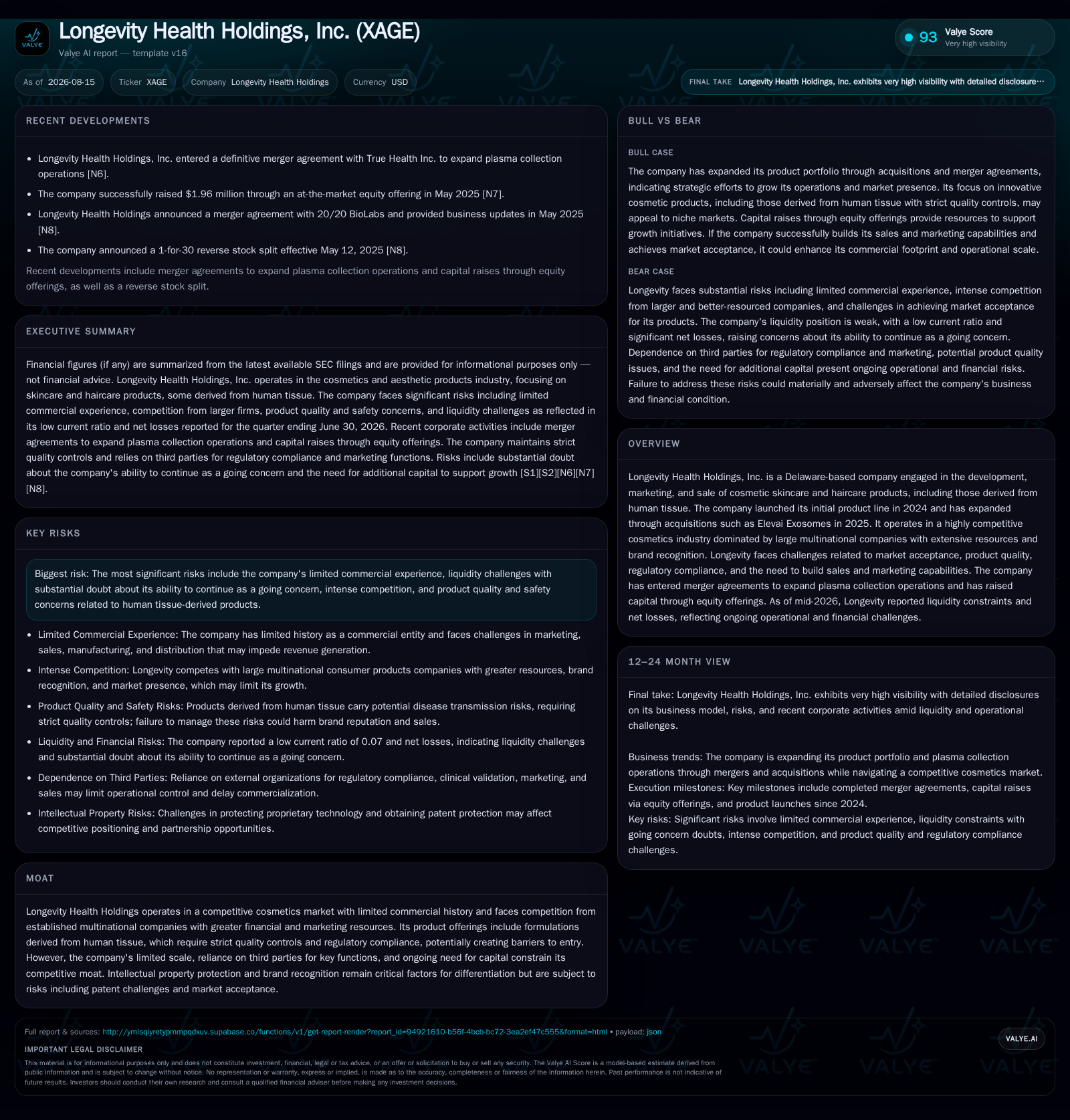
Longevity Health Holdings, Inc. faces significant hurdles as it attempts to commercialize novel cosmetic skincare and haircare products containing human tissue-derived ingredients. The company’s latest quarterly filing signals entrenched net losses, severe liquidity constraints, and ongoing legal and regulatory risks that cloud its near-term viability. Operating in a competitive industry dominated by multinational incumbents, Longevity’s limited scale and emerging brand recognition constrain its competitive moat. Key growth drivers include product innovation and acquisitions, but persistent capital needs and regulatory scrutiny remain critical challenges to watch.
Recent Operating Update
Longevity Health Holdings filed its latest quarterly report on August 14, 2026 [S2], reflecting ongoing operational strains typical of a young cosmetics company attempting to commercialize novel products. As of June 30, 2026, the company reported only $35,471 in cash and equivalents with current assets at approximately $711,716 against current liabilities of about $9.6 million — yielding a critically low current ratio of 0.07 [F1]. This reflects acute near-term liquidity stress that underpins management's disclosure of substantial doubt regarding the company's ability to continue as a going concern [S1]. Recent SEC updates also reveal encumbered debt agreements secured by comprehensive liens on intellectual property and other assets, alongside covenant restrictions tied to future financings [S3]. These financing constraints compound the challenges of scaling up operations in a capital-intensive industry.
Business Model
Longevity Health operates primarily in the development, marketing, and sale of cosmetic skincare and haircare products with formulations that notably include human tissue-derived ingredients [S1]. This biologically sourced input adds scientific differentiation but demands stringent quality controls and regulatory oversight uncommon in conventional cosmetics manufacturing. Revenue generation follows a multi-channel approach involving direct-to-consumer (DTC) sales complemented by wholesale distribution partnerships [S1]. The monetization hinges on product launches supported by marketing campaigns aimed at consumer education and brand-building around aesthetic results tied to proprietary formulations.
However, generating sustainable product revenue remains elusive to date due to limited commercial history and cautious market reception influenced by the novel nature of the ingredients. The reliance on third-party suppliers for raw materials and contract manufacturers for production further diffuses operational control over costs and quality [S1]. Intellectual property protections via patents and trademarks are pursued but face inherent uncertainties given complex patent landscapes and potential infringement litigation risks common within this sector [S16]. Customer adoption depends heavily on demonstrable efficacy and safety profiles amid competition from entrenched multinational brands with far greater scale and marketing resources.
Industry Structure and Competitive Position
The broader cosmetics and personal care industry is dominated by large multinational corporations such as Estée Lauder or L'Oréal that benefit from extensive brand equity, diversified product portfolios across skincare, haircare, fragrance segments, ubiquitous retail presence, and robust R&D pipelines. Longevity remains markedly smaller with nascent brand recognition struggling to penetrate this crowded space.
Competition is intensified not only by traditional cosmetics giants but also emerging specialty skincare brands emphasizing natural or bioengineered ingredients. Longevity attempts differentiation through its use of human tissue-derived cosmetic ingredients — an area that brings both scientific novelty and regulatory complexity uncommon at scale in the cosmetics industry.
This positioning creates both opportunity as well as risk: regulatory authorities impose heightened scrutiny over product safety claims involving biological substances plus satisfactory GMP compliance standards. Failure or delays in meeting such standards can trigger recalls or adverse enforcement actions undermining consumer trust—a critical intangible asset in this sector [S19][S26]. Moreover, trademark protection uncertainties expose Longevity to competitive risks if rivals successfully design around existing patents or challenge intellectual property rights [S10][S16].
Growth Drivers
Key growth initiatives include leveraging product innovation centered on novel formulations incorporating exosomes acquired through the Elevai transaction completed in 2025 [S1]. Scientific advances enabling unique anti-aging or restorative cosmetic effects could drive market uptake if substantiated through clinical studies. Expansion into plasma collection operations via merger agreements aims at vertical integration potentially reducing raw material costs while enhancing supply chain control.
Direct-to-consumer sales channels represent another strategic vector given rising consumer preference for personalized skincare experiences online alongside digital marketing leverage through social media influencers—critical for brand awareness metrics in early-stage beauty firms.
Launches planned for additional skincare products during 2026 reflect management’s intent to broaden offerings beyond initial introductions; success rates for these launches are pivotal metrics shaping future revenue trajectory [S21]. The company emphasizes ongoing R&D investments despite tight capital to stay competitive against incumbents innovating constantly.
Acquisitions remain part of growth strategy to accelerate portfolio breadth; however, effective integration execution remains unproven relative to resource constraints.
Risks and Watchpoints
Significant risks revolve around market acceptance hurdles given consumer wariness toward biologically derived cosmetic ingredients. If efficacy perceptions falter or adverse side effects emerge—even isolated incidents—product return rates could spike adversely impacting brand reputation permanently [S19][S26]. Regulatory compliance costs stemming from evolving frameworks such as the FDA’s potential introduction of pre-market authorization requirements for certain cosmetic products add unpredictability to cost structures [S19][S22].
Liquidity constraints pose existential risk; recurring net losses alongside a near-minimal cash runway heighten the likelihood of operational cutbacks unless fresh financing is secured promptly [F1][S7]. Legal disputes regarding convertible note obligations exacerbate uncertainty about available financial flexibility [S1][S3]. The stringent covenants associated with existing debt facilities may restrict strategic maneuvering including potential partnerships or acquisitions critical for growth.
Intellectual property threats from competitors’ patent challenges or infringement suits could divert scarce management focus while forcing costly redesigns or licensing fees impacting margins negatively [S10][S12]. Furthermore, dependency on third-party contract manufacturers exposes vulnerability to supply chain disruptions or quality lapses undermining product reliability.
Consumer sentiment volatility influenced by rapid shifts in personal-care trends imposes pressure on inventory turnover rates; inability to anticipate preferences leads to markdowns affecting gross margin percentages.
What to Watch Next
Critical upcoming indicators include announcements related to regulatory clearances or certifications enabling new product launches—a positive catalyst if achieved smoothly without delays or costly reformulations. Monitoring progress integrating acquired plasma collection operations following merger agreements will signal capacity expansion success.
Liquidity developments stand paramount: any capital raise sufficient to alleviate working capital shortages would stabilize operations whereas failure increases going concern doubts prominently flagged by management. Additionally, changes in convertible note covenant terms or litigation resolutions can materially affect financial stability [S3]. Tracking sell-through rates post newly launched products will offer early insights into market acceptance dynamics given inherent skepticism toward novel ingredient claims.
Finally, improvements in brand recognition metrics through social media engagement analytics or expanded distribution channel penetration will be essential metrics reflecting gradual competitive foothold establishment against incumbent giants.
Financial Profile Discussion
As of June 30, 2026, Longevity Health Holdings reported cash and equivalents of $35,471 with current assets totaling approximately $711,716 against current liabilities near $9.6 million, resulting in a critically low current ratio of 0.07 [F1]. Total debt stood near $9.36 million based on the most recent available data from September 2023, with net debt close to $9.33 million [F1]. These figures highlight acute liquidity stress and underscore management's disclosure of substantial doubt regarding the company's ability to continue as a going concern [S1][S3].
This financial profile underscores an urgent need for additional capital infusions either via equity issuance or debt restructuring despite restrictive covenants attached to existing notes which limit borrowing capacity without triggering mandatory prepayments or defaults under specified conditions [S3]. Without meaningful financing relief or rapid top-line expansion supplemented by margin-enhancing operational leverage gains, risk of insolvency events rises sharply.
In summary, Longevity Health is emblematic of an early-stage innovative cosmetics company navigating formidable market entry barriers including capital scarcity, regulatory complexity due to novel bio-ingredients, intense competition from multinational incumbents enriched with superior resources, coupled with fundamental challenges relating to customer acceptance dynamics crucial for revenue acceleration.
This analysis synthesizes publicly available SEC filings through August 2026 alongside structured sector knowledge pertinent to cosmetics companies specializing in biotech-infused products but does not constitute investment advice nor a research view regarding ownership positions.
Disclaimer: This is research-only, informational analysis and not investment advice. It may include AI-generated interpretation and general industry context. Always verify important details using primary sources.

Comments