
byNordic Acquisition Corp Extends Combination Deadline Amid Redemption Wave
Significant shareholder redemptions and a sponsor-funded extension compress byNordic’s timeline and capital available for its Northern European tech de-SPAC.
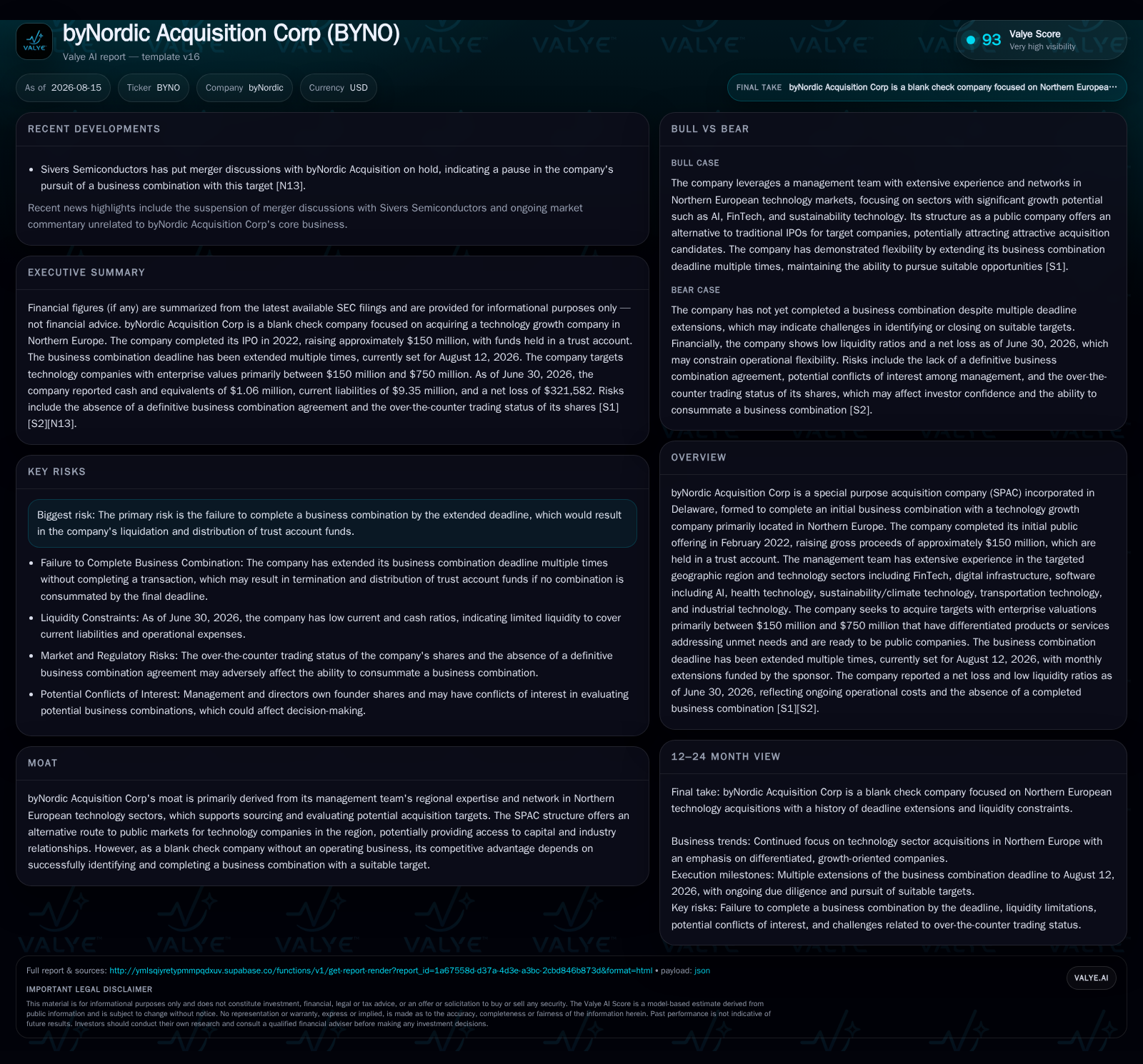
By mid-August 2026, byNordic Acquisition Corp faced a near-halving of its trust account following substantial shareholder redemptions at the August 6 meeting, reducing net available cash to approximately $2.9 million from $5.75 million pre-redemption [S3]. The sponsor funded an extension fee to prolong the business combination deadline by one month through September 12, 2026 [S3]. As a blank check company, byNordic’s ability to consummate a merger with a Northern European technology growth company depends heavily on closing a deal within this limited timeframe. High redemption rates have sharply reduced acquisition capital and increased reliance on additional financing sources, elevating execution risk under tight timing pressures [S2]. While the management team’s regional expertise supports target sourcing, shrinking liquidity and looming deadlines pose significant challenges.
Redemption Reduces Trust Account Significantly; Extension Buys Limited Time
At its August 6 annual meeting, byNordic Acquisition Corp saw substantial shareholder redemptions with 215,488 shares tendered for cash-out. This redemption removed about $2.84 million from the trust account’s gross balance of approximately $5.75 million prior to redemption, leaving just under $2.9 million available for pursuing an initial business combination [S3]. This sharp reduction constrains the capital available for acquisitions considerably compared with the original IPO proceeds.
To maintain its ability to close a transaction despite compressed liquidity and approaching deadline, byNordic’s sponsor funded an $8,850 extension fee on August 10 that extended the business combination deadline by one month—from August 12 to September 12, 2026 [S3]. This fee is calculated pro rata based on the reduced number of shares outstanding after redemptions (221,255 shares), which limits the total extension benefit unless further financing or extensions occur.
Focused Regional Strategy Anchored in Northern European Tech Growth
ByNordic was established as a blank check company targeting technology growth companies primarily located in Northern Europe — encompassing Nordic nations, Baltic states, UK/Ireland, Germany, France, and Benelux countries [S1]. Management brings deep sector knowledge across key verticals such as FinTech platforms addressing regulatory evolution (e.g., PSD2 compliance), AI-driven software applications, healthtech innovations digitizing patient care workflows, sustainability ventures aligned with climate initiatives, advanced transportation technologies including electrification trends, and industrial tech solutions.
This focused geographic and sector approach leverages management’s local networks and expertise to source proprietary targets capable of benefiting from public market capital access. The absence of operating revenues prior to combination emphasizes that value creation depends entirely on identifying suitable targets and executing transactions efficiently.
Capital Structure and Market Position Relative to Peer SPACs
ByNordic raised approximately $175.95 million gross in its IPO including full exercise of over-allotment options alongside private placements to sponsors at $10 per share [S1], positioning it in the mid-size range among SPACs targeting similar tech growth sectors in Northern Europe.
However, high redemption rates have eroded base trust funds substantially. Additionally, the presence of redeemable warrants exercisable at $11.50 per share introduces dilution risk that could compress post-de-SPAC equity value unless share price appreciation occurs post-merger. Sponsor shares are subject to lock-up provisions affecting alignment dynamics between early investors and public shareholders.
Peer SPACs with comparable regional focus typically sustain larger trust balances after redemptions and finalize business combinations within original timeframes or via minimal extensions without jeopardizing investor confidence—highlighting byNordic’s elevated execution risks given recent developments.
Time Pressure Intensifies Amid Uncertain Deal Progress
Regulatory constraints impose strict deadlines on SPACs’ combination periods—usually around 18 months—with only limited extensions permitted upon payment of fees into the trust account. ByNordic’s most recent extension fee was $8,850 paid on August 10, 2026, extending the deadline by one month to September 12, 2026 [S3]
This pattern underscores mounting urgency but also heightens risk that no qualifying target will be secured before expiration amid volatile market conditions and diminished liquidity. The company’s OTC Pink listing status restricts trading liquidity relative to Nasdaq-listed peers potentially dampening investor enthusiasm [S2],[S3]. Absence of any announced definitive business combination at this late stage raises concerns about timely deal closure.
Failure to consummate will trigger liquidation procedures returning remaining net assets held in trust pro rata after expenses—a scenario unfavorable for sponsors who typically lose founder shares’ value in liquidation cases [S2],[S3],[S1].
Market Demand Supports Northern European Tech Listings Despite Execution Risks
Despite challenges faced by some SPACs recently, demand persists among Northern European technology companies for alternative routes to public markets beyond traditional IPO channels.
Regional clusters produce innovative firms specializing in AI-enabled solutions and climate-positive technologies seeking growth capital aligned with EU sustainability mandates. Investor appetite favors exposure across verticals such as FinTech automation addressing regulatory complexity (PSD2), sustainable energy infrastructure adapting to carbon neutrality goals, and digital health platforms enhancing patient care—all captured within byNordic’s investment thesis leveraging management’s regional networks for proprietary deal flow generation [S1].
Such incremental financings can dilute existing shareholders unless accretive returns materialize swiftly post-combination [S1],[S3].
Geopolitical tensions affecting Europe broadly—including spillover effects from conflicts involving Russia-Ukraine—and macroeconomic uncertainties could adversely affect target valuations or post-merger scaling prospects [S1]. Market volatility can also depress share prices of speculative instruments like SPAC units trading below net asset value (NAV), further challenging investor sentiment.
Financial Profile Discussion: Trust Account Status & Extension Fee Burden
As of August 12 disclosures indicate net trust account funds stand near $2.9 million after paying out approximately $2.84 million for redemptions earlier that month [S3]. Operating expenses remain limited primarily to administrative costs such as legal fees given no operating revenues typical for blank check companies prior to completing combinations.
Best-effort estimates show total debt around $600,000 versus roughly $1.06 million cash equivalents as of mid-2023 [F1]. Current assets of $187,023 and current liabilities of $9,352,313 as of June 30, 2026, imply a constrained current ratio near 0.02, consistent with pre-combination operational status [F1].
Monthly extension fees paid cumulatively erode funds modestly but remain small relative to overall cash balances historically maintained within trust accounts designed to protect investor principal.
Outlook: Critical September Deadline & Monitoring Deal Signals
Attention now centers on the fixed September 12 deadline granted through recent board-approved extension enabled by shareholder vote on August 6—allowing one-month extensions funded by sponsors without further stockholder approval [S3],[S26],[S9].
Absence of any announced definitive agreements suggests heightened scrutiny is warranted regarding progress toward securing viable targets or closing external PIPE commitments essential given depleted trust resources.
Further redemptions ahead would exacerbate capital constraints increasing liquidation risk; conversely stable or declining redemption rates might restore some market confidence though skepticism persists due to OTC Pink trading status limiting liquidity.
Failure to close a qualifying initial business combination timely will force liquidation distributing remaining trust assets pro rata after expenses—effectively ending the blank check vehicle without transformative transaction success.
This analysis reflects information disclosed through August 14–15, 2026 ([S1]-[S28]) supplemented with companyfacts financial data ([F1]), focusing strictly on disclosed facts without forward-looking speculation.
Disclaimer: This is research-only, informational analysis and not investment advice. It may include AI-generated interpretation and general industry context. Always verify important details using primary sources.

Comments