
OS Therapies Advances OST-HER2 Amid Financial and Regulatory Milestones
OS Therapies reports significant Phase IIb clinical progress for OST-HER2 immunotherapy amid rising liquidity pressures from secured debt issuance.
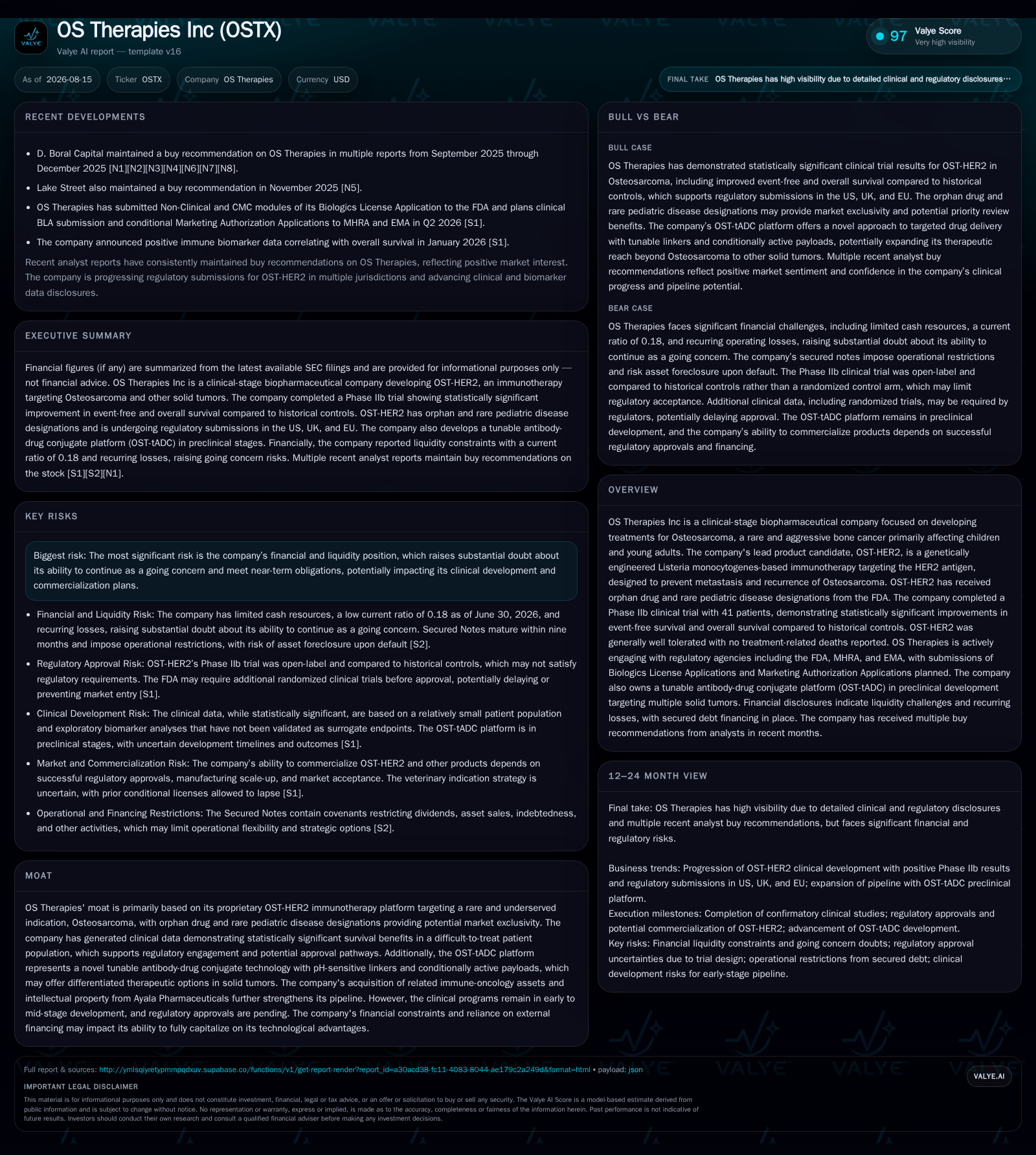
In its latest 10-Q filing, OS Therapies highlights positive outcomes from its Phase IIb trial of OST-HER2 in osteosarcoma, including statistically significant improvements in survival endpoints and favorable safety profiles, reinforcing its orphan drug designations and regulatory engagement trajectory. Concurrently, the company has issued $24 million in secured convertible notes bearing restrictive covenants, exacerbating liquidity constraints with a current ratio below 0.2 and raising substantial doubt about continued operations. OS Therapies' dual platform strategy combining OST-HER2 immunotherapy with the OST-tADC ADC technology aims to diversify pipeline risks but faces typical early-stage developmental challenges. Near-term catalysts include FDA Type B meetings on Biologics License Application (BLA) clinical modules and further biomarker data releases, set against the backdrop of financial risks that could impact clinical development timelines.
OST-HER2 Clinical Milestones Shape Regulatory Pathway Expectations
OS Therapies' latest quarterly filing confirms the completion and statistical success of its Phase IIb clinical trial involving 41 patients with recurrent osteosarcoma treated with OST-HER2 immunotherapy. The trial reported a two-year overall survival rate of 75% for treated patients compared to a historical control rate of approximately 40%, achieving strong statistical significance (p < 0.0001) [S1], [S2]. This sizable survival benefit in a notoriously aggressive pediatric bone cancer addresses a significant unmet medical need and underpins the company’s regulatory strategy. Importantly, OST-HER2 exhibited a favorable safety profile with no treatment-related deaths reported, supporting a tolerability profile suitable for eventual marketing approval discussions.
Complementing clinical efficacy is exploratory biomarker data showing activation in the interferon gamma immune pathway correlates with longer-term survival. Such biomarkers inform potential patient selection strategies and serve as possible surrogate endpoints in future regulatory submissions or post-marketing studies, though validation remains pending [S1]. These results have fueled ongoing engagement with key regulators including the U.S. Food and Drug Administration (FDA), Medicines and Healthcare products Regulatory Agency (MHRA), and European Medicines Agency (EMA). Notably, OS Therapies has filed non-clinical and Chemistry, Manufacturing & Controls (CMC) components of its Biologics License Application (BLA) for OST-HER2 and plans imminent submission of the clinical module following an anticipated FDA Type B meeting around mid-2026. Parallel conditional Marketing Authorization Application (MAA) filings are targeted for the MHRA and EMA [S1], [S2].
This robust clinical data package combined with orphan drug designation benefits creates a foundation for accelerated review pathways typical for rare pediatric oncology indications. However, given usual biopharma phased de-risking principles, ultimate regulatory approval still hinges on review outcomes and manufacturing scale-up validation.
Dual Platform Strategy Fortifies Pipeline but Execution Risk Persists
Beyond OST-HER2, OS Therapies leverages its OST-tADC platform—a proprietary antibody-drug conjugate technology featuring pH-sensitive linkers designed to deliver conditionally active payloads selectively within tumor microenvironments. This approach potentially extends therapeutic reach into broader solid tumor types beyond osteosarcoma and mitigates single-product dependency risk inherent to early-stage biopharma firms [S1].
The establishment of an ADC advisory board with members experienced in ADC regulatory requirements reflects strategic governance intended to navigate chemistry, manufacturing, and controls (CMC) complexities crucial for clinical progression and commercialization prospects. The innovative pH-sensitive linker chemistry posits differentiation against established ADC developers such as Seattle Genetics by enhancing tumor selectivity and potentially reducing systemic toxicity—though these advantages remain subject to clinical validation as OS Therapies advances this platform through early development stages [S1].
Pipeline diversification through a distinctly different modality like OST-tADC not only broadens future revenue opportunities but also aligns with evolving immuno-oncology trends emphasizing combination therapies.
Capital Structure Tensions Elevate Liquidity Concerns Amid Secured Note Issuance
While clinical progress is unequivocal, OS Therapies confronts significant financial headwinds as evidenced by its recent capital raise through senior secured convertible notes totaling $24 million as of June 30, 2026 [F1]. The first tranche was closed at $5.4 million in August 2026 with an optional second tranche up to $5 million available subject to investor discretion [S2], [S3]. These notes bear a high interest rate of approximately 9% per annum alongside an original issue discount of 7.5%, reflecting investor demand for risk-adjusted returns given the company’s uncertain cash flow outlook.
The note agreements impose substantial restrictive covenants severely limiting operational flexibility. Restrictions include prohibitions on dividend payments or stock repurchases without prior noteholder consent, caps on incurring additional indebtedness or variable rate transactions linked to stock prices, limitations on asset sales outside ordinary course business dealings, and mandatory application of value-added tax refunds toward note prepayment obligations [S3], [S15], [S16].
On balance sheet metrics as of June 30, current assets stood at approximately $3.64 million versus current liabilities exceeding $20 million, yielding an acute current ratio around 0.18—well below standard liquidity comfort thresholds in biotech sectors where cash runway is critical amid lengthy development timelines [F1]. Operating losses persist without revenue generation as is typical for clinical-stage biotech entities; this structural cash burn accentuates reliance on external financing.
The company's independent auditor flagged substantial doubt about continuing as a going concern given these factors which materially heightens execution risk across ongoing development programs if additional funding cannot be secured timely or on manageable terms [S2].
Competitive and Regulatory Landscape Centers on Rare Pediatric Oncology Dynamics
OS Therapies occupies a specialized niche within the broader immuno-oncology landscape focused on rare pediatric bone cancers—a segment characterized by limited approved therapies and correspondingly high unmet need. Peers developing novel immunotherapies targeting rare cancers include Adaptimmune Therapeutics and Immunocore; companies like Bluebird Bio offer reference benchmarks given their orphan drug designation portfolios facilitating regulatory incentives such as market exclusivity extensions.
The orphan drug designation for OST-HER2 confers potential protection against generic competition post-launch within key jurisdictions including the U.S., EU, and UK markets, while rare pediatric disease status may enable access to priority review vouchers adding commercial value upon approval routes unique to this demographic context.
Regulatory authorities increasingly recognize the challenges inherent in conducting large randomized trials for ultra-rare conditions such as osteosarcoma metastasis post-resection; hence accelerated pathways based on robust Phase II data supplemented by biomarker correlatives offer pragmatic routes to market access albeit subject to complex evidentiary scrutiny.
Key Growth Drivers Underpinned by Orphan Drug Incentives and Biomarker Advances
The company's growth trajectory depends heavily on successful navigation through regulatory milestones—including upcoming FDA Type B meetings planned for second quarter 2026 focusing on validating the clinical module BLA submission strategy—and continuing evidence generation around immune biomarkers predictive of response durability within patient subgroups [S1], [S2].
Strategic expansion plans include leveraging the OST-tADC platform into additional solid tumor indications expanding addressable markets beyond pediatric osteosarcoma cases.
Orphan drug designations across major markets provide pricing power enhancements backed by market exclusivity periods typically lasting seven years in the U.S., incentivizing investment into rare cancer therapeutics despite small patient populations. Complementary pricing incentives include eligibility for longer market protection periods available under rare pediatric disease programs.
Pipeline maturation supported by intellectual property acquisitions—such as those from Ayala Pharmaceuticals—potentially strengthens competitive moats around proprietary ADC technologies enhancing partnership attractiveness.
Risks Include Cash Burn, Dilution Potential, and Regulatory Hurdles Ahead
Notwithstanding promising science milestones, OS Therapies faces acute risks notably concentrated in its financial condition. The company's limited cash resources compounded by heavy indebtedness from secured note facilities create looming refinancing obligations that if unmet could precipitate defaults triggering asset foreclosures by noteholders [F1], [S3].
Dilution risk remains material due to approximately 46 million common shares outstanding plus convertible securities including Series A preferred stock convertible into common shares along with extensive warrants and options cumulatively exercisable into millions more shares potentially diluting equity value significantly upon conversion or exercise events [S2], [S7]. This share overhang introduces volatility concerns impacting capital raising activities.
Clinical-stage biopharmaceutical development inherently carries typical uncertainty related to trial enrollment rates continuity, manufacturing scale-up feasibility particularly for live bacterial vector-based immunotherapies like OST-HER2, timing unpredictability around regulatory approvals across different geographic agencies, adverse safety events that could emerge during larger pivotal trials or post-market surveillance phases.
'What to Watch': Near-Term FDA Meeting Outcomes and Financing Developments
Investors should monitor multiple catalysts over coming quarters: first is the outcome of the FDA Type B meeting expected around Q2 2026 which will shape subsequent BLA submission timing and content rigor potentially influencing approval likelihood timeline; second is release of expanded immune biomarker datasets clarifying Patient stratification strategies that might enhance label scope or reimbursement appeal; third relates to conversion or funding decisions around the optional second note tranche offering additional capital flexibility albeit contingent on prevailing market appetite amid financial pressures.
Regulatory dialogue outcomes will serve as primary valuation inflection points dictating advancement confidence across both core OST-HER2 asset as well as OST-tADC pipeline candidates.
Financial Profile Discussion: Capital Accessibility and Operating Cash Constraints
As of June 30, 2026 balance sheet data reveals OS Therapies holds roughly $3.6 million in current assets against $20.6 million current liabilities yielding a critically low current ratio (~0.18), indicative of near-term liquidity stress amplifying risk exposures typical in cash-intensive clinical-stage biotech firms without commercial revenues yet generated [F1]. Total debt stands at approximately $24 million comprised mainly of recently issued secured convertible notes that carry restrictive covenants locking operational flexibility including dividend suspensions and share repurchase prohibitions plus mandatory prepayment clauses tied to VAT refund inflows from UK subsidiaries thereby channeling all available excess cash flows toward debt amortization efforts rather than organic reinvestment or strategic initiatives [S3], [S15], [S16].
The substantial net operating losses accumulated—as reflected by nearly $29 million operating loss reported in year ending December 2025—underscore continued heavy R&D spending intrinsic to advancing novel immunotherapies through late-phase trials requiring consistent capital influxes under challenging macroeconomic financing conditions prevailing generally across early-stage biopharma ecosystems today [F1]
Management's capacity to secure additional financing under favorable terms remains indispensable not only for sustaining trial progress but also preventing covenant breaches that could provoke default scenarios adversely impacting corporate continuity prospects highlighted explicitly via independent audit skepticism about going concern assumptions evident within disclosures accompanying latest SEC filings [S2]
Disclaimer: This is research-only, informational analysis and not investment advice. It may include AI-generated interpretation and general industry context. Always verify important details using primary sources.

Comments