
Avalon GloboCare Confronts Liquidity and Commercialization Hurdles in Dual Health-Tech and AI Segments
Early-stage commercialization of Keto Air breathalyzer and nascent RPM AI platform face market, regulatory, and funding constraints.
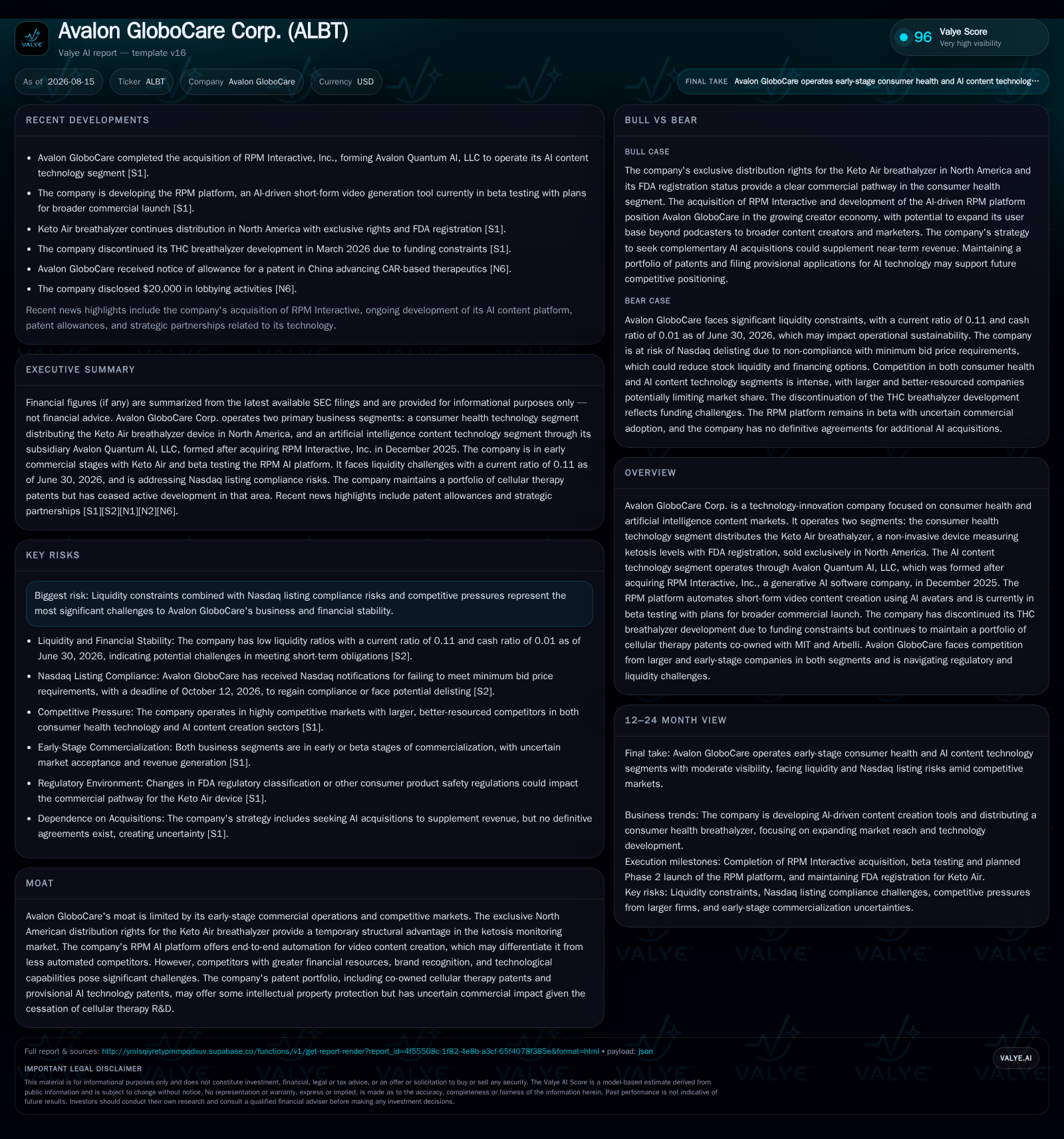
Avalon GloboCare operates two distinct but emerging business lines: an exclusive North American distributor of the FDA-registered Keto Air ketosis breathalyzer device and a newly acquired generative AI-driven short-form video content platform. The company’s early-stage commercial rollout has yet to generate meaningful revenue, with ongoing liquidity challenges exacerbated by Nasdaq listing compliance risks. Execution on scaling Keto Air sales via influencer channels and launching the AI content platform commercially will be critical milestones to demonstrate viable growth potential amid intensifying competition and limited capitalization.
Recent Operating Update
Avalon GloboCare’s latest quarterly filing dated August 14, 2026 reveals its continued struggle as an early-stage innovator balancing development and commercialization across two segments: consumer health technology and artificial intelligence content platforms [S2]. No revenue was reported for the period ending June 30, 2026, with operating losses persisting consistent with prior periods [F1][S2]. The absence of revenue underscores the segment nascence despite previous FDA registration achievements for the Keto Air device. Meanwhile, the acquisition-driven pivot into AI content generation continues cautiously with RPM Interactive’s generative AI platform still undergoing beta testing without clear timelines for significant market traction [S1][S2].
Triggering heightened attention are liquidity pressures reflected by extremely low cash balances ($39K) against current liabilities exceeding $4.5 million at quarter-end, resulting in a precarious current ratio of 0.11 [F1]. The firm secured a new business loan of $825K in July 2026 featuring weekly repayment installments commencing immediately — indicative of tight working capital conditions and reliance on debt restructuring to sustain operations through critical commercialization phases [S7][S8]. The Nasdaq compliance alert remains active due to sub-$1 share prices, extending the cure period until October 2026; failure to regain compliance risks delisting that would further constrict capital market access [S2][S9].
Business Model Overview
Avalon GloboCare's business model straddles two complementary but operationally distinct verticals within emerging technology-driven markets. The consumer health technology segment centers on exclusive distribution in North America (USA, Canada, Mexico) of the Keto Air breathalyzer — a non-invasive device designed for ketosis monitoring aligned with ketogenic diet trends [S1]. Distribution exclusivity provides structural leverage to capture a niche wellness audience favoring convenient metabolic tracking over alternative urine strips or costly laboratory tests.
Revenue realization is primarily through direct sales facilitated by social media influencers acting as brand evangelists combined with partnerships targeting commercial channels like law enforcement agencies—a dual approach tasked with driving product adoption and volume sales [S1]. The FDA registration lends regulatory credibility essential for consumer trust in health diagnostics devices though scale remains embryonic.
The company's artificial intelligence content technology segment is newer and more speculative. It evolved through the December 2025 acquisition of RPM Interactive, Inc., which specializes in generative AI-powered automation of short-form videos using avatars—a tool catering towards digital content creators seeking scalable production efficiencies as video dominates social engagement metrics [S1][S2]
RPM's value proposition lies in fully automated workflows encompassing topic generation through to final video editing without manual input—a differentiator versus partial automation competitors. Monetization prospects rest on subscription or usage-based licensing models targeting creators and enterprises along with potential partnerships with major social platforms [S1]. Yet commercial launch dates remain fluid as functionality proves out during beta testing.
Notably, Avalon previously pursued a THC breathalyzer development but ceased this line in early 2026 due to funding limitations, indicating tightened capital allocation prioritizing the Keto Air and AI initiatives considered more strategically viable at present [S1]. Concurrently, the company maintains a portfolio of cellular therapy patents co-owned with MIT and Arbelli; however, active research or product development in this domain appears paused pending more stable funding conditions
Industry Structure and Competitive Position
Avalon operates in inherently competitive sectors characterized by fast-paced innovation cycles dominated by better-capitalized peers. In consumer health devices, players like Fitbit or Withings have established brand recognition coupled with broader multi-metric devices that gather rich biometric data beyond ketosis—limiting Avalon’s ability to capture broad market share strictly on breathalyzer utility absent wider wellness ecosystem integration.
Conversely, the generative AI content sector features aggressive entrants such as Synthesia or Rephrase.ai who benefit from deeper R&D budgets and stronger distribution ties within creator economies. Avalon’s RPM platform attempts differentiation via end-to-end automation including voice synthesis and avatar realism but faces barriers posed by entrenched competitors continuously enhancing their offerings.
Additional structural challenges include dependency on key partnership agreements—for Keto Air’s exclusive North American distribution—and navigating regulatory complexities across health-device safety standards as well as evolving AI content governance frameworks concerning intellectual property rights and user data privacy rules.
Intellectual property constitutes a potential defensive moat, albeit currently limited given cessation of pharmaceutical-oriented R&D activities. Provisional AI technology patents might later underpin licensing revenues if RPM commercial success materializes; however, immediate impact remains speculative.
Growth Drivers
Key drivers supporting possible value realization center on surging consumer interest in health tracking technologies amid persistent ketogenic diet popularity. Keto Air offers a reusable, cartridge-free advantage attracting consumers deterred by traditional methods’ inconvenience or cost structure. Successful influencer campaigns coupled with expanding commercial channel penetration could validate scalability via volume sales metrics such as device units sold.
On the digital front, growth depends heavily on rapid onboarding within creator networks relying on short-form video trends driven by social media platforms like TikTok and Instagram Reels. Increasing sophistication in generative AI enables RPM to unlock substantial efficiencies for high-volume user bases—monthly recurring revenue (MRR) generation directly linking platform adoption rates to sustainable revenues.
Strategic acquisitions remain integral as Avalon openly seeks bolt-on targets that complement both segments potentially accelerating market entry or technological enhancements. Maintaining FDA registration compliance bolsters credibility lending some barrier against generic knockoffs for Keto Air while progressing beta testing towards broad commercial launch is vital for RPM’s transition from developmental expense to revenue contributor.
Risks and Constraints
Risks remain prominent given Avalon’s limited operating history transitioning through multiple pivots—from biotechnology roots towards hybrid consumer health tech and advanced generative AI offerings—complicating predictability around growth pathways.
Persistent net losses exceeding $17 million as recently reported raise substantial doubt about going concern without sustained financing infusion; concentrated near-term liquidity risks are amplified by current liabilities vastly surpassing liquid assets [F1][S1][S2]. Debt covenants attached to new secured loans curtail strategic flexibility.
Market acceptance uncertainties exist broadly: consumer hesitation adopting novel ketosis measurement devices versus incumbents or lifestyle skeptics may delay mass-market penetration. Similarly, the burgeoning yet crowded generative AI video content space is marked by rapidly changing platform standards potentially rendering new entrants obsolete swiftly without continual investment.
Regulatory compliance comprises another challenge—FDA scrutiny over device safety can hinder marketing efforts or necessitate costly adjustments while shifting regulatory regimes around AI-generated content expose RPM operations to legal uncertainties impacting client confidence.
Lastly, failure to maintain Nasdaq listing could severely limit future equity financing or shareholder liquidity further constraining operational runway just when accelerated commercialization demands capital.
What To Watch Next
Investors should closely monitor indicators including any reported metrics on device units sold through influencer channels for Keto Air alongside updates on progress toward full commercial deployment beyond beta testing for the RPM platform. Evidence of growing active user base size or initial MRR traction would mark important inflection points validating underlying business strategies.
Additional critical milestones involve balance sheet strengthening actions—such as equity raises under disclosed $10 million equity purchase agreements—and Nasdaq minimum bid price developments ahead of October 2026 deadlines defining public trading viability.
Legal filings describing expansions or contractions in patent portfolios may signal strategic shifts around intellectual property leverage while announcements regarding further bolt-on acquisitions would shed light on management’s ability to scale both segments synergistically.
Finally, any disclosures related to regulatory approvals or adverse findings concerning Keto Air or AI content conformances will be material influence factors impacting medium-term viability prospects.
Financial Profile Discussion
Avalon GloboCare’s financial position remains strained entering mid-2026. Cash reserves at roughly $39,000 provide minimal buffer against operational cash burn amid current liabilities tallying over $4.5 million; this ratio places substantial pressure on working capital adequacy measured by a distressingly low current ratio near 0.11 [F1]. Not captured explicitly is undrawn availability from recent equity purchase commitments which will be necessary to prevent default scenarios given imminent debt servicing scheduled following a loan secured in late July totaling $825,000 repayable via weekly installments starting almost immediately [S7][S8].
Recurring net losses continue to erode equity base evidenced by approximately $105 million accumulated deficit noted in prior filings; no sustainable revenue has emerged despite operating expenditures reflective of simultaneous development efforts across product lines [F1][S1]. The Company has maintained reporting compliance but sustained inability to produce positive cash flow heightens risk profile especially considering Nasdaq listing jeopardy that could preclude efficient capital market access leading into Q4 2026.
Effective capital management will require balancing incremental fundraising dilution against imperative funding needs while operational execution must accelerate commercialization outcomes sufficiently quickly to reduce reliance on external capital extending cash runway past key industry inflection junctures.
Disclaimer: This is research-only, informational analysis and not investment advice. It may include AI-generated interpretation and general industry context. Always verify important details using primary sources.

Comments