
Prairie Operating Co. Faces Nasdaq Compliance Challenge While Pursuing Capital-Efficient Growth in the DJ Basin
Prairie Operating Co. updates on latest quarter operating results, strategic asset position in the Denver-Julesburg Basin, and navigates listing compliance risks.
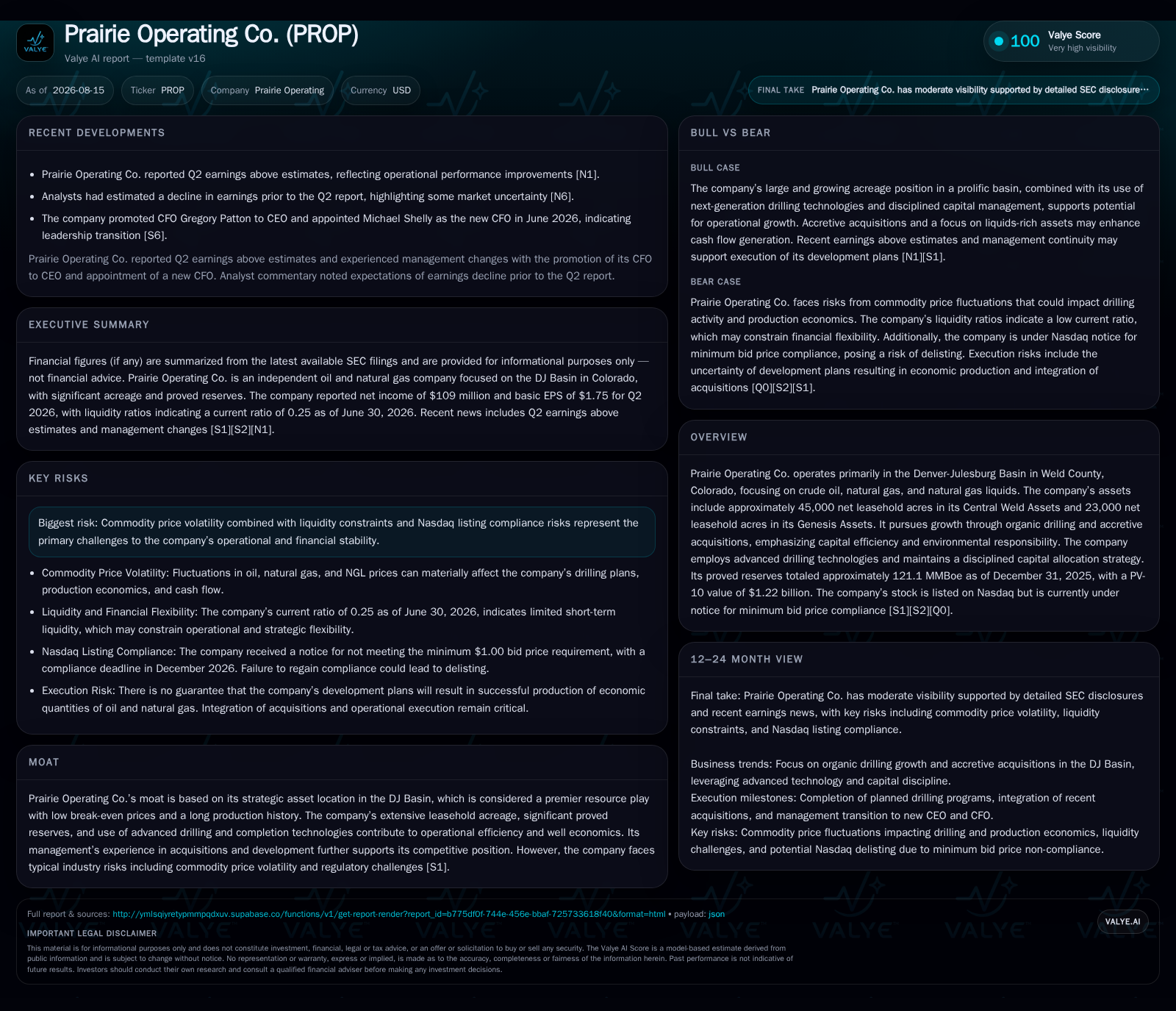
Prairie Operating Co. operates a significant crude oil, natural gas, and NGL portfolio concentrated in the DJ Basin with substantial leasehold acreage and proved reserves. The company's latest quarterly filings confirm steady operational execution alongside Nasdaq minimum bid price non-compliance risk that threatens its public listing status. Prairie prioritizes capital efficiency, organic drilling backed by free cash flow, and accretive acquisitions to drive growth amid volatile commodity prices and balance sheet constraints. Monitoring its progress on share price recovery, reserve development, and cost discipline will be critical for confirming sustainable operating improvement.
Recent Operating Update
In Prairie Operating Co.’s latest quarterly report filed on August 14, 2026 (Form 10-Q), the company details continued operational activity within its core Denver-Julesburg (DJ) Basin assets situated primarily in Weld County, Colorado [S2]. This scale represents a meaningful presence within a prolific U.S. resource play known for comparatively low break-even development costs. As of their most recent year-end (December 31, 2025), Prairie reported proved reserves totaling approximately 121.1 million barrel of oil equivalent (MMBoe), supported by a PV-10 estimate near $1.22 billion – a critical valuation benchmark representing discounted future revenues from proved reserves before tax [S1].
However, the primary near-term corporate challenge emerging from this filing is the ongoing risk related to Prairie’s Nasdaq listing compliance with respect to minimum bid price standards. On July 2, 2026, the company received official notification that its common stock had traded below the required $1.00 per share threshold for over thirty consecutive business days [S2]. Under Nasdaq Listing Rule 5550(a)(2), Prairie has until December 29, 2026 to restore their share price above this floor for ten consecutive trading days to avoid delisting proceedings. A potential second compliance period of an additional six months may be available if certain conditions are met but is not guaranteed [S2][S28]. Failure to meet these requirements would likely suppress liquidity further and could force Prairie into over-the-counter markets or other alternatives that reduce public investor access.
Business Model Specifics
Prairie’s upstream business model revolves around acquiring and developing crude oil, natural gas, and natural gas liquids (NGLs) assets predominantly situated in the DJ Basin—a region recognized for robust hydrocarbon productivity and long-established infrastructure networks conducive to cost-efficient operations [S1]. Revenue generation depends fundamentally on realized commodity prices multiplied by net production volumes sold primarily through third-party purchasers via negotiated arrangements linked to spot or index pricing references adjusted for quality differentials and transport distances [S1]. To mitigate raw price volatility inherent in energy markets, Prairie maintains hedging activities involving derivative contracts that provide economic protection on portions of anticipated output but introduce potential mark-to-market gains or losses depending on market swings [S1].
The firm has demonstrated a two-pronged growth strategy emphasizing organic drilling focused on horizontal well development complemented by disciplined acquisition targets characterized by producing reserves with substantial undeveloped acreage for bolt-on expansion [S1]. This approach aims at capital efficiency—measuring well-level economics relative to spending—and strives to finance drilling programs principally through internally generated free cash flow while controlling leverage levels prudently.
Operating tactics include deploying advanced drilling and completion technologies designed to optimize well productivity such as multi-stage hydraulic fracturing within horizontal lateral sections—techniques standard among industry peers like Concho Resources or Devon Energy yet tailored here for the specific geologic context of central Colorado formations [S1]. Operational KPIs relevant here would encompass reserve replacement ratios to maintain or grow proved reserve counts against production depletion as well as finding and development costs ($/boe) reflecting efficiency.
Nevertheless, revenue concentration risk is material: following an integration process of recent acquisitions completed in late 2025, two customers accounted for approximately 93% of total hydrocarbon revenue during the latter half of that year—an exposure that can amplify counterparty credit or volume risk should contract dynamics shift unfavorably [S1]
Industry Structure and Competitive Position
Operating exclusively within the upstream segment places Prairie amid a landscape populated by independent exploration & production companies competing both regionally within prolific basins like the DJ Basin and nationally against integrated majors with diversified portfolios. The company’s reliance on leasehold acreage control is paramount; owning nearly 68,000 net leasehold acres combined provides strategic control over drilling inventory essential for sustaining production momentum.
Compared against peers such as Pioneer Natural Resources or Devon Energy who may operate larger or more geographically dispersed portfolios, Prairie's concentrated asset footprint allows sharper operational focus but also concentrates exposure to basin-specific regulatory policies particularly environmental constraints increasingly applied at state levels in Colorado [S1]. Compared with integrated majors like ConocoPhillips or Occidental Petroleum that benefit from greater financial scale and pipeline integration capabilities but broader business complexity, Prairie benefits from nimble decision-making capacity though faces scale disadvantages.
The firm operates inside a capital-intensive sector where cost structures directly impact break-even prices essential for profitability amid fluctuating commodity prices. Costs tied closely to operating expenses per barrel ($/boe), capital expenditures required per new well developed ($/boe added), and corporate SG&A impact cash flow margins.
Horizontal drilling operations inherently carry higher complexity than vertical wells due to technical challenges associated with extended laterals requiring precise geosteering and sophisticated completion treatments; while these technologies produce superior EURs (Estimated Ultimate Recovery), they demand robust engineering expertise which Prairie aligns strategically through technology adoption efforts mentioned in its filings [S1].
Growth Drivers
Prairie’s growth trajectory hinges on several well-defined drivers underpinned by industry fundamentals:
- Commodity Prices: Improved realized pricing elevates cash flow available for reinvestment; although volatile globally, tightening supply-demand fundamentals can fuel sustained mid-cycle price levels benefiting Prairie directly.
- Capital Efficiency & Drilling Inventory: Maintaining a large inventory of high-quality permitted drill sites enables rapid response when commodity prices permit expanding activity without excessive lease acquisition costs.
- Reserve Replacement: Strategic acquisitions supplement organic reserve additions ensuring long-term sustainability underpinning production growth.
- Technology Deployment: Implementation of next-generation hydraulic fracturing techniques enhances per-well performance reducing unit costs.
- Environmental Compliance: Commitment to environmentally responsible operations supports regulatory approvals facilitating uninterrupted permitting cycles necessary for continuous capital deployment.
Each growth vector is measurable via KPIs such as drilling success rate (percentage of drilled wells producing commercially viable hydrocarbons), operating cost per boe, reserve replacement ratio exceeding one ideally to offset depletion fully, and capital expenditure efficiency indicated by $ spent per incremental boe added.
Risks / Watchpoints / Growth Constraints
Prairie confronts several critical risks warranting close observation:
- Nasdaq Listing Compliance: Failure to regain minimum bid price exposes shares to delisting consequences hampering investor confidence and equity capital access [S2][S28].
- Commodity Price Volatility: Prolonged downcycles impact revenues directly; hedging mitigates but does not eliminate price risk completely [S1].
- Liquidity Constraints: Current ratio near 0.25 reflects tight liquidity situation at quarter-end June 30, 2026; limited cash balances increase vulnerability if unexpected expenditures arise or financing access tightens amid market stress [F1].
- Customer Concentration: Reliance on few major buyers presents counterparty risk; disruptions would disproportionately affect sales volume stability [S1].
- Operational Risks: Horizontal drilling complexity can lead to dry holes or suboptimal completions; rig availability constraints also affect timing.
- Regulatory Environment: Evolving federal/state policies governing emissions and water use could impose incremental compliance costs or delay permitting.
- Reserve Estimation Accuracy: Any material revision downward could impair PV-10 valuations compromising credit facilities borrowing bases.
These considerations underscore importance of sustained focus on capital discipline alongside proactive stock price management strategies.
What To Watch Next
In coming quarters investors should track several leading indicators including:
- Progress on share price recovery above $1 threshold mandated by Nasdaq before December deadline;
- Quarterly disclosures detailing production volumes in boe/d reflecting operational ramp or declines;
- Updates on proved reserves quantity changes evidencing successful reserve replacement;
- Commentary around customer diversification efforts reducing concentration risk;
- Capital expenditure levels contextualized against free cash flow generation confirming self-funded growth potential;
- Hedging gains/losses volatility influencing reported income;
- Any announcements regarding regulatory developments impacting asset operations;
- Management commentary on new acquisition prospects or divestitures influencing portfolio composition.
Financial Profile Discussion
Prairie’s latest balance-sheet snapshot at June 30, 2026 shows current assets amounting to approximately $41.9 million against significantly higher current liabilities around $167.4 million resulting in a constrained current ratio near 0.25 indicative of liquidity pressure if short-term obligations escalate unexpectedly or revenue collection slows [F1]
Reported total debt stands near $11.25 million based on last full-year data ending December 31, 2024 with no explicit indication of marked change through mid-2026 filings though incremental draws under revolving credit facilities cannot be ruled out absent newer disclosures [F1]. Net debt approximates total debt less minimal cash yielding a similar leverage indicator.
In June 2026, Prairie amended its credit facility extending moratorium periods around distributable free cash flow covenants while increasing borrowing base redetermination frequency signifying lender vigilance as capital discipline intensifies under evolving commodity-price influenced cash flow variability [S18]. The appointment of new CFO Michael Shelly with significant investment banking experience suggests intent toward strengthened financial oversight possibly foreshadowing potential refinancings or equity raises if warranted by market conditions [S16][S19].
Overall financial health evidences sizable leverage relative to liquidity which constrains flexibility whereas maintaining prudent capex funding largely via free cash flow becomes an operational imperative moving forward.
This analysis synthesizes publicly disclosed regulatory filings up through August 14, 2026 including key quarterly results filings (10-Q), material event reports (8-K), annual disclosures (10-K), supplemented with contextually relevant news sources without offering investment advice.
Disclaimer: This is research-only, informational analysis and not investment advice. It may include AI-generated interpretation and general industry context. Always verify important details using primary sources.

Comments