Outdoor Specialty Products, Inc.: Founder-Led Innovation in a Crowded Fishing Tackle Market
A deep dive into ODRS’s journey as a niche fishing accessory innovator navigating scale and capital hurdles.
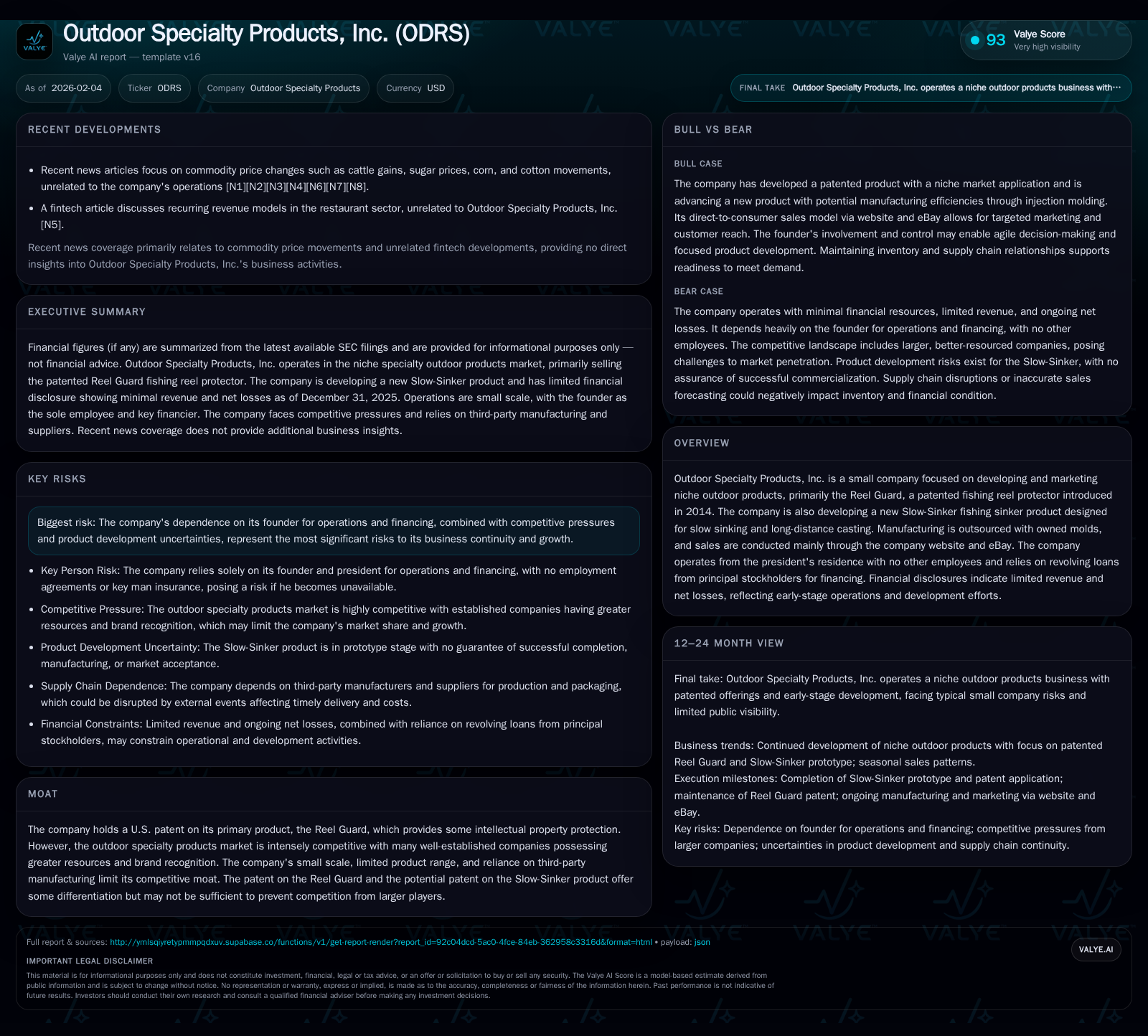
Outdoor Specialty Products, Inc. operates as a one-man enterprise driven by founder Kirk Blosch’s passion for fishing tackle innovations. Its patented Reel Guard product represents a unique solution within a crowded market, while the ambitious Slow-Sinker development underscores ongoing efforts to expand the product line. Operating from a home base with outsourced manufacturing, the company faces pronounced financial fragility highlighted by minimal revenue and dependence on shareholder loans. The competitive landscape features large well-resourced players, limiting ODRS’s moat despite patent protections and niche positioning.
Genesis and DNA: From Invention to Niche Market Player
Kirk Blosch’s story is quintessentially that of an entrepreneur driven by genuine passion rather than scale ambition. Originating the Reel Guard in 2014 to address a very specific frustration—damage to fishing reels—Blosch set in motion a path marked by careful invention and grassroots perseverance. Operating without employees beyond himself, Blosch embodies both inventor and sole operator roles. This founder-centric setup naturally shapes all aspects of Outdoor Specialty Products’ strategy: lean operations, focus on niche products tailored to specialized angling needs, and an innate wariness of overextending limited resources. Unlike broader outdoor goods companies chasing mainstream appeal or mass distribution channels, ODRS dwells squarely in the small pond of specialty tackle innovation.
The Reel Guard Legacy: Patent Strength and Product Positioning
The Reel Guard is more than a mere accessory; it represents a patented protective innovation addressing reel care with a uniquely thin rubberized shield affixed via custom adhesive strips. The U.S. patent (No. 9,872,485) conferred critical intellectual property rights upon issuance in early 2018, providing formal legal protection against direct replication. Designed especially for fly fishing reels up to 4.25 inches with primarily square or slightly rounded edges, the product targets enthusiasts predisposed toward equipment preservation.
However, while the patent imparts distinctiveness relative to generic reel covers or bumpers flooded in retail channels, its practical moat is mitigated by the product’s narrow application range and limited brand recognition outside its modest online sales sphere. The Reel Guard could feasibly be emulated by larger competitors investing in similar IP or alternative materials once its concept proves commercially viable at scale.
Slow-Sinker Ambitions: Innovation Amid Capital Constraints
Expanding beyond protection into fishing performance enhancement, ODRS’s Slow-Sinker project reveals an aspiration to break ground with novel injection-molded sinkers that combine slow sinking rates with long-distance casting capabilities. This product concept embraces material density engineering married to streamlined manufacturing through single-component injection molding—a potential boon for cost reduction and production agility.
Yet this initiative remains early-stage: designs are prototyped but not finalized; production awaits validation; market demand unproven. Importantly, ODRS explicitly intends no manufacturing start pending further funding—a stark marker of resource scarcity curtailing commercial rollout rhythms. Here lies both opportunity and existential risk—success could catalyze scaling while failure or delay would drain scarce capital without revenue uplift.
Behind the Curtain: Operating from Home with Outsourced Manufacturing
Operationally opaque compared to typical corporate entities, ODRS runs competitively on minimal infrastructure: directing activities from Blosch’s personal residence with zero direct employees points. Manufacturing partnerships for products like Reel Guard leverage third-party molders based on company-owned tooling, allowing flexibility but also exposing controls over quality consistency and volume scalability.
This skeletonized footprint achieves cost containment but severely limits bandwidth for marketing expansion or swift operational adjustments demanded by competitive outdoor gear markets. It further concentrates execution risk entirely on Blosch—as chairman of product development through fulfillment—and restricts institutional gravitas investors might expect from more staffed enterprises.
Financial Snapshot: Lean Revenues, Mounting Losses, and Fragile Cash Flow
The financial portrait is stark: $65 total revenue recorded for fiscal year ending December 31, 2025 juxtaposed against a net loss topping $20,000 paints a picture of nascent commercial traction mired in fixed overhead burden. Cash equivalents dwindled below $3,000 year-end—barely enough to cover incidentals—with current assets totaling just over $12,900 demonstrating minimal working capital buffer.
This fragile balance sheet manifests direct reliance on revolving shareholder loans injected predominantly from principal stockholders (i.e., founder affiliated), without which ongoing operations would falter immediately. Questions naturally arise about sustainability absent significant sales growth or successful capital raises—constraints that bind ODRS firmly within survival mode rather than growth mode.
Competitive Landscape: Patents vs. Industry Giants' Muscle
In the sprawling outdoor specialty products arena—dominated by large brands like Shimano or Rapala wielding vast R&D budgets—the small-scale patented products of ODRS tread precariously. While patents guard core design ideas potentially protecting the Reel Guard from copycat assaults briefly, barriers remain shallow once scaled production efficiencies favor bigger rivals.
Furthermore, entrenched brand loyalty among anglers and widespread distribution networks amplify incumbents’ reach versus ODRS’s relatively insular e-commerce model (primarily website and eBay). This uneven footing limits prospects for substantial market share capture absent either disruptive innovation breakthroughs or strategic partnerships.
Risks Rooted in Founder Dependence and Market Realities
Concentration risk looms large given ODRS's operational dependency on Kirk Blosch’s active stewardship combined with his financing role through cyclical debt injections. Any withdrawal of founder involvement or capital support could precipitate near-term liquidity crises.
Additionally, uncertainties around successfully commercializing Slow-Sinker technology present execution risk compounded by lack of diverse leadership or organizational depth—factors pivotal during pivot points or scaling attempts typically required in outdoor product markets known for fickle consumer trends.
Value Outlook: Balancing Potential Against Pragmatic Challenges
ODRS resides at an intersection of genuine IP-driven novelty tempered heavily by operational fragility manifested through negligible sales volume and funding scarcity. The patent portfolio suggests some room for differentiation; however, their narrow scope coupled with tiny footprint leaves growth potential contingent upon overcoming formidable resource disadvantages.
From an analytical lens focused on value investing parameters—not speculative hype—the company exemplifies a high-risk/high-conviction bet centered on founder vision actualization amid intense external pressures—a scenario requiring tempered expectations balanced by cautious optimism if foundational milestones succeed.
What Investors Should Watch Next: Triggers for Growth or Further Strain
Key near-term indicators include whether the Slow-Sinker product can advance beyond prototype testing toward finalized design coupled with commencement of manufacturing runs—a step fundamentally linked to availability of fresh funding lines.
Equally important will be any discernible uptick in sales velocity of Reel Guard through existing e-commerce channels signaling stronger consumer acceptance post-initial launch years later. Lastly, changes in founder involvement intensity or new capital infusion announcements will constitute critical signals outlining whether Outdoor Specialty Products can transition out of survival mode toward sustained commercial footing.
This report relies exclusively on publicly available SEC filings dated up to February 2026 [S1][S2] and company disclosures summarized as of early 2026 [F1], without incorporating material nonpublic information or speculative forecasts. It does not provide investment advice but aims to illuminate business fundamentals shaping Outdoor Specialty Products' current standing within its niche outdoor fishing tackle segment.
Disclaimer: This is research-only, informational analysis and not investment advice. It may include AI-generated interpretation and general industry context. Always verify important details using primary sources.

Comments