
Johnson & Johnson’s 2025 Review: Diversified Innovation Amid Patent and Legal Challenges
Johnson & Johnson continues to leverage its broad healthcare portfolio to drive growth despite pressures from biosimilars and litigation.
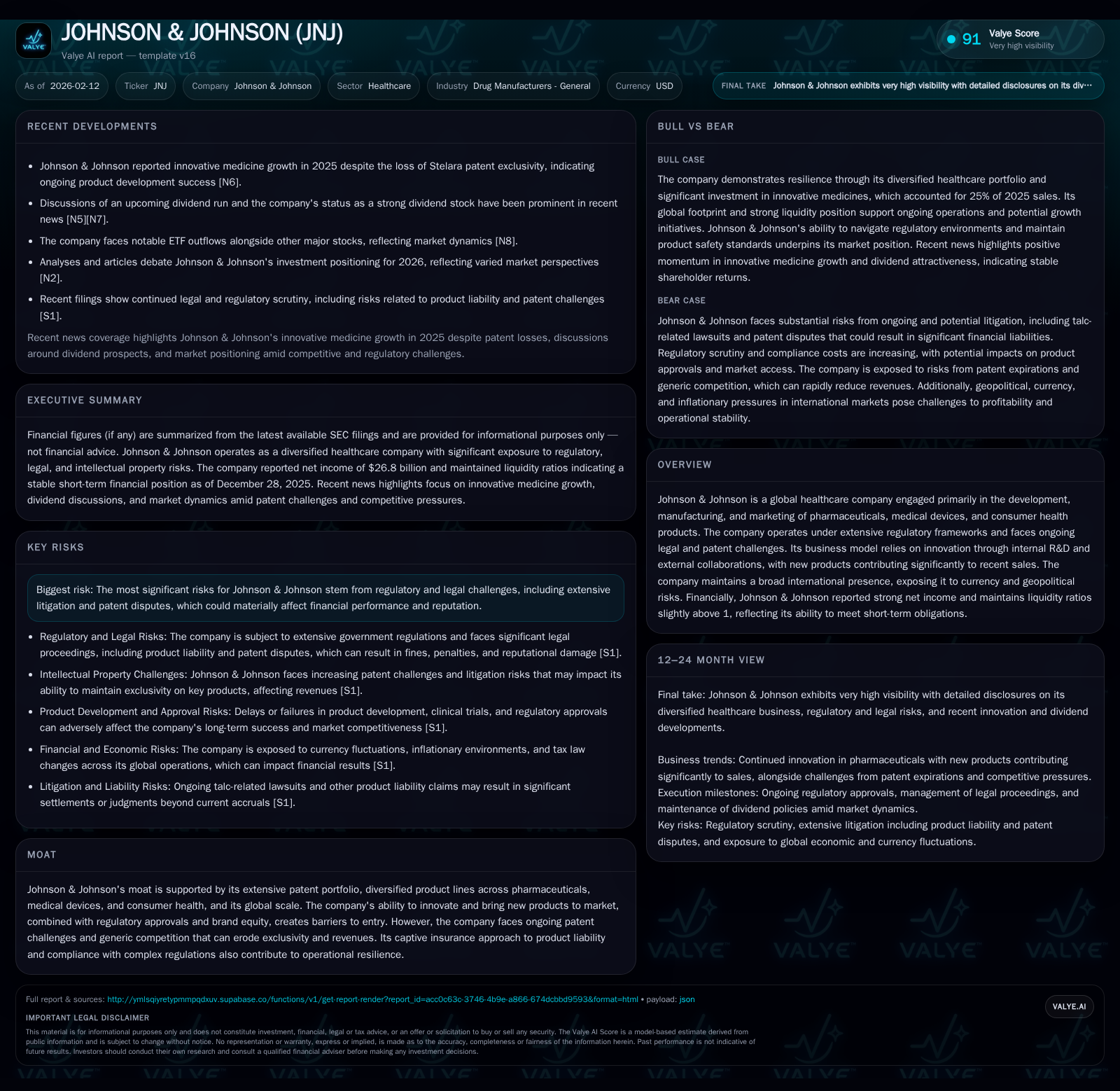
In fiscal 2025, Johnson & Johnson (JNJ) reported a 6% increase in worldwide sales to $94.2 billion, fueled by strong volume growth across pharmaceuticals, medical devices, and consumer products. The company faced significant headwinds from the loss of STELARA exclusivity and ongoing legal proceedings but offset these with robust oncology and neuroscience portfolio expansion, notably through recent acquisitions like CAPLYTA. JNJ’s global footprint contributes both to revenue diversification and complexity amid currency fluctuations and geopolitical risks. Its resilient financial profile is supported by strong net income and liquidity ratios slightly above 1. Its moat remains anchored in patent coverage, innovation capability, and global scale, although ongoing patent disputes and regulatory challenges continue to pose material risks.
Overview of Business Segments
Johnson & Johnson operates through three main segments: Pharmaceuticals (Innovative Medicines), Medical Devices, and Consumer Health Products. Innovative Medicines remain the largest revenue driver, generating $60.4 billion in sales during 2025—up 6% from the prior year primarily due to volume increases outpacing price declines [S1]. Within this segment, oncology therapies surged by over 22%, largely driven by DARZALEX's continued market share gains and capacity expansions for newer products such as CARVYKTI and TECVAYLI. Neuroscience also grew double digits, aided by the acquisition-fueled launch of CAPLYTA.
Revenue Trends and Dynamics
JNJ’s consolidated worldwide sales climbed 6% year-over-year to approximately $94.2 billion, reflecting steady execution despite notable pricing pressure (-3.1%) offsetting volume strength (+8.4%) [S1]. U.S.-based sales represented over half of total revenues at $53.8 billion, up nearly 7%. International markets contributed the balance ($40.4 billion), showing improved operational growth compared to the prior year’s decline [S1]. Currency effects were modestly positive overall (+0.7%), though regionally mixed with Europe benefitting more than Latin America or Asia-Pacific.
Patent Expirations and Biosimilar Impact
A principal challenge for JNJ during 2025 was the marked erosion in STELARA revenue precipitated by biosimilar competition following patent expiry [S1]. The decline in STELARA sales negatively affected both worldwide Innovative Medicines (operational drop ~10.4%) as well as U.S. (-12%) and international markets (-7.9%), making it one of the largest drug-specific headwinds faced by the company recently [S1]. This mirrors broader industry dynamics where blockbuster biologics increasingly face biosimilar incursions that compress margins and market share.
Growth Avenues Through Innovation & Acquisition
To offset patent cliffs such as STELARA’s, JNJ places heavy emphasis on innovation-driven growth via internal R&D investments complemented by strategic acquisitions like that of CAPLYTA in early 2025 [S1]. Earlier-stage oncology candidates including RYBREVANT/LAZCLUZE demonstrated meaningful uptake supporting expansion in targeted therapies with potential opening new franchise areas [S1]. This dual approach—organic growth augmented by external transactions—is central to sustaining competitive advantage in a highly regulated pharmaceutical industry.
Legal Environment: Ongoing Litigation Risks
JNJ remains embroiled in extensive legal proceedings encompassing multiple domains such as talc-related liabilities for baby powder products and patent infringement disputes [S1]. While the company believes it maintains substantial defenses, these matters entail potentially large financial exposure beyond current reserves due to prolonged litigation timelines involving thousands of claimants [S1]. Notably, JNJ eschews third-party product liability insurance opting instead for a captive insurance subsidiary which may limit financial risk transfer capacity but reflects confidence in risk management frameworks.
Geographic Markets & Currency Exposure
Geographically, Europe saw moderate (+6.5%) growth buoyed partly by currency gains (+4.1%), while regions like Latin America demonstrated operational gains offset by adverse currency movement (-5%) [S1]. The Asia-Pacific region experienced balanced modest growth (~3%), reflecting diverse economic conditions across countries served by JNJ’s global operations [S1]. Such wide international presence offers resilience against localized disruptions but introduces complexity related to foreign exchange volatility and geopolitics.
Financial Health: Liquidity & Profitability
The company closed fiscal 2025 with net income exceeding $26 billion alongside cash plus equivalents nearing $20 billion indicating ample liquid resources [F1][S1]. Current assets marginally exceeded current liabilities (current ratio ~1.03) signaling generally balanced short-term solvency though not without tightness [F1]. Operational cash flow generation remains strong providing flexibility for investment or shareholder returns.
Regulatory & Compliance Landscape
JNJ operates under intensifying regulatory scrutiny from agencies worldwide including the U.S FDA where changing approval processes may delay time-to-market for new products or introduce supply chain constraints [S1]. The company underscores its proactive governance structure around cybersecurity risks incorporating board oversight and executive-level dedicated roles ensuring compliance amidst evolving threats [S1]. Failure or delays in regulatory approvals pose material risk affecting future revenue pipelines.
Competitive Position & Moat Analysis
JNJ’s competitive moat stems largely from its robust patent estate protecting innovative drugs combined with diversified revenue streams spanning pharmaceuticals, devices, and consumer health brands [valye_report_excerpt]. Patent protection enables pricing power though increasing biosimilar challenges erode exclusivity periods forcing continuous innovation cycles internally or through alliances [S1]. Brand equity fostered over decades alongside scale advantages further contribute to barriers deterring new entrants.
Industry Context & Peer Comparison
Within the drug manufacturing space, companies like Pfizer face similar pressures from patent expirations necessitating fresh product introductions or acquisitions for sustained growth [N5]. Contrastingly JNJ benefits from relatively less exposure to a single blockbuster given diversified portfolio breadth though must navigate complex integration challenges arising from frequent M&A activity.
Conclusion
Johnson & Johnson remains emblematic of a mature healthcare conglomerate balancing growth ambitions against inherent sectoral risks related to intellectual property attrition and legal uncertainties. Its ability to deliver steady top-line improvements amid pricing pressures attests to effective product lifecycle management and commercial execution reinforced through accretive acquisitions like CAPLYTA. Nonetheless vigilance on litigation outcomes, regulatory adaptations, and competitive intensity will be critical as it seeks sustainable innovation-led momentum going forward.
This analysis is based solely on publicly available information as of February 2026 and does not constitute investment advice or recommendations.
Disclaimer: This is research-only, informational analysis and not investment advice. It may include AI-generated interpretation and general industry context. Always verify important details using primary sources.

Comments