
Anterix Inc.: Spectrum Monopoly Navigating FCC Hurdles to Power Utility Networks
ATEX leverages exclusive 900 MHz spectrum assets critical for private utility wireless networks while contending with regulatory bottlenecks.
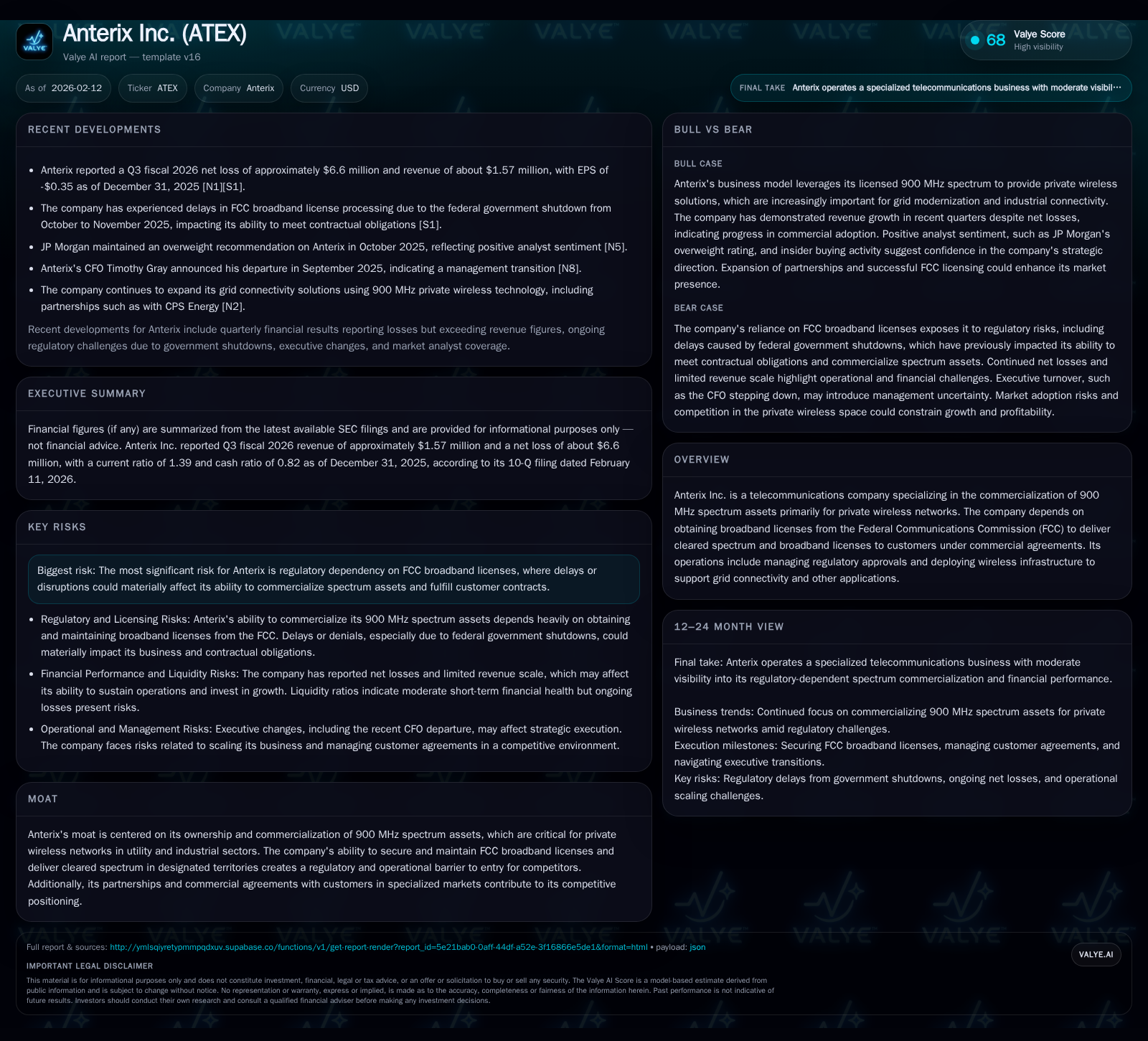
Anterix Inc. operates at the intersection of telecommunications and energy infrastructure by commercializing cleared 900 MHz spectrum licenses crucial for private wireless networks serving utilities. Its competitive edge rests on FCC-granted broadband licenses that unlock this spectrum’s value but expose the company to risks from regulatory delays and federal government shutdowns. Strategic partnerships, notably with utilities like CPS Energy, illustrate market validation amid growth-phase financials marked by operational losses as infrastructure scales. The near-term outlook hinges heavily on FCC licensing momentum and continued commercialization progress within a niche yet increasingly vital telecom ecosystem.
Wireless Spectrum: Anterix’s Strategic Asset and Moat
At the core of Anterix Inc.'s business lies a unique and valuable possession: the exclusive rights to commercialize the 900 MHz spectrum primarily for private wireless networks targeting utilities and industrial sectors. This spectrum band is scarce and highly coveted due to its propagation characteristics, which enable reliable, wide-area wireless communication essential for modern grid applications such as smart metering, outage management, and operational telemetry.
Ownership of cleared spectrum licenses granted through the Federal Communications Commission (FCC) provides Anterix with a structurally entrenched competitive advantage. Unlike typical telecommunications carriers battling in crowded bands prone to interference or public congestion, Anterix controls a niche that effectively acts as a private pipeline for critical utility communications. This exclusivity erects significant barriers to entry: competitors cannot replicate these assets without similarly difficult FCC authorizations or acquiring precious bandwidth elsewhere.
The Valye report underscores this intellectual property of spectrum as underpinning Anterix's strategic moat [F1]. Coupled with intricate regulatory navigation capabilities and commercial agreements tailored to utilities' unique needs, Anterix stands apart from generic wireless providers by offering tailored solutions that integrate spectrum ownership with end-customer deployments.
Financial Pulse: Growth Signals Amid Operational Losses
Examining Anterix's recent quarterly results reveals an operational narrative typical of mid-stage infrastructure plays scaling commercialization efforts. For Q3 ending December 2025, revenue reached $1.57 million, surpassing analyst expectations amidst expanding customer engagements [N1][F1]. However, this top-line progression coexists with a net loss tallying $6.6 million, reflecting ongoing costs tied to network buildouts, licensing expenses, and related overhead.
Liquidity metrics present a cautiously optimistic picture: cash and equivalents totaled approximately $29.5 million at quarter-end, against current liabilities around $36 million. This yields a current ratio near 1.39 – sufficient for short-term obligations but highlighting limited excess buffer should operational costs accelerate or revenue recognition delay [F1].
The negative income trajectory is not atypical for companies in capital-intensive sectors relying on long lead times between licensing approvals and full commercial rollout. It illustrates the financial toll exerted as Anterix tightens infrastructure integration while managing FCC regulatory processes.
FCC Licensing: The Regulatory Bottleneck Defining ATEX’s Fate
A defining characteristic of Anterix's business model is its heavy dependence on FCC broadband licenses that authorize use of cleared 900 MHz spectrum in designated territories. This regulatory dependency forms both an asset gatekeeper and an Achilles' heel.
Throughout Q4 2025 and into early 2026, federal government actions materially affected this dynamic. A protracted shutdown from October to November 2025 severely constrained FCC staffing levels and brought most licensing activities to a near halt [S2]. The backlog resulted in postponed issuance and renewal of broadband licenses critical for customer deployments.
Such interruptions ripple through Anterix’s contractual commitments; many agreements mandate timely delivery of licensed spectrum access integral to customer project timelines. The resultant delays introduce covenant risks and potential revenue impacts while complicating capital deployment strategies.
Management candidly acknowledges these factors as principal risk variables: future government shutdowns or regulatory slowdowns could disrupt licensing cadence again, impairing both operational execution and financial performance [S2]. Thus, agency responsiveness is effectively a gating factor in Anterix’s commercialization trajectory.
Utility-Driven Innovation: Partnerships Powering Grid Connectivity
Notwithstanding regulatory headwinds, real-world progress emerges through strategic customer collaborations bolstering technology validation and commercial expansion.
Notably, Anterix’s partnership with CPS Energy stands as a tangible proof point [N4]. Through this collaboration, CPS Energy leverages Anterix’s licensed 900 MHz private wireless network to enhance grid connectivity—improving reliability, enabling advanced monitoring capabilities, and facilitating efficient outage response mechanisms.
This alliance moves beyond theoretical spectrum ownership to active utility network modernization—a critical inflection marking transition from pilot initiatives toward scalable deployments. It reflects growing acceptance among utilities that dedicated broadband private networks provide operational advantages over public cellular alternatives by guaranteeing coverage consistency and latency performance in complex terrain.
Such partnerships not only provide immediate revenue streams but also fortify Anterix's positioning as an indispensable network infrastructure partner within utility ecosystems transitioning toward digital transformation.
Risk Radar: Navigating Government Shutdowns and Licensing Delays
Delays stemming from federal disruptions underscore material risks embedded in Anterix’s operating environment.
The October-November 2025 government shutdown exemplified how external macro-political factors can unexpectedly hobble critical licensing workflows at the FCC [S2]. Reduced staffing precipitated prolonged adjudication timelines for license applications—causing cascading scheduling challenges across multiple customer projects dependent on those authorizations.
As ATEX relies extensively on timely access to broadband licenses for compliance with contractual service levels, recurrence of similar shutdowns or regulatory slowdowns represents a persistent threat vector capable of undermining revenue recognition cycles and inflating working capital needs.
Investor vigilance must therefore incorporate sensitivity to macro-government stability metrics and FAA administrative bottlenecks as variables intrinsically linked to Anterix's operational continuity [S2].
Market Sentiment and Option Activity: What Are Investors Saying?
Market participants have recently demonstrated heightened interest in Anterix evidenced by surges in option trading volume alongside pronounced share price appreciation.
In early February 2026, option volume expanded notably concurrent with a +10.3% jump in share price [N3][N5]. Such activity may reflect speculative positioning anticipating positive developments related to FCC license issuance progress or announcements concerning further utility partnerships.
While heightened option activity signals market optimism about near-term catalysts potentially unlocking valuation inflection points, it simultaneously suggests underlying volatility driven by uncertainty surrounding regulatory timing—a reminder that investor enthusiasm coexists with caution regarding external dependencies.
Future Outlook: Prospects in a Niche Yet Critical Telecom Space
Looking ahead, Anterix occupies a highly specialized telecom vertical essential for next-generation grid modernization initiatives increasingly prioritized amid decarbonization goals.
Its control over cleared 900 MHz spectrum positions it uniquely to serve utility customers seeking robust private wireless infrastructures tailored for mission-critical applications inaccessible over congested shared bands. Financial metrics indicate an organization still investing through losses into platform buildout but gaining traction via key partnerships signaling commercial viability [N1][N4][F1].
Nevertheless, the company’s prospects hinge substantially on successful navigation of FCC licensing processes free from renewed government shutdown disruptions [S2]. The interplay between accelerating demand from utilities embracing private LTE/5G networks and maintaining steady regulatory support will dictate whether ATEX can transition from niche speculator status into sustained growth executing its commercialization blueprint.
In sum, Anterix presents a compelling case study blending telecommunication asset control with utility sector evolution—offering transformative potential tempered by clear external constraints requiring vigilant monitoring going forward.
This analysis is provided solely for informational purposes based on available data as of the date cited and does not constitute investment advice or recommendations.
Disclaimer: This is research-only, informational analysis and not investment advice. It may include AI-generated interpretation and general industry context. Always verify important details using primary sources.

Comments