
First Industrial Realty Trust: Navigating Industrial Real Estate Amid Structural Demand Shifts
An in-depth look at First Industrial Realty Trust’s position in the industrial REIT sector, highlighting its financial resilience and strategic opportunities.
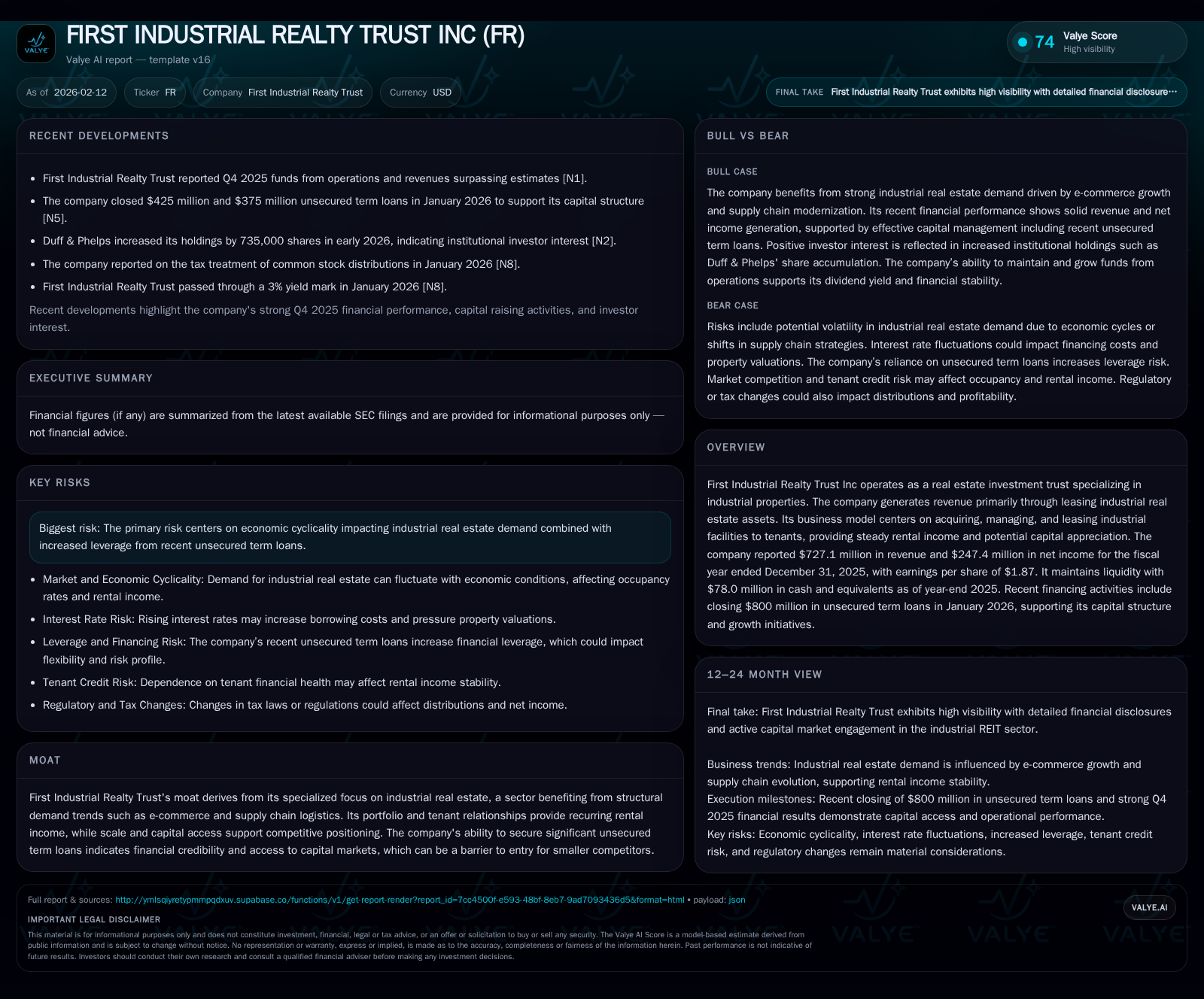
First Industrial Realty Trust Inc (FR) is a specialized industrial real estate investment trust that leverages strong market trends such as e-commerce growth and supply chain demands. The company reported robust fiscal year 2025 results with $727.1 million in revenue and $247.4 million net income, reflecting steady leasing activity and portfolio management. Its recent $800 million unsecured term loans demonstrate solid capital access supporting expansion, although cyclical economic risks and increased leverage warrant monitoring. With a focused portfolio and scalable business model, First Industrial maintains competitive moats amidst evolving industrial real estate dynamics.
Company Overview
First Industrial Realty Trust, Inc. (Ticker: FR) operates as a real estate investment trust (REIT) with a specialized focus on industrial properties across the United States. The business model centers on acquiring, developing, managing, and leasing industrial facilities designed primarily to serve warehousing, distribution, and light manufacturing sectors.
For the fiscal year ending December 31, 2025, First Industrial reported revenues of approximately $727.1 million alongside net income of $247.4 million and earnings per share (EPS) of $1.87 [F1]. The company maintains liquidity with $78.0 million in cash and equivalents as of the end of 2025 [F1]. These financial results underscore the firm's operational effectiveness amid a competitive and evolving industrial real estate market.
Strategic Moat and Market Positioning
First Industrial's competitive moat largely originates from its exclusive focus on industrial real estate—a subsector experiencing structural tailwinds driven by shifts in logistics stemming from e-commerce proliferation and supply chain transformation trends. This positioning enables the company to capitalize on sustained demand for modern distribution centers and last-mile delivery facilities.
In addition to macro demand drivers, First Industrial's scale allows it to offer diverse property types across key logistics hubs, providing tenant diversification that helps generate stable recurring rental income [S1]. The firm's track record of acquiring high-quality assets alongside efficient capital deployment enhances long-term portfolio value.
Capital Structure and Recent Financing Activity
A noteworthy development is the company's closing of $800 million in unsecured term loans during January 2026—split between two tranches of $425 million and $375 million respectively [N6]. Accessing such significant unsecured debt instruments reflects the market's confidence in First Industrial's credit profile and supports ongoing investment programs that may include acquisitions, redevelopment projects, or refinancing existing obligations.
While this leverage expansion supports growth initiatives, it also elevates exposure to interest rate fluctuations and macroeconomic downturn risks that could impact tenant demand or rental income trajectories.
Industry Context: Evolving Demand Drivers
The industrial real estate sector has gained prominence due to several converging factors:
- Rapid growth of e-commerce increasing demand for fulfillment centers near major population centers.
- Supply chain reconfiguration post-pandemic driving diversification of warehouse networks.
- Rising automation necessitating updated facility designs capable of supporting robotics and advanced logistics technologies [Analysis].
REITs like First Industrial benefit when they maintain geographic breadth across key transport corridors and adapt facilities to evolving tenant requirements.
Performance Highlights
Recent quarterly disclosures indicate First Industrial has continued outperforming consensus revenue and funds from operations (FFO) estimates [N3]. This outperformance suggests resilient asset utilization rates and effective lease management amidst broader macroeconomic uncertainties affecting commercial real estate sectors.
Additionally, institutional interest is notable—Duff & Phelps' purchase of approximately 735,000 shares signals confidence from investment professionals in First Industrial's strategy [N4].
Risks & Considerations
Despite robust fundamentals, potential headwinds merit attention:
- Economic cyclicality presents downside risk if demand for industrial space weakens due to recessionary pressures or declines in trade volume.
- Elevated leverage following recent unsecured loan issuances may increase financial risk if interest rates rise or operational cash flows weaken unexpectedly.
- Competitive pressures intensify as peers seek prime logistics assets amid constrained new supply environments.
Careful liquidity management will be crucial should economic conditions tighten.
Comparative Industry Dynamics
Industrial REITs collectively are poised for growth given recovery signals in leasing activity after pandemic-related disruptions [N8]. However, success factors vary by quality of asset base, tenant mix sophistication, and capital access capabilities. Firms like First Industrial that combine these elements effectively are better positioned to capture market share relative to smaller or less diversified players.
The broader REIT landscape also sees players like Alexandria Real Estate Equities focusing on life sciences or Vornado expanding retail footprints [N1,N2]—highlighting varied specialization approaches within commercial real estate.
Outlook & Strategic Priorities
Going forward, First Industrial's priorities likely encompass maintaining high occupancy levels through proactive tenant engagement while selectively pursuing accretive acquisitions or development opportunities supported by its enhanced capital structure. Continuously upgrading property specifications to meet modern logistic demands—such as increased clear heights or electric vehicle charging infrastructure—may further strengthen tenant retention.
Moreover, prudent leverage calibration aligned with stable cash flow generation will be essential to preserve financial flexibility.
This analysis reflects data available as of early 2026 including latest SEC filings and recent news reports. It provides an integrative view without explicit investment recommendations. Readers should consider prevailing macroeconomic conditions and consult professional advisors before forming conclusions regarding securities ownership or exposure.
Disclaimer: This is research-only, informational analysis and not investment advice. It may include AI-generated interpretation and general industry context. Always verify important details using primary sources.

Comments