
OFS Capital Corp’s Growth and Capital Management Under Rising Credit Market Pressure
OFS Capital Corp primarily invests in U.S. middle-market credit, balancing income generation with leveraging debt facilities amid credit risk challenges.
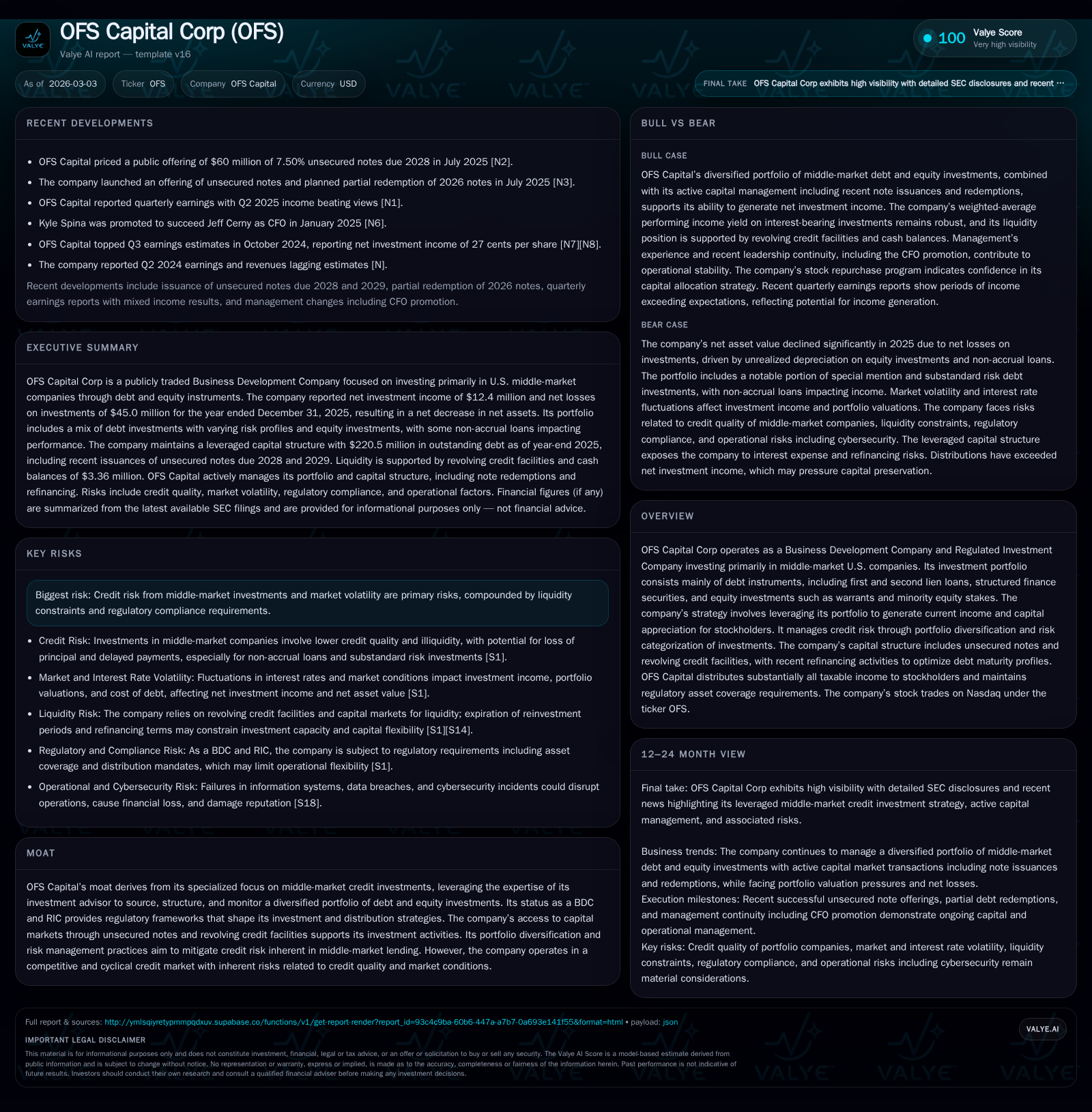
OFS Capital Corp focuses on generating current income and capital appreciation through a diversified debt-weighted portfolio primarily targeting middle-market companies. The company’s recent years show volatility in net income due to realized and unrealized losses offset by stable operating cash flows. Refinanced debt facilities and new unsecured notes provide liquidity runway while regulatory limits on leverage and persistent credit risks constrain future growth potential. Monitoring asset coverage ratios, investment income yields, and market liquidity remain key to assessing OFS’s prospects.
Company Overview and Strategy
OFS Capital Corp operates as a Business Development Company (BDC) and Regulated Investment Company (RIC), focusing primarily on providing debt financing to U.S. middle-market companies. Its diversified investment portfolio is predominantly made up of first and second lien loans, structured finance securities, warrants, and minority equity interests. The company seeks to generate both current income through interest payments and long-term capital appreciation via selective investments structured with downside protection features such as secured lending or subordinated debt positions [S1],[S4].
A core part of OFS's operational strategy lies in its disciplined approach to credit risk management, which includes portfolio diversification across industries and active monitoring and categorization of investments by credit risk tiers ranging from average to substandard [S1]. Its capital structure relies extensively on unsecured notes and revolving credit lines that are regularly refinanced or extended to maintain liquidity and manage funding costs [S5],[S6]. Maintaining compliance with regulatory minimum asset coverage ratios (150%) under the Investment Company Act limits leverage but aims to protect shareholder interests [S16].
Historical Financial Performance
The past four years highlight considerable volatility in OFS Capital's profitability and net asset value attributable primarily to the performance swings within its investment portfolio:
Historical performance (annual)
| FY | Net ($mm) | CFO ($mm) | Net YoY |
|---|---|---|---|
| 2025 | -33 | 44 | -216.4% |
| 2024 | 28 | 33 | +6216.6% |
| 2023 | 0 | 82 | +93.9% |
| 2022 | -8 | 3 |
Source: SEC companyfacts cache [F1].
Capital returns and efficiency (annual)
| FY | Div ($mm) | Buybacks ($) | ROE% |
|---|---|---|---|
| 2025 | 16 | -26.9 | |
| 2024 | 18 | 16.5 | |
| 2023 | 18 | 0 | -0.3 |
| 2022 | 15 | 231000 | -4.2 |
Source: SEC companyfacts cache [F1].
Net asset value per share declined sharply by approximately 28% year-over-year from $12.85 at the close of 2024 to $9.19 at the end of 2025 [F1][S1], reflecting marked unrealized depreciation on portfolio securities combined with realized losses during the year.
Despite negative net income in 2023 and a larger loss in 2025 (-$33 million vs prior positive year), OFS has maintained positive operating cash flows due mainly to non-cash losses impacting profitability differently than cash flows generated by interest collections and repayments on portfolio loans.
Dividend payments approximated distribution of nearly all taxable income but decreased slightly in line with profits: from about $18 million in 2024 down to roughly $16 million in 2025, reflecting caution amid the challenging market environment [F1][S20].
Portfolio Composition and Credit Risk
OFS’s portfolio remains weighted towards "average" risk category loans accounting for over 70% of fair value as of December 31, 2025, with 'special mention' loans comprising roughly 25%. Substandard loans amounted to about 4% [S1]. Non-accrual loans totaled approximately $36.6 million on an amortized cost basis at year-end — a slight decrease from previous levels — signaling ongoing but moderated credit stress among borrowers [S1].
An important dimension is that many loans are secured senior or unitranche positions, which provide priority claims on collateral in default scenarios but do not completely eliminate principal exposure or volatility due to market conditions affecting borrower performance [S14]. This inherent middle-market lending risk is exacerbated by cyclical economic factors that influence default rates and recovery prospects.
Capital Structure and Liquidity Profile
At December 31, 2025, OFS had total debt outstanding of approximately $220.5 million split among revolving credit facilities ($4.5 million balance on Banc of California Credit Facility), a BNP facility fully repaid in February 2026 upon new Natixis financing closure, and unsecured notes aggregating roughly $165 million [F1][S4]-[S9]. The weighted average interest rate on outstanding debt stood near 7.1%, up from prior years reflecting refinancings under rising rate conditions.
Notably, the company amended its primary Banc of California Credit Facility to extend maturity from February 2026 through February 2028 with updated financial covenants including minimum net investment income tests post-incentive fees [S5]. Transition from BNP Facility to Natixis Facility also reflects efforts to optimize liquidity with longer maturities (Natixis matures in early 2031) and pricing tied to SOFR plus applicable spreads [S8],[S13].
The company remains subject to asset coverage ratio constraints set at minimum thresholds dictated by regulatory changes reducing required minimums from historically stricter limits (from 200% coverage down to 150%) facilitating greater leverage but increasing sensitivity around NAV declines affecting borrowing capacity [S16],[S24].
Cash reserves stood comparatively low at around $3.4 million at year-end while distributions are financed through operating cash flow generated by portfolio yields or proceeds from portfolio realizations — illustrating tight liquidity dynamics typical for BDCs emphasizing current income generation [F1][S7],[S9].
Capital Allocation: Distributions and Share Repurchases
OFS prioritizes distributing substantially all taxable ordinary income consistent with RIC tax-status obligations under Subchapter M which allows avoidance of entity-level taxes if compliance is maintained [S15]. Dividend levels have tracked closely with net investment income though scaling back distributions slightly during periods of losses highlights prudent payout management.
The firm maintains an active Stock Repurchase Program authorizing up to $10 million in buybacks extended through May 2026; however, no repurchases occurred during the first nine months of fiscal year 2025 given cautious capital deployment needs amid portfolio pressures [N2][S20].
Given limited excess cash availability after distributions plus active refinance needs, buybacks appear secondary relative to sustaining liquidity for new investments or debt service.
Future Growth Prospects and Constraints
Growth drivers for OFS hinge importantly on several axes:
- Expanding its middle-market loan portfolio selectively as new opportunities arise,
- Prudent use of leverage within regulatory constraints,
- Successful capital raises at or near NAV enabling reinvestment,
- Favorable credit cycle conditions enhancing recoveries and reducing provisions,
- Effective management fee structures encouraging alignment without excessive drag.
Conversely, growth is capped by:
- Regulatory limits imposing ceiling on leverage,
- Potential inability to raise additional equity or senior securities amidst NAV volatility,
- Elevated non-accruals restraining new lending capacity,
- Competitive BDC landscape compressing spreads,
- Rising benchmark interest rates increasing debt servicing costs potentially squeezing net investment income margins [S24],[S28].
Monitoring guidance around NAV trends, loan loss provisions, interest yield spreads versus funding costs, along with covenant compliance will be critical metrics for investors following OFS going forward.
Expectations and What To Watch For (Analysis)
Though explicit forward guidance was not disclosed beyond quarterly earnings releases declaring regular dividends (e.g., Q1-2026 distribution declared at $0.17 per share payable March-end) [S3], key milestones include:
- Material improvement or stabilization in NAV per share,
- Reduced non-accrual loan balances signaling improved portfolio health,
- Successful refinancing or extension of existing facilities without adverse covenant impacts,
- Capital raise announcements that could enable meaningful portfolio growth,
- Distribution sustainability aligned with net investment income generated under prevailing market conditions.
Without continued improvement in credit markets or strategic capital actions, OFS may face pressure on its dividend policies or forced deleveraging through asset sales [S15],[S16],[S20].
Returns and Capital Efficiency Metrics
Reported ROE based on last available figures is negative approximately -26.9% for fiscal year ended Dec 31, 2025 derived from net loss against shareholders' equity values reflecting elevated impairment expenses along with unrealized losses impacting book returns substantially more than operating cash flow measurements [F1]. Despite this, positive cash flows demonstrate underlying collection strength even if valuation mark-to-market fluctuations have depressed reported earnings.
Distributions reflect roughly consistent payout behavior though reduced somewhat in absolute terms relative to peak years while buyback activity remains muted — consistent with conserving liquidity amidst uncertain credit environments [F1][S20].
Sector Perspective (Analysis)
The BDC sector specializing in middle-market credit faces a dual challenge: balancing yield generation against cyclically sensitive credit losses while managing stringent leverage restrictions under evolving regulatory regimes such as Rule 18f-4 governing derivatives use further complicating hedging strategies against interest rate volatility. Furthermore, growth strategies increasingly involve access to public equity markets albeit constrained during drawdown phases when investor appetite for credit risk narrows sharply. OFS Capital’s approach typifies prudence focused on diversified senior-secured loan exposures alongside cautiously managed leverage profiles—a hallmark strategy aiming for downside protection though vulnerable during broad economic downturns.
Conclusion: Navigating Credit Cycle Pressures With Prudent Capital Management
OFS Capital Corp manifests many attributes characteristic of resilient middle-market focused BDCs: conservative underwriting standards balanced with leveraged capital structures optimized through refinancing initiatives extending maturities into late decade horizons. Nonetheless, shrinking NAV per share coupled with sizeable non-accrual loans underscore ongoing cyclical headwinds faced especially within more stressed sectors since COVID-related disruptions. Careful attention toward maintaining regulatory compliance benchmarks for leverage together with measured distributions will remain paramount as external economic uncertainties persist. Investors should track quarterly updates surrounding portfolio health metrics alongside any strategic financing or equity issuance activity representing pivotal levers influencing future trajectory.
This analysis relies solely on data sourced from recent SEC filings up until March 3, 2026 ([F1]-[S29]). It reflects historical facts combined with cautious interpretation where explicit guidance was unavailable without making speculative forecasts or investment recommendations.
Disclaimer: This is research-only, informational analysis and not investment advice. It may include AI-generated interpretation and general industry context. Always verify important details using primary sources.

Comments