
OMNIQ Corp. Drives Growth with AI Vision Solutions While Managing Liquidity Risks
OMNIQ’s latest quarterly update highlights steady operational progress leveraging its proprietary AI-based machine vision platform amid balance sheet pressures and ongoing litigation.
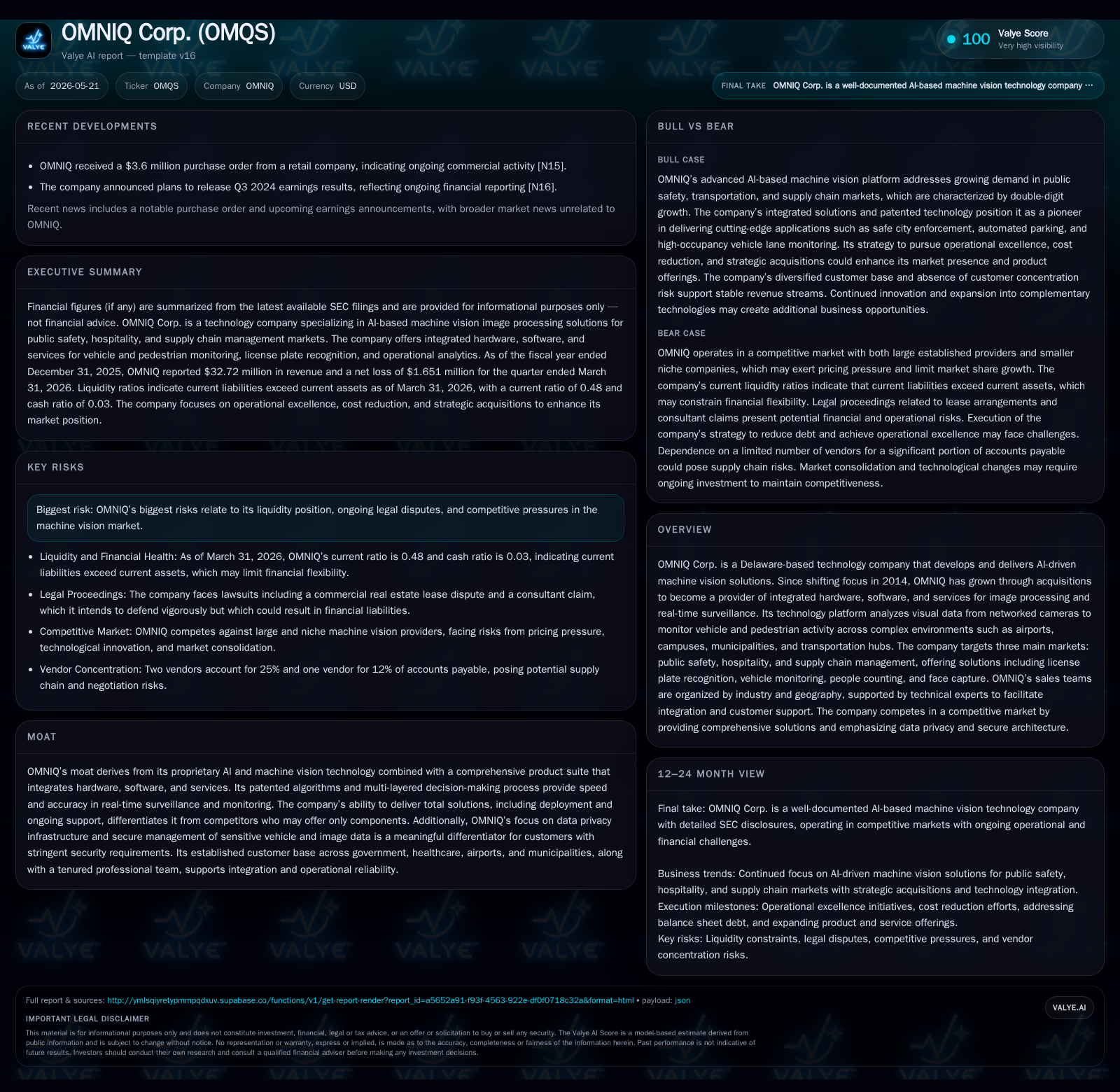
OMNIQ Corp. reported in its May 2026 10-Q that while strategic focus on revenue growth and cost control continues, liquidity challenges persist due to a current ratio well below 1.0 and substantial liabilities. The company’s AI-driven machine vision solutions maintain relevance across public safety, hospitality, and supply chain markets with integrated hardware-software-service offerings uniquely positioned against competitors. Growth opportunities center on expanding Safe City and ticketless parking markets alongside potential acquisitions to broaden technological scope. Key risks stem from elevated leverage and active legal disputes requiring vigilant management attention. Upcoming quarters will reveal the success of operational improvements and legal risk mitigation efforts.
Latest Quarterly Update Highlights
OMNIQ Corp.’s most recent quarterly filing dated May 20, 2026 (Form 10-Q) conveys a steady operational stance emphasizing cost controls and revenue growth initiatives while grappling with financial headwinds [S2]. The filing notably contains no new risk factor disclosures, signaling management’s view that existing risks remain unchanged. Complementing this, an 8-K filing on the same day confirms Shai Lustgarten remains CEO while also serving as interim CFO and Chairman of the Board, consolidating top executive responsibility during a period demanding tight financial stewardship [S3].
Liquidity remains a salient issue: current assets totaled approximately $13.4 million against current liabilities of about $28 million as of March 31, 2026—resulting in a current ratio near 0.48—highlighting short-term funding strain [F1]. Despite these balance sheet pressures, management is progressing on its plan to streamline operations and pursue revenue growth through enhanced product offerings.
This Q1 update serves as the critical lens through which OMNIQ’s business model contemporaneity can be assessed amid its strategic ambitions to bolster market presence.
Business Model and Product Offering
OMNIQ operates an integrated technology platform that combines proprietary artificial intelligence-driven machine vision software with dedicated hardware components and managed services to deliver real-time visual data processing solutions [S1]. Customers pay primarily for turnkey systems that encompass image capture via networked cameras, AI analysis for event detection (such as license plate recognition or pedestrian movement), plus installation support and ongoing maintenance.
The company targets three principal verticals: Public Safety (including homeland security applications), Hospitality (notably parking management), and Supply Chain Management. Each vertical relies on accurate automated surveillance technologies facilitating safer movement of people and assets within large-scale environments like airports, campuses, municipalities, hospitals, warehouses, and border crossings [S1][S22]
A key differentiator lies in OMNIQ's patented cognitive science-inspired algorithms characterized by multi-layered decision-making enabling swift yet precise pattern recognition under operational stress conditions such as anti-terror measures or traffic monitoring [S28]. The company complements this with a full suite of configurable software packages blending internally developed modules with third-party elements to best fit customer needs.
Their sales teams organize efforts by geographic territory and industry specialization supported by seasoned systems engineers who ensure smooth integration—a factor critical for customer retention given the technical complexity involved.
Competitive Positioning and Industry Dynamics
The industry landscape is fragmented with numerous players offering niche products focusing on one slice of machine vision technology—whether camera hardware providers or specialized software vendors. OMNIQ sets itself apart by bundling complete end-to-end solutions comprising hardware installation, AI-enabled analytics platforms, communications infrastructure, plus post-deployment support making switching costs higher for clients opting for alternative fragmented offerings [S22].
Additionally, OMNIQ emphasizes robust data privacy infrastructures essential to customers subject to strict regulatory environments requiring secure handling of sensitive imagery such as facial recognition or license plate data [S22]. This privacy-first posture differentiates the company in public safety applications where data governance is paramount.
Market consolidation is an ongoing trend influencing OMNIQ’s strategy. By acquiring complementary firms active in data collection technologies or mobile system integrations since 2014—including Bar Code Specialties Inc., HTS Image Processing Inc., EyepaxIT Consulting LLC., and Dangot Computers Ltd.—OMNIQ has steadily expanded its product breadth to better compete against larger integrators all while navigating competitive pressures inherent in AI-driven surveillance markets [S1]
Analysis suggests that OMNIQ operates at a scale sufficient to secure significant government contracts but faces persistent competitive pressure requiring continuous innovation investment.
Growth Catalysts and Expansion Opportunities
Key growth drivers for OMNIQ stem from multiple vectors:
- Product Suite Synergies: Post-acquisition integration enables cross-selling broader integrated machine vision solutions across established customer bases enhancing wallet share per client. Leveraging combined intellectual property accelerates tailoring new offerings responsive to dynamic client needs [S1].
- Expansion in High-Growth Verticals: Both the Global Safe City market and Ticketless Safe Parking segments are cited as billion-dollar opportunities experiencing double-digit CAGR propelling demand for OMNIQ’s specialized AI surveillance products [S1][S22].
- Technological Leadership: The company's commitment to embedding patented AI algorithms into logistics visibility software supports automation efficiency gains attractive to supply chain clients seeking margin improvements through modernized surveillance replacements [S1].
- Strategic Acquisitions: Ongoing market consolidation affords opportunities for buying niche technologies that supplement OMNIQ’s platform capabilities in mobile systems integrations or enhanced data collection tools aimed at deepening competitive moat [S1].
Tracking KPIs such as acceleration in customer pipeline bookings tied to multi-product deployments or ramped-ups in managed service contracts would be insightful milestones signaling materialization of these drivers.
Risks: Financial, Legal, and Competitive Challenges
Despite valuable technology assets, OMNIQ faces several notable headwinds:
- Financial Strain: The balance sheet shows significant liquidity pressure with a current ratio around 0.48 as of Q1 2026 highlighting mismatch between short-term liabilities (
$28M) versus available current assets ($13.4M) compounded by cash reserves under $800K—concerning indicators if operating cash flows do not improve markedly soon [F1]. Total debt data tracked historically approximates net debt over $16 million indicating elevated leverage risk demanding close operational cash management [F1]. - Legal Proceedings: The company remains engaged in multiple legal disputes including a $5.6 million commercial real estate lawsuit filed in Israeli courts connected with Dangot Computers Ltd., among others. Mediation efforts are underway but uncertainty remains regarding final exposure levels. Additional lawsuits involve claims from former employees over unpaid commissions totaling several hundred thousand dollars; these matters carry potential adverse financial impacts though management asserts intent to vigorously defend positions [S26][S29].
- Competitive Pressures: Machine vision is an evolving arena with rapid innovation cycles demanding continued R&D investment lest incumbents lose share to emerging disruptors offering improved accuracy or lower cost solutions. Maintaining technological leadership is pivotal amid peers specializing narrowly versus OMNIQ's broader integrated offering [S22].
Management rhetoric focuses on operational excellence initiatives designed to mitigate these risks; nonetheless execution remains critical.
Milestones and What to Watch Next
Upcoming markers warrant scrutiny including:
- Subsequent quarterly results reporting revenue trajectory shifts evidencing successful sales execution or contract renewals tied to integrated AI solution deployments [S2][S3].
- Announcements around completion or progress of ongoing legal mediations or settlements offering clarity around contingent liabilities impacting cash flow stability.
- Updates regarding further strategic acquisitions expanding product portfolio breadth aligning with stated consolidation strategy potentially unlocking synergy gains.
- Evidence of sustained cost reductions post-integration reflecting improving operating margins demonstrating progress against debt servicing challenges.
These indicators will collectively shape medium-term visibility into OMNIQ's capacity to convert technology advantages into scalable profitable growth while navigating persistent structural risks.
Financial Overview: Liquidity and Leverage Snapshot
As reflected by the latest financial snapshot ending March 31, 2026,[F1] OMNIQ holds approximately $787K in cash equivalents paired with current assets totaling about $13.4 million against disproportionate current liabilities near $28 million pointing toward meaningful short-term funding pressure (current ratio ~0.48). Historical total debt traces back at approximately $17.5 million translating into estimated net debt exceeding $16 million.[F1] This capital structure backdrop necessitates rigorous liquidity management especially considering ongoing litigation-related contingencies.[F1][S26]
The balance sheet constraints underscore why senior management has doubled roles integrating CEO duties with interim CFO responsibilities aimed at strengthening fiscal discipline.[S3] Meanwhile operational plans prioritize revenue growth from proprietary AI innovations coupled with aggressive cost containment following successive acquisitions.[S1]
Overall financial profile characterizes a company at an inflection point balancing promising market opportunities of AI-enabled machine vision solutions against immediate financial refinement imperatives.
This analysis synthesizes publicly available SEC filings including the latest quarterly report (10-Q) dated May 20, 2026,[S2] related current reports (8-K),[S3] and comprehensive annual disclosure (10-K) from April 15, 2026,[S1] supplemented by Companyfacts balance-sheet snapshots as of March 31, 2026.[F1] It refrains from investment research views focusing strictly on operational, competitive, risk-management insights relevant for stakeholders monitoring OMNIQ Corp.'s trajectory within the evolving machine vision industry landscape.
Disclaimer: This is research-only, informational analysis and not investment advice. It may include AI-generated interpretation and general industry context. Always verify important details using primary sources.

Comments