
Passage Bio Advances Gene Therapy Platform Amid Financial and Clinical Milestones
Passage Bio’s financial trends intertwine with its clinical and strategic efforts, reflecting a biotech in transition from persistent losses toward potential therapeutic breakthroughs.
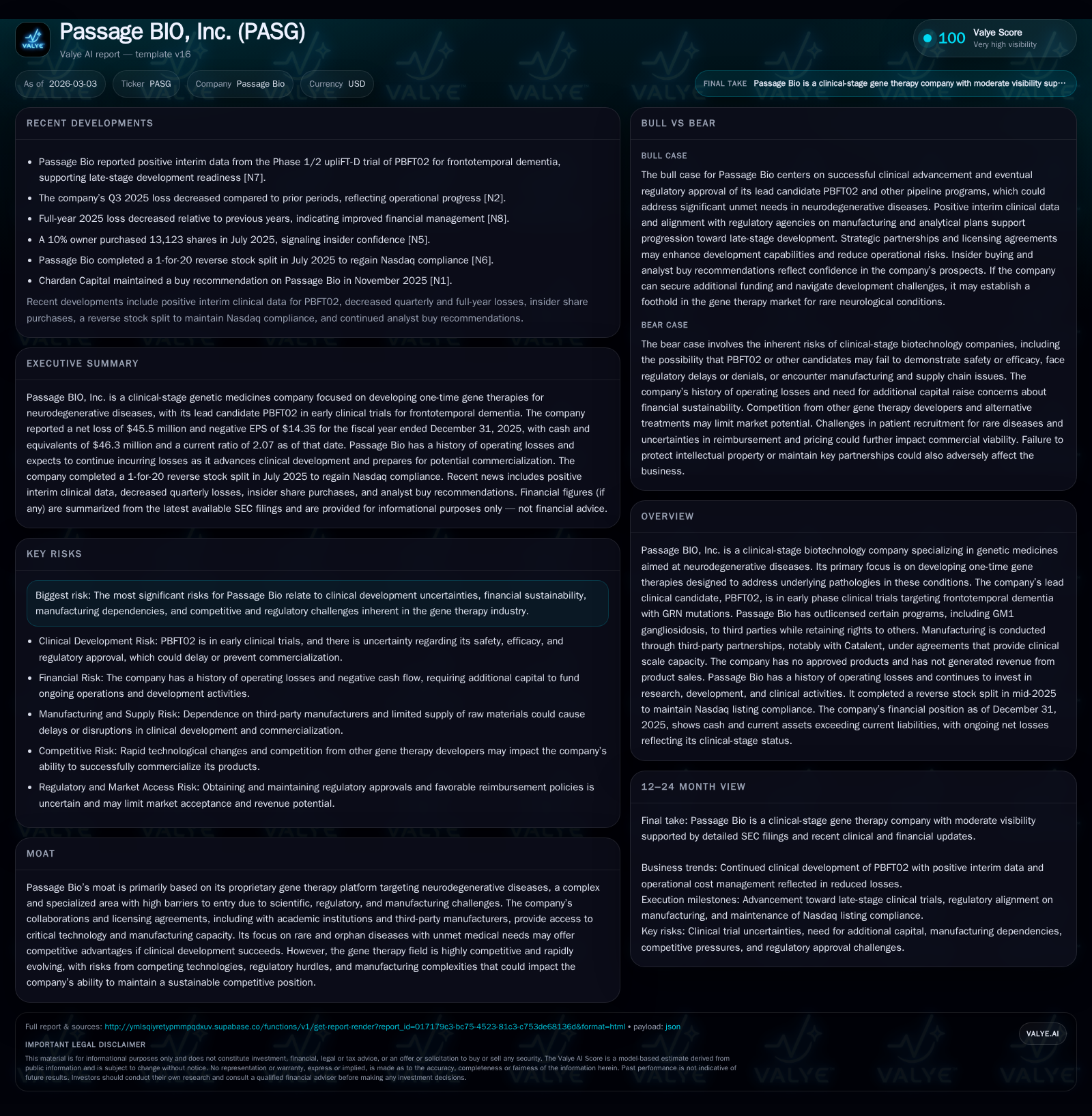
Passage Bio, a clinical-stage gene therapy company targeting neurodegenerative diseases, has steadily narrowed operating losses from 2022 through 2025 while maintaining robust R&D investments. Its lead candidate PBFT02, aimed at frontotemporal dementia with GRN mutations, remains in early clinical trials, marking a critical developmental focus. The company relies heavily on third-party manufacturing partnerships such as Catalent to address complex vector production. Despite financial headwinds, including negative cash flows and low equity levels, Passage Bio retains a current ratio above 2.0, supporting near-term liquidity. Key risks persist around clinical development uncertainty, regulatory hurdles unique to gene therapies, and patient enrollment challenges given the orphan indication status.
Historic Financial Performance: Narrowing Losses during Heavy R&D Investments
Passage Bio’s financial trajectory over the recent four fiscal years reveals a steady reduction in operating losses aligned with its clinical-stage burn rate dynamics typical of biotechs focused on genetic medicines development. Operating income improved from a negative $138.4 million in FY 2022 to approximately negative $49.3 million in FY 2025—a near 30% year-over-year improvement from FY 2024 to FY 2025 [F1]. Net income followed a similar pattern improving from -$136.1 million in FY 2022 to -$45.5 million in FY 2025.
Operating cash flows mirror this trend with outflows contracting by over one-third between FY 2024 (-$47.95 million) and FY 2025 (-$31.5 million), consistent with scaled but ongoing research and clinical investments [F1]. These figures underscore the extensive capital intensity during pre-commercial stages in gene therapy, where costs predominantly stem from R&D activities without offsetting product revenues.
Historical performance (annual)
| FY | Net ($mm) | CFO ($mm) | OpInc ($mm) | Net YoY |
|---|---|---|---|---|
| 2025 | -46 | -32 | -49 | +29.7% |
| 2024 | -65 | -48 | -70 | +36.5% |
| 2023 | -102 | -78 | -108 | +25.0% |
| 2022 | -136 | -118 | -138 |
Source: SEC companyfacts cache [F1].
Capital returns and efficiency (annual)
| FY | ROE% |
|---|---|
| 2025 | -242.7 |
| 2024 | -105.7 |
| 2023 | -91.7 |
| 2022 | -67.6 |
Source: SEC companyfacts cache [F1].
Data sourced from Passage Bio 10-K filings [F1]
This pattern indicates Passage Bio's concerted effort to narrow its loss profile while investing aggressively in its pipeline development.
Clinical Pipeline Focus: PBFT02’s Advancement Targeting Frontotemporal Dementia
At the core of Passage Bio's scientific portfolio lies PBFT02, its lead gene therapy candidate currently undergoing early phase clinical trials aimed at frontotemporal dementia (FTD) caused by GRN mutations [S1][S3]. This represents a rare neurodegenerative orphan indication characterized by progressive neuronal loss and limited existing treatment options.
Development challenges for PBFT02 include patient recruitment hurdles due to the low prevalence of GRN mutation variants within the wider FTD population—this imparts risks of enrollment delays common among orphan drug trials [S2]. Moreover, gene therapies entail intrinsic scientific complexity including vector delivery efficiency and long-term safety monitoring requiring incremental trial phases.
Given the paucity of approved treatments targeting root causes of neurodegeneration, successful advancement of PBFT02 could serve as a key value inflection point for Passage Bio pending validation in Phase 1/2 readouts or eventual progression toward pivotal studies [N0][S3]. However, early-phase assets carry elevated developmental risk including possible clinical hold scenarios imposed by regulators—a consideration made explicit within company risk disclosures [S4][S6].
Manufacturing Strategy: Third-Party Partnerships Steering Clinical Supply
Manufacturing gene therapy vectors requires highly specialized processes involving viral vector production under stringent quality control standards; Passage Bio’s approach centers on leveraging third-party contract manufacturing organizations (CMOs), notably Catalent, for clinical scale manufacturing capacity [N0].
This reliance on external manufacturers aligns with industry sector norms given prohibitive costs of establishing in-house capabilities for AAV vector output.
Partnership agreements secure necessary supply continuity critical for multi-phase trial execution but introduce dependency risks around vendor performance and scalability—a known bottleneck area within gene therapy development where raw material shortages or process deviations can cause costly delays or batch failures.
Capital Structure and Liquidity: Assessing Cash Runway and Equity Trends
As of December 31, 2025, Passage Bio held approximately $46.3 million in cash and equivalents balanced against $23.1 million in current liabilities yielding a current ratio around 2.07—indicating adequate near-term liquidity positioning relative to obligations [F1][S13][S17].
Nonetheless, shareholders' equity contracted substantially over this horizon—from $201 million at end-2022 down to about $18.8 million at end-2025—reflecting cumulative net losses and capital market transactions influencing balance sheet dynamics [F1].
The reverse stock split event mentioned suggests efforts to consolidate share structure possibly aimed at maintaining listing standards or improving trading metrics though further details were not explicitly disclosed .
Capital raising history remains salient considering continual operating deficits necessitating external funding to sustain R&D investment pipelines while navigating commercialization timelines.
Addressing Clinical Development Risks: Regulatory and Market Challenges in Gene Therapy
Passage Bio’s risk disclosures emphasize multiple industry-specific challenges emphasizing:
- The uncertainty embedded within novel clinical paradigms where proof-of-concept endpoints bear interpretative complexity;
- The possibility of FDA or global regulators imposing clinical holds based on safety data review;
- Product liability exposure heightened by first-in-class therapeutic modalities coupled with limited initial insurance coverage;
- Vulnerabilities related to intellectual property rights amidst crowded innovation sectors;
- Patient enrollment obstacles particularly acute for rare orphan populations potentially elongating timelines;
- Healthcare reimbursement environments undergoing dynamic policy shifts influencing pricing strategies post-launch preparation [S2][S4][S5][S6].
Such layered risks are endemic to genetic medicines firms transitioning from research to late-stage development.
Future Prospects: Growth Catalysts and Key Milestones to Watch
Explicit forward-looking guidance remains absent from public filings; however analytical focus centers on monitoring:
- Progress updates regarding PBFT02’s Phase progression,
- Any Orphan Drug Designation or Fast Track approvals which may accelerate regulatory pathways,
- Data readouts validating efficacy/safety profiles,
- Manufacturing scale-up achievements enhancing trial throughput capability,
- Strategic licensing or partnership expansions that might de-risk balance sheet exposure while broadening therapeutic scope [N0][S3].
Value creation remains tightly coupled to tangible pipeline milestones amidst high fixed cost structures characteristic of gene therapy biotechs.
Capital Allocation Dynamics: Investments, Dilution, and Return Metrics
With no revenue generation yet due to an absence of approved products, Passage Bio’s returns metrics reflect deep ongoing investment into research activities evidenced by sustained R&D expenses driving net losses that suppress return on equity—approximately negative 243% based on latest annual net income versus equity levels at end-FY25 [F1].
No dividend payouts or share repurchase programs have been recorded reflecting standard practice for early-stage biotechnology companies reliant on external financing rounds.
Equity financing dependency continues as a principal lever for liquidity sustenance with careful stewardship needed given shareholder dilution risks inherent when bridging prolonged development cycles without commercial inflows.
This analysis integrates financial data from SEC filings [F1] alongside regulatory disclosures [S#] highlighting Passage Bio’s evolution as a gene therapy innovator confronting typical sector challenges from capital intensity through clinical uncertainty while advancing towards critical developmental inflection points.
The company exemplifies the dynamic balance biotech firms must strike between scientific innovation potential and practical financial sustainability within an ultra-specialized domain targeting orphan neurodegenerative diseases where success metrics extend beyond conventional pharmaceutical models.
Disclaimer: This document presents an informational analysis without any investment recommendation or advice.
Disclaimer: This is research-only, informational analysis and not investment advice. It may include AI-generated interpretation and general industry context. Always verify important details using primary sources.

Comments