
PDS Biotechnology Advances Clinical Pipeline with Strategic Trial Amendments and Regulatory Engagements
Recent protocol amendments and published clinical data reinforce PDSB’s focus on targeted immunotherapies with potential accelerated regulatory pathways.
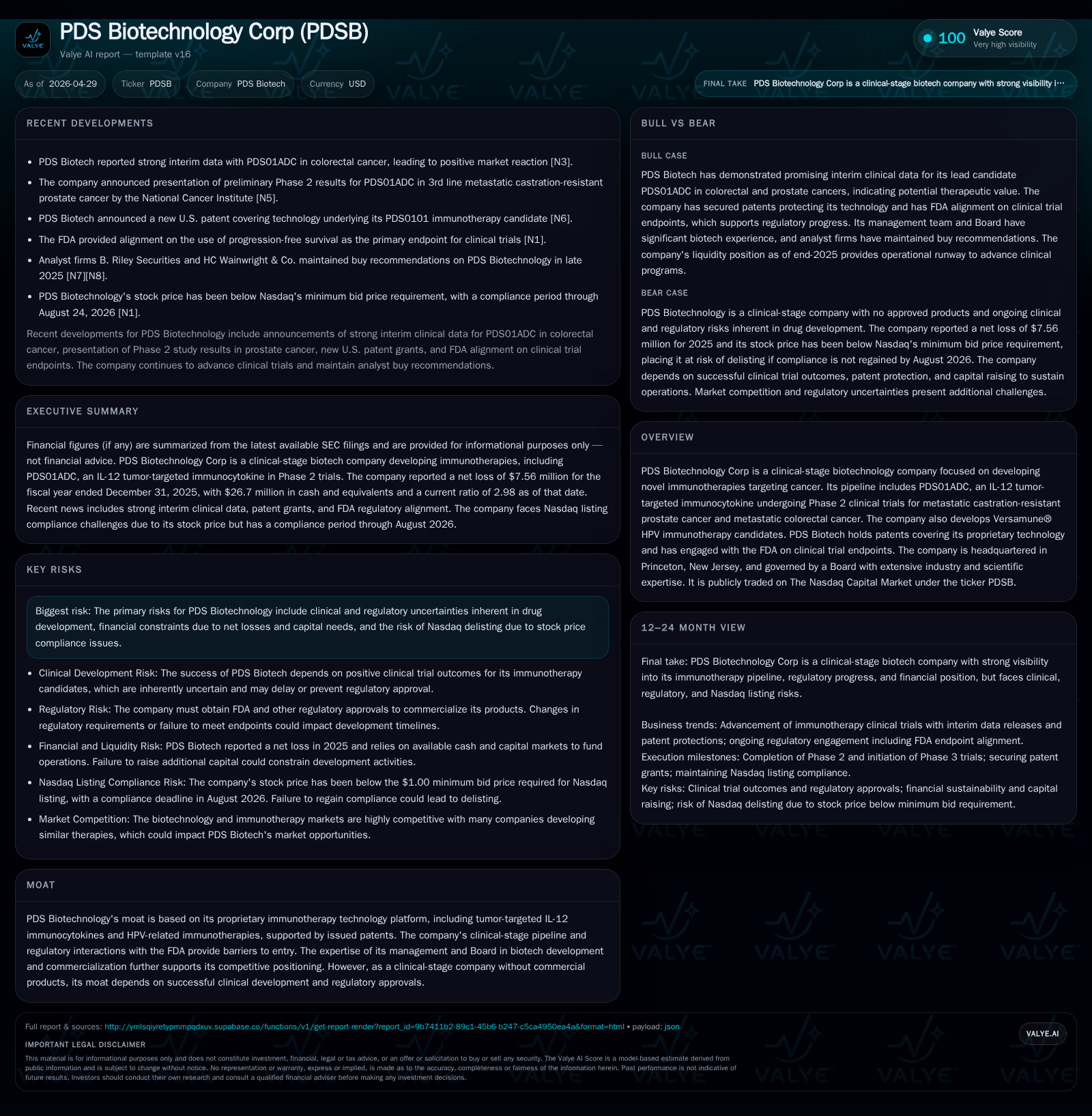
In April 2026, PDS Biotechnology Corp updated its corporate presentation reflecting progress in its clinical-stage pipeline, notably advancing the Phase 3 VERSATILE-003 trial with an amended endpoint to support accelerated approval for its HPV-targeted immunotherapy candidate. The company’s lead product, PDS01ADC, has demonstrated promising interim clinical and biomarker data in Phase 2 trials against difficult-to-treat cancers. Operating as a clinical-stage biotech, PDSB’s moat rests on proprietary IL-12 tumor-targeted immunocytokine technology and patented delivery platforms. However, the firm faces typical early-stage risks including regulatory uncertainties, capital needs, and Nasdaq listing compliance challenges.
Recent Operating Update
PDS Biotechnology Corporation (Nasdaq: PDSB) recently filed a Form 8-K on April 24, 2026 ([S3],[S14]) primarily updating its corporate presentation to reflect advancements in its clinical pipeline and trial strategy. This update follows a series of key announcements earlier in the year that demonstrate active regulatory engagement and clinical data dissemination.
Notably, on February 20, 2026 ([S7],[S17]), the company announced a pivotal protocol amendment to its Phase 3 VERSATILE-003 trial evaluating PDS0101, its HPV16-positive immunotherapy candidate. This amendment adds progression-free survival (PFS) as an interim primary endpoint aimed at supporting an accelerated FDA approval pathway while maintaining median overall survival (mOS) as the ultimate primary endpoint for full approval. The FDA's lack of objection after the standard wait period indicates alignment with PDSB's regulatory strategy.
Complementing this clinical development, on April 15, 2026 ([S16]), PDSB disclosed that biomarker and immunological data from Stage 1 of its Phase 2 trial testing PDS01ADC in metastatic solid tumors were published in the Journal of Clinical Oncology Oncology Advances. These data reflect mechanistic validation of tumor-targeted IL-12 delivery enhancing anti-tumor immune responses—a critical step for advancing toward registration milestones.
Business Model Overview
PDS Biotechnology operates as a clinical-stage company specializing in novel immunotherapies designed to modulate the immune system against cancers with high unmet need. Its revenue model is presently pre-commercial; hence income generation hinges on successfully navigating clinical trials leading to product approvals or partnership/licensing deals.
Its core offering consists of two main therapeutic programs:
PDS01ADC - An antibody-directed cytokine candidate delivering interleukin-12 directly to tumors. This candidate is undergoing Phase 2 evaluation targeting metastatic castration-resistant prostate cancer (mCRPC) and metastatic colorectal cancer (mCRC). Tumor-selective IL-12 aims to overcome systemic toxicity issues common with traditional cytokine therapy.
Versamune® Platform & HPV Immunotherapies - A proprietary nanoparticle-based adjuvant technology utilized in HPV-associated cancer candidates like PDS0101. These agents aim at eliciting potent T-cell mediated responses against HPV16 viral antigens expressed in head & neck squamous cell carcinoma.
Revenue drivers will ultimately involve milestone payments from collaborations or commercial sales post-approval; currently, expenses are predominantly R&D driven reflecting pipeline advancement efforts.
Industry Structure and Competitive Position
The immuno-oncology sector is densely competitive with diversified players pursuing checkpoint inhibitors, engineered cytokines, cell therapies, and tumor vaccines. Within this landscape, PDS Biotech differentiates through its tumor-targeted IL-12 delivery approach which might mitigate dose-limiting toxicities seen with systemic cytokines.
Moreover, its Versamune® technology adds a platform advantage by enabling enhanced immune activation tailored toward virus-driven malignancies such as HPV-related cancers—a niche with considerable commercial interest given rising incidence rates globally.
Its patent portfolio covering these technologies together with ongoing FDA interactions concerning clinical trial design create moderate barriers to entry.
Growth Drivers
Growth catalysts for PDSB include:
- Clinical Milestones: Successful outcomes from ongoing Phase 2 studies of PDS01ADC could validate mechanism-of-action claims; positive interim data have already received market notice ([N4]).
- Regulatory Acceleration: Adoption of progression-free survival as a surrogate endpoint in VERSATILE-003 sets a feasible path for accelerated FDA approval thereby potentially shortening time to market ([S7],[S17]).
- Strategic Data Publication: Peer-reviewed immune biomarker validation bolsters scientific credibility encouraging clinician adoption post-launch ([S16]).
- Patent Protections: Issued patents provide exclusivity across key assets limiting generic substitution threats.
- Management & Board Expertise: Experienced leadership enhances operational execution capability across R&D and regulatory interactions ([S1]).
Risks and Watchpoints
Key risks include:
- Clinical Development Risk: As a wholly clinical stage entity without commercial sales or products yet approved, significant uncertainty remains about efficacy/safety outcomes at pivotal stages.
- Funding Constraints: Continued net losses require ongoing capital raises which could dilute existing shareholders. Current cash reserves offer limited runway subject to trial pacing ([F1]).
- Nasdaq Listing Compliance: The company received Nasdaq deficiency notices due to persistently low share price (<$1), requiring corrective action such as reverse stock splits or price recovery by August 2026 ([S20],[N3]). Failure may trigger delisting risk.
- Competitive Dynamics: Rapid innovation cycles within immuno-oncology necessitate continual pipeline advancement lest competitors capture market share first.
What To Watch Next
Investors should monitor:
- Updated top-line results from Phase 2 trials of PDS01ADC for signals of clinical activity or safety hurdles.
- Progress reports on VERSATILE-003 enrollment pace and interim analyses based on amended protocol endpoints.
- Regulatory feedback concerning accelerated/standard approval paths especially from ongoing FDA correspondence.
- Company communications regarding capital raising strategies addressing liquidity needs ahead of Q3-Q4 fiscal periods.
- Market reactions around Nasdaq compliance milestones approaching late summer deadlines.
Financial Profile Summary
Latest financial snapshot
| Metric | Value | Period |
|---|---|---|
| Cash & equivalents | $27mm | |
| 2025-12-31 | ||
| Current assets | $28mm | |
| 2025-12-31 | ||
| Current liabilities | $9mm | |
| 2025-12-31 | ||
| Current ratio | 2.98x | |
| 2025-12-31 |
Source: SEC companyfacts cache [F1].
As of December 31, 2025 ([F1]):
*Indicates net loss typical for developmental stage biotechs focused on R&D investment without commercial revenues currently.
Liquidity metrics indicate manageable coverage of short-term liabilities; however continued operating losses underscore the imperative for incremental capital infusions to sustain clinical programs.
The analysis reflects publicly available SEC filings and company disclosures without addressing investment suitability or recommendations.
Disclaimer: This is research-only, informational analysis and not investment advice. It may include AI-generated interpretation and general industry context. Always verify important details using primary sources.

Comments