
PepsiCo’s Strategic Resilience and Market Leadership Amid Competitive Pressures and Macroeconomic Challenges
PepsiCo's enduring brand strength and adaptive strategies sustain its leadership in the non-alcoholic beverages space despite evolving market headwinds.
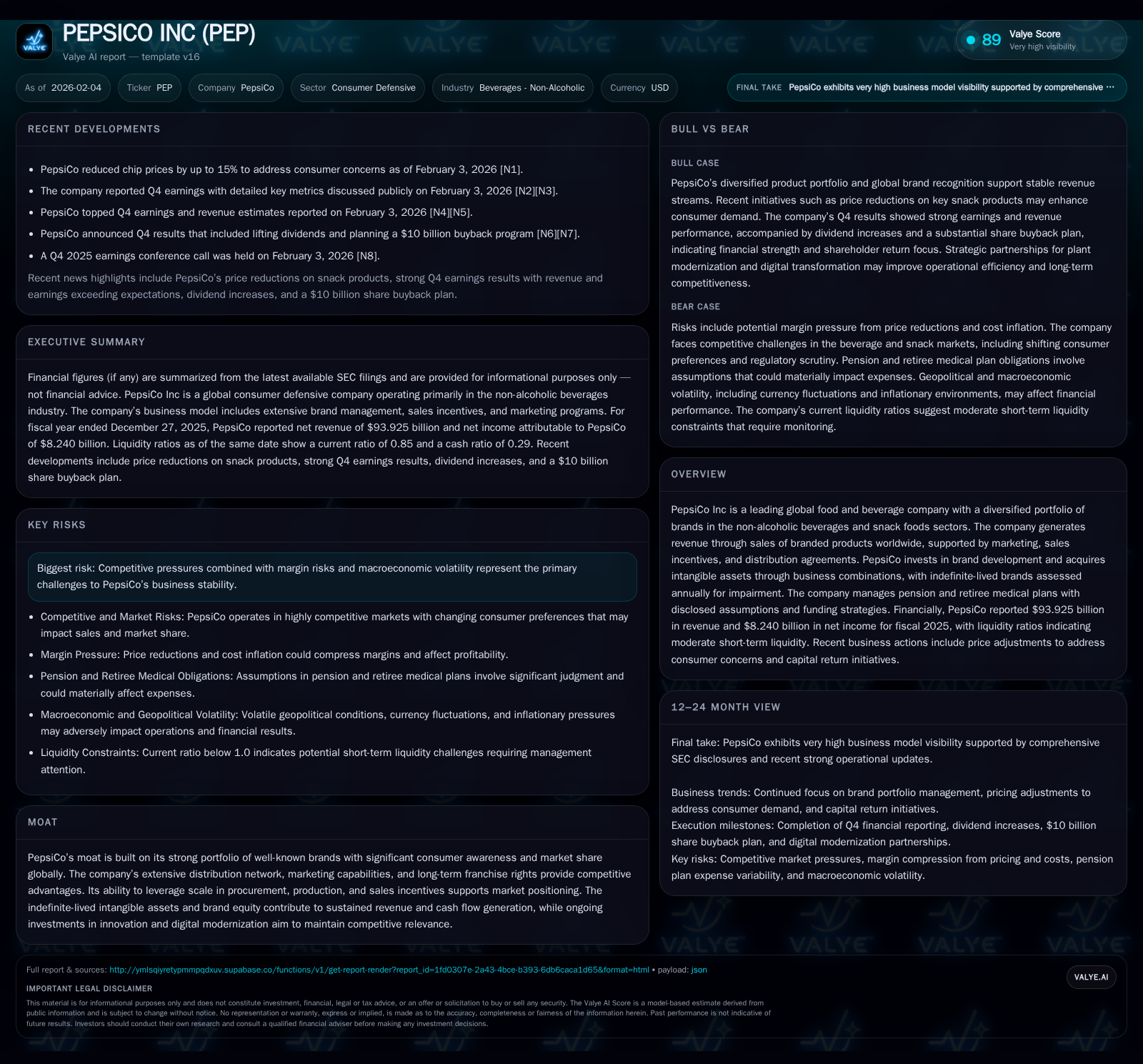
PepsiCo demonstrated robust financial results in fiscal 2025, with revenues approaching $94 billion and solid net income performance. The company strategically adjusted pricing—most notably lowering chip prices up to 15%—to address heightened consumer sensitivities while managing margin pressures. Its wide-reaching moat, anchored by an unparalleled brand portfolio and distribution network, enables consistent market leadership. Meanwhile, complex pension, retiree medical obligations, and nuanced tax strategies impact earnings quality. Capital return initiatives including a dividend increase and sizable buyback underscore confidence in ongoing cash flow generation. Innovation efforts support relevance amid shifting consumer preferences. Despite persistent risks from competition and macroeconomic factors, PepsiCo’s balanced approach positions it well moving forward.
Navigating 2025: Financial Milestones and Growth Signals
PepsiCo’s fiscal 2025 financial results articulate a narrative of resilience amid a complex macroeconomic backdrop. The company generated $93.925 billion in revenue alongside $8.24 billion in net income [F1], underscoring robust demand for its diverse brand portfolio across both beverage and snack categories. This performance exceeded analyst expectations as highlighted in recent earnings commentary [N1][N3]. However, an examination of liquidity reveals a current ratio of approximately 0.85 (current assets of nearly $27.95 billion against current liabilities of roughly $32.76 billion) [F1], signaling moderate short-term liquidity cushion that remains sufficient though slightly tighter than some peers within consumer defensive sectors.
This blend of top-line strength combined with cautious liquidity management reflects PepsiCo’s balancing act: aggressively managing working capital needs while investing for growth.
Priced to Compete: Pricing Adjustments Addressing Consumer Sensitivities
In early 2026, PepsiCo implemented price cuts on certain snack products—including reductions up to 15% on chips—to mollify consumer concerns over affordability during inflationary times [N9]. This strategic move reveals the company's sensitivity toward maintaining volume momentum amidst an environment where discretionary spending is under pressure.
While lowering prices inherently tightens margins—a key risk factor noted in SEC disclosures [S1]—the decision signals PepsiCo’s willingness to trade near-term margin expansion for sustained consumer loyalty and volume recovery. The tactic aligns with broader marketplace trends where nimble pricing adjustments help preserve brand relevance without sacrificing long-term demand.
The Moat Unpacked: How Brand Equity and Distribution Sustain Leadership
Central to PepsiCo’s durable market position is an entrenched moat comprising globally recognized brands like Pepsi-Cola, Lay’s, Quaker, and Gatorade along with exclusive perpetual franchise rights permitting beverage manufacture or distribution within defined territories [valye_report_excerpt.moat][S1]. These intangible assets are classified as indefinite-lived due to their continuous revenue generation history bolstered by ongoing investments in marketing and innovation.
The company’s expansive distribution network combined with skilled procurement scale allows favorable input costs while ensuring product availability across global markets—enhancing barriers to entry for competitors. Additionally, the ability to leverage sales incentives calibrated annually underpins shelf prominence and drives volume effectively.
Behind the Numbers: Deep Dive into Pension & Tax Complexities
PepsiCo’s financials carry layers of complexity stemming from pension and retiree medical plans that cover U.S. and certain international employees [S1]. Valuation hinges on multiple actuarial assumptions including turnover rates, retirement age projections, mortality assumptions, expected return on plan assets, and discount rates benchmarked against high-quality corporate bonds.
These assumptions require considerable management judgment; any changes can substantially sway reported expenses or liabilities. For instance, the discount rate used was modestly raised from prior years (6.0% for pension service cost discount rate in 2025 compared to 5.4% previously) which could reduce present value of future obligations thereby favorably impacting expense recognition.
Tax strategy also plays a vital role; the effective tax rate fell slightly from 19.4% in 2024 to 19.0% in 2025 due partly to timing differences inherent between book accounting and tax return treatments of items leading to deferred tax assets and liabilities [S1]. Coordination between reported tax expense versus cash taxes paid reinforces the importance of understanding temporary versus permanent tax differences for earnings quality analysis.
Capital Return Dynamics: Dividends Raised and Aggressive Buyback Plan
Reflecting confidence rooted in steady cash flows, PepsiCo announced an increased dividend alongside a substantial $10 billion share repurchase program post its Q4 earnings release [N5][N6]. This dual capital return approach mirrors a shareholder-friendly stance common among blue-chip consumer staples companies.
Given the reported net income levels [$8.24 billion] and liquidity positioning [F1], these moves appear well-aligned from a funding perspective without compromising flexibility needed for operational or strategic investments.
Such robust capital allocation signals that management views its business model as durable while aiming to sustainably reward investors amidst an uncertain economic climate.
Innovation & Modernization: Staying Relevant in a Shifting Market
To counterbalance evolving consumer preferences—especially trends favoring health-conscious choices—and competitive substitution threats, PepsiCo continues investing heavily in product innovation as well as digital modernization efforts [valye_report_excerpt.moat][S1]. These initiatives include reformulating existing products with healthier ingredients, developing new offerings targeting wellness trends, leveraging data analytics for targeted marketing campaigns, and enhancing e-commerce capabilities.
Sustaining this investment pipeline is integral not just for incremental sales but crucially for preserving brand vitality over decades—a key pillar underpinning its intangible asset valuations.
Risks in Focus: Competitive and Macroeconomic Headwinds Ahead
Competitive dynamics remain intense; notable is anecdotal evidence pointing to some consumers preferring Coca-Cola alternatives citing taste or brand affinity reasons [N10]. Coupled with inflationary cost burdens squeezing margins further amplified by potential regulatory constraints globally [S1], PepsiCo faces a challenging landscape requiring agility.
Macro volatility—such as fluctuating commodity prices or currency exposure—adds layers of unpredictability impacting both costs and pricing decisions.
Risk disclosures emphasize the delicate balance required between defending market share through pricing flexibility versus maintaining profitability thresholds for sustained reinvestment capability.
Looking Ahead: Strategic Priorities and Market Positioning
PepsiCo's recent earnings call reiterated its commitment toward strong organic growth supported by continued innovation cadence while employing prudent cost management tactics [N5][valye_report_excerpt]. The affirmed outlook acknowledges prevailing uncertainties but underscores fundamental brand durability as a buffer.
Strategically cultivated intangible assets combined with disciplined financial stewardship—including navigating pension liabilities thoughtfully—create a layered defense against volatility.
Moving forward, the imperative lies in leveraging scale advantages while responding nimbly to shifting consumer habits through pricing agility and portfolio evolution.
This nuanced posture embodies PepsiCo's medium-term strategy: resilient yet adaptive — sustaining market leadership by balancing legacy strengths with forward-looking maneuvering amid an unsettled economic backdrop.
This analysis is based on publicly available information including PepsiCo’s recent SEC filings [S1], market data [F1], industry news reports [N#], and Valye News proprietary excerpts as of February 2026. It does not constitute investment advice or recommendations.
Disclaimer: This is research-only, informational analysis and not investment advice. It may include AI-generated interpretation and general industry context. Always verify important details using primary sources.

Comments