
Peoples Financial Corp /MS/: Diversified Lending, Earnings Stability, and the Unanswered Questions of Liquidity and Growth
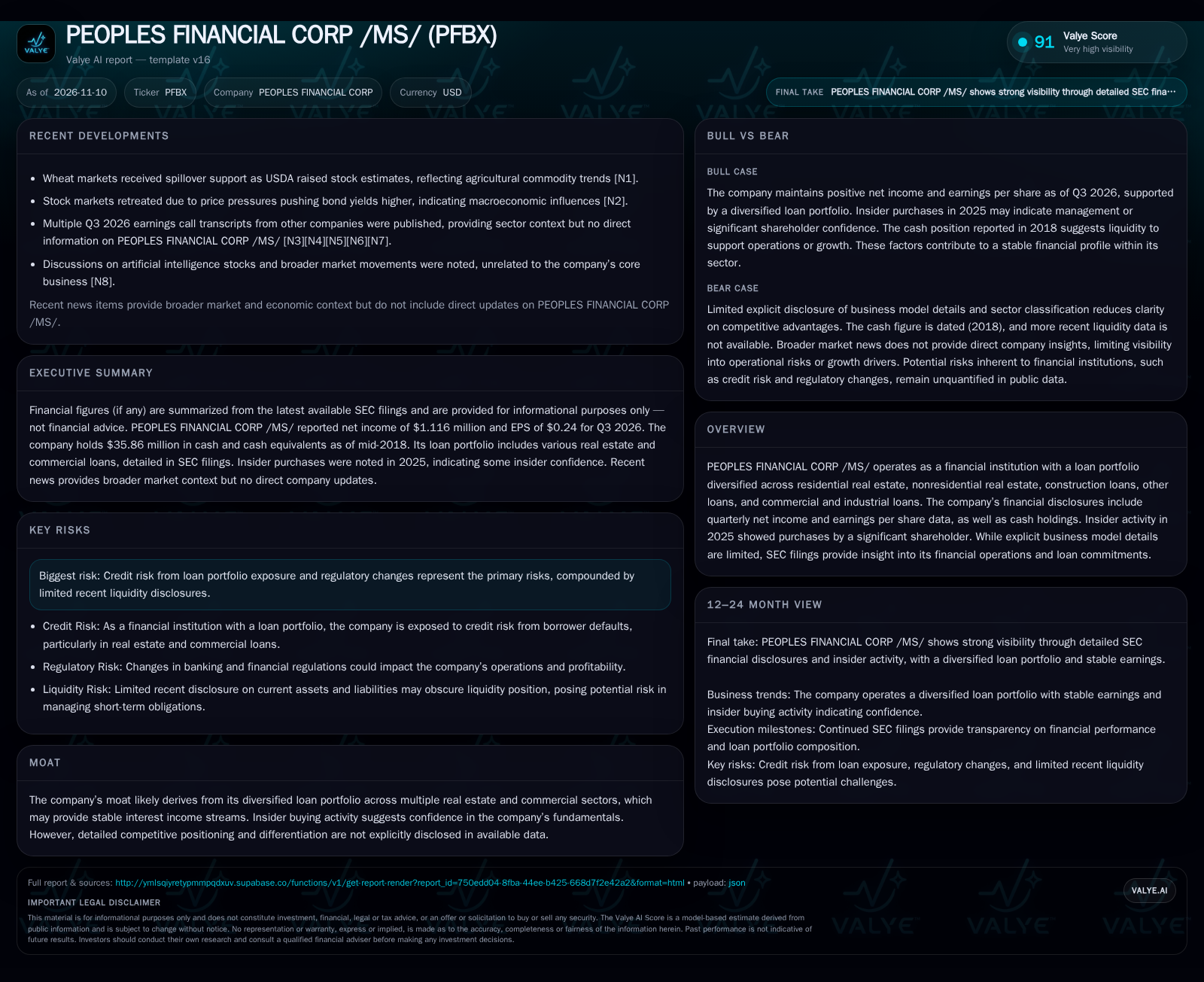
Peoples Financial Corp /MS/ (PFBX) reported $1.1 million in net income for Q3 2026, supported by a diversified loan portfolio spanning residential and commercial real estate.
Peoples Financial Corp /MS/ posted $1.1 million in net income for Q3 2026 on a diversified loan book, with insider buying in 2025 suggesting confidence.
Peoples Financial Corp /MS/ stands as a regional financial institution with a well-diversified loan portfolio and demonstrated profitability, posting over $1.1 million in net income for the third quarter of 2026. The real test for PFBX will be whether its diversified lending model can protect earnings and support growth in the face of sector headwinds and information gaps.
Q3 2026 Earnings and Portfolio Composition: What’s Tangible Now
The company reported net income of $1,116,000 for the quarter ending September 30, 2026, translating to earnings per share of $0.24 [S2]. This establishes ongoing profitability in a period marked by broader financial sector volatility. The loan book, as detailed in SEC filings, is distributed across residential and nonresidential real estate, construction, and commercial loans, indicating a deliberate approach to risk diversification [S2].Insider transaction activity was reported in the cited source; this activity does not by itself establish insider confidence. However, the most recent cash and cash equivalents figure dates back to June 2018, and no recent liquidity or capital adequacy disclosures are available, creating uncertainty about the company's current potential financial flexibility [S2].
How Lending Mix and Margin Dynamics Could Shape Returns
As a traditional lender, Peoples Financial Corp /MS/ likely generates revenue primarily from net interest income, with profitability driven by the spread between loan yields and funding costs. The reported diversification across multiple loan types—residential, nonresidential, construction, and commercial—may enable the company to balance yield and risk. Typically, commercial and construction loans offer higher interest rates but greater credit risk, while residential real estate lending is more commoditized but can provide volume stability and lower default rates in normal cycles.
Operating leverage in regional banks often emerges from fixed-cost infrastructure (branches, compliance, technology) against variable loan volume. If loan growth outpaces expense growth, incremental profits can expand meaningfully. However, without recent disclosures on loan growth, noninterest income, or cost structure, it is unclear whether PFBX is capturing this potential. Funding costs are also a key variable—rising deposit rates or reliance on wholesale funding could compress net interest margins, particularly if asset yields are slow to reprice. The company reported cash and liquidity metrics for the period; these figures do not by themselves establish operating runway, investment capacity, financial flexibility, or financing capacity.
The interplay between loan portfolio composition and interest rate environment is critical in shaping Peoples Financial Corp's net interest margin trajectory. For example, if the company’s loan yields are largely fixed-rate, a rising interest rate environment could compress margins unless funding costs are similarly fixed or hedged. Conversely, a predominance of variable-rate loans could allow quicker repricing to market rates, potentially preserving margins but introducing earnings volatility. Additionally, the company's funding mix—whether primarily deposits, brokered deposits, or wholesale borrowings—affects interest expense sensitivity and liquidity risk. A higher reliance on volatile or expensive funding sources could constrain margin expansion and increase refinancing risk during market stress.
Assessing Moat Potential: Diversification vs. Scale and Specialization
In the crowded landscape of regional and community banking, diversification of the loan book can provide some resilience against sector-specific shocks—such as downturns in local real estate or construction. However, this strategy's effectiveness depends on underwriting quality, risk controls, and the ability to price loans competitively without sacrificing margin.
Compared to larger regional or national peers, Peoples Financial Corp /MS/ may lack scale-driven cost advantages or access to lower-cost funding. Niche competitors may also target specific lending verticals with greater underwriting sophistication or digital delivery, potentially eroding share or compressing spreads. The absence of explicit evidence about digital capabilities, customer retention, or unique service offerings means PFBX’s moat likely relies on relationship banking and local market knowledge—a defensible but limited position if larger players or fintech entrants intensify competition.
The effectiveness of Peoples Financial Corp's diversification strategy also hinges on its underwriting discipline and risk management capabilities. Diversification alone does not guarantee resilience if credit evaluation standards vary across loan types or if risk concentrations exist within sub-sectors. Moreover, the competitive landscape may pressure pricing, especially in commoditized residential lending segments where digital platforms can offer faster, lower-cost service. In contrast, relationship-driven commercial lending requires local expertise and service customization, which could be a sustainable advantage if executed well. However, without scale, investing in technology and compliance to meet evolving regulatory and customer expectations may be challenging, potentially limiting competitive positioning over time.
Earnings Expansion If Loan Growth Outpaces Credit Losses
If Peoples Financial Corp /MS/ can expand its loan book—particularly in higher-yielding commercial or construction segments—without a commensurate rise in credit losses, net interest income could rise and operating leverage could boost overall profitability. The diversified portfolio could buffer against isolated sector shocks, while a stable or improving local economy would likely support asset quality.
Confirmation of this scenario would require evidence of sequential loan growth, stable or declining nonperforming assets, and positive trends in net interest margin. Additional insider buying or new disclosures on capital adequacy and liquidity would further support the case for a sustainable earnings expansion. Falsification would come from rising charge-offs, flat or shrinking loan balances, or negative trends in margin due to funding cost pressures.
Stable Earnings with Modest Loan Growth and Managed Credit Risk
The most plausible near-term outlook is steady, moderate profitability anchored by the existing diversified loan portfolio. Incremental loan growth in core segments—offset by disciplined underwriting—could maintain or slightly improve earnings, but without the scale or differentiation to deliver outsized returns. Credit costs may rise modestly if macro conditions soften, but barring a severe downturn, the diversified exposure should help contain losses.
Evidence supporting this scenario would include continued quarterly profitability, stable earnings per share, and no material deterioration in asset quality metrics (if disclosed). A lack of loan growth or rising provision expenses would suggest an inability to capitalize on local lending opportunities or heightened credit risk.
Credit Deterioration or Funding Constraints Erode Profitability
The principal risk for Peoples Financial Corp /MS/ is a wave of credit losses—especially in commercial, construction, or nonresidential real estate loans—triggered by local economic weakness or sector-specific downturns. This could force higher loan loss provisions, compressing earnings or even resulting in net losses. If funding costs rise (e.g., due to deposit outflows or reliance on wholesale funding) and loan yields lag, net interest margin could also be squeezed.
Confirmation of this scenario would include a spike in nonperforming loans, negative net income, or regulatory enforcement actions. Falsification would require updated disclosures showing reported liquidity position and capital, as well as stable or improving asset quality.
What Will Reveal PFBX’s Real Earnings Power and Resilience?
Quarterly net charge-off rates and nonperforming loan ratios, if disclosed, would clarify the true credit risk embedded in the diversified portfolio.
Sequential loan growth by segment—especially in commercial and construction lending—would indicate whether the company is capturing new business or losing share.
Net interest margin trends, if provided, would show whether funding cost pressures are eroding profitability.
Evidence of digital channel adoption or customer acquisition cost evolution would help assess competitive positioning versus larger banks and fintechs.
Any new insider transactions or share repurchase activity could signal management’s view of intrinsic value and future prospects.
Regulatory filings or enforcement actions would be critical red flags for operational or compliance weaknesses.
If disclosed, noninterest income as a percentage of total revenue would reveal the degree of business model diversification beyond traditional lending.
Disclaimer: This is research-only, informational analysis and not investment advice. It may include AI-generated interpretation and general industry context. Always verify important details using primary sources.

Comments