
PHOTRONICS INC Accelerates Technological Leadership Amid Global Semiconductor Trends
Photronics leverages advanced manufacturing, a global footprint, and targeted capital allocation to navigate growth in the photomask market despite industry cyclicality.
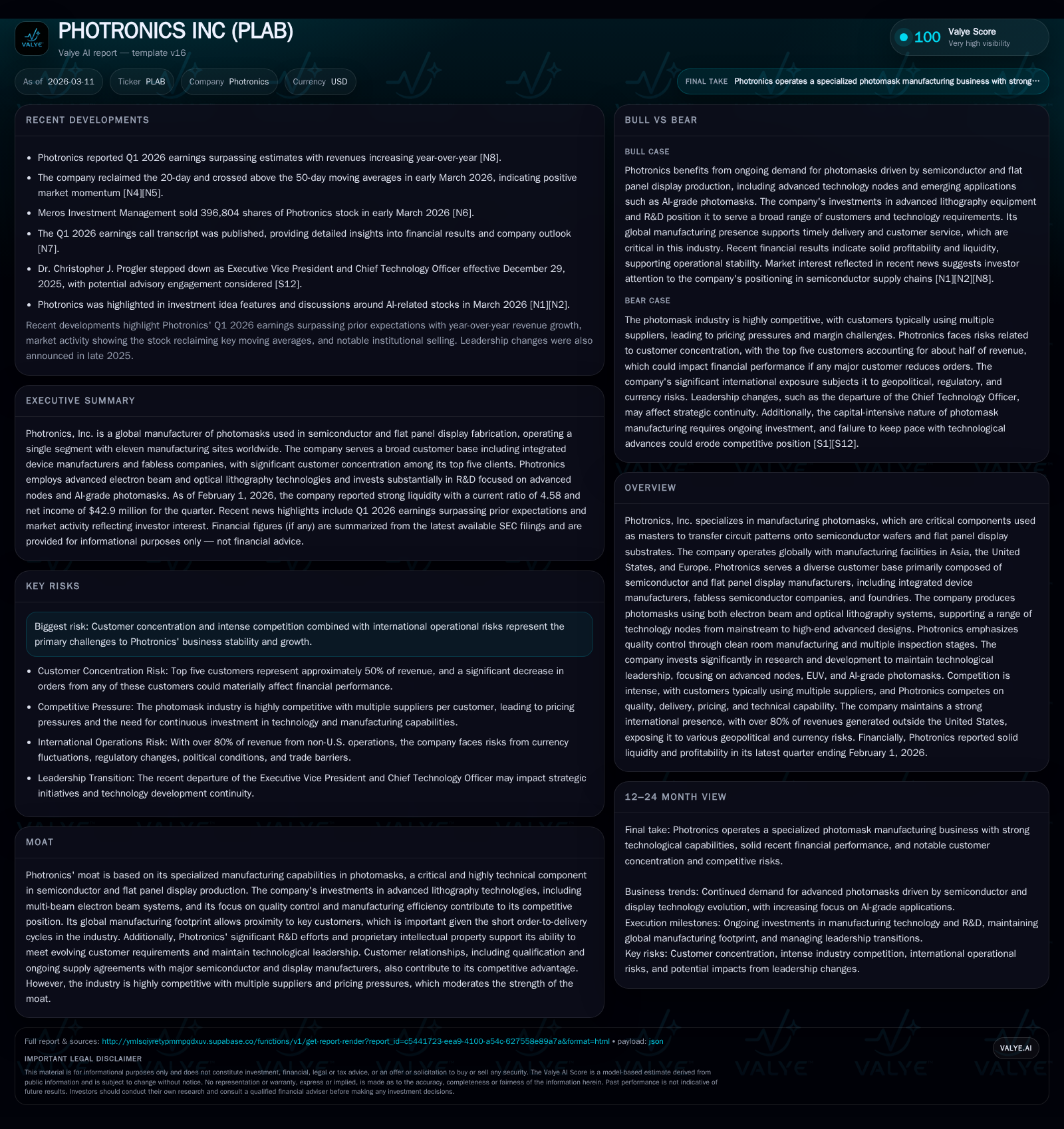
Photronics Inc. remains a pivotal player in semiconductor and flat panel display manufacturing by producing critical photomasks using advanced lithography across global facilities. Despite facing a 6% dip in operating income in FY2025, the company sustained net income growth supported by robust quality control and strategic R&D investments. Its customer concentration risk and geopolitical exposure represent ongoing challenges, yet Photronics’ increased capital expenditures and resumed buybacks signal confidence in long-term prospects. Key monitoring points include margin pressures and evolving semiconductor technology nodes where Photronics aims to maintain its technical leadership.
Historical Financial Performance Highlights and YoY Variations
Photronics exhibited a nuanced financial trajectory through fiscal year 2025. Operating income retreated by approximately 6%, descending from $221.5 million in FY2024 to $208.2 million in FY2025, likely reflecting cost pressures or cyclical softness in semiconductor photomask demand [F1]. Contrasting this contraction, net income showed an uptick of 4.4%, rising to $136.4 million from $130.7 million the previous year, suggesting improved non-operating items or tax efficiencies balancing core earnings pressure [F1]. Operating cash flow softened by roughly 5.2%, sliding to $247.8 million from $261.4 million, consistent with tighter operating margins or working capital shifts common in highly cyclical semiconductor supply chains [F1]. The company’s capital expenditure profile expanded markedly, rising by nearly 44% to $188.1 million as Photronics strategically invested in capacity enhancement and technological upgrades to sustain competitive positioning into advanced lithography nodes [F1][S11]. This increase corresponded with maintained free cash flow generation (~$59.7 million), demonstrating operational resilience during greater investment outlays.
Historical performance (annual)
| FY | Net ($mm) | CFO ($mm) | OpInc ($mm) | Capex ($mm) | Net YoY |
|---|---|---|---|---|---|
| 2025 | 136 | 248 | 208 | 188 | +4.4% |
| 2024 | 131 | 261 | 222 | 131 | +4.1% |
| 2023 | 125 | 302 | 253 | 131 | +5.6% |
| 2022 | 119 | 275 | 212 | 112 |
Source: SEC companyfacts cache [F1].
Capital returns and efficiency (annual)
| FY | Buybacks ($mm) | FCF ($mm) | ROE% |
|---|---|---|---|
| 2025 | 97 | 60 | 11.6 |
| 2024 | 0 | 131 | 11.7 |
| 2023 | 0 | 171 | 12.9 |
| 2022 | 3 | 163 | 14.3 |
Source: SEC companyfacts cache [F1].
Note: Revenue figures for these years were not explicitly provided; analysis focuses on reported profitability and cash flow series[F1].
The above oscillations reflect Photronics’ exposure to the semiconductor industry’s cyclical nature and price competition pressure while highlighting its capability to generate solid returns amidst variability.
Manufacturing Excellence and Specialized Technology Capabilities
Photronics secures its moat through concentrated investment in specialized lithographic manufacturing processes essential to fabricating next-generation semiconductor chips and advanced flat-panel displays (FPDs). The company operates eleven manufacturing facilities worldwide—three sites each in Taiwan and the U.S., two in China, one South Korea plant focused on FPD photomasks, plus two European locations—enabling proximity to key customers primarily located across Asia’s high-tech corridors [S1][S4][S7].
Central to Photronics' manufacturing edge is its deployment of both electron beam (e-beam) lithography systems—incorporating proprietary multi-beam architectures—and laser-based optical lithography technologies tailored for different mask complexity tiers that correlate with technology nodes down to sub-28 nanometers [S6][S9]. The integration of multi-beam e-beam systems accelerates mask write times while maintaining precision critical for high-density circuitry designs supporting AI-grade processing units or advanced packaging applications—a capability distinguishing it from many peers reliant on legacy single-beam systems [S11].
Manufacturing environments adhere strictly to clean room protocols controlling temperature, humidity, and particulate contamination with multiple inspection cycles spanning defect detection, pellicle application (which protects the mask during wafer exposure), repair operations, and final quality verifications before shipping [S7]. This rigorous process underscores Photronics’ commitment to yield optimization amid increasingly complex design rules dictated by evolving semiconductor scaling demands.
Customer Base, Geographic Footprint, and Competitive Positioning
Photronics serves a diversified yet concentrated client base encompassing approximately 636 customers as of FY2025; however, it derives about half of its revenues from the top five customers—dominated by integrated device manufacturers (IDMs), fabless semiconductor companies, and pure-play foundries [S6]. In particular, customers A, B, and C contributed roughly 16%, 13%, and 8% respectively of consolidated revenue in FY2025 indicating material dependency risks.
Geographically, roughly 82% of Photronics’ revenues originate outside the United States—primarily Asia—with significant revenue stemming from Taiwan, China, South Korea regions aligned with the location of major semiconductor fabs [S5][S8]. Such presence facilitates rapid order-to-delivery cycles vital given lead times as short as one day for early mask layers on some IC products while enabling localized support for region-specific design roadmaps.
Competitive pressures are intense within the photomask sector featuring a small number of established players including Dai Nippon Printing Co., Hoya Corporation, LG Innotek Co., Ltd., alongside captive unit operations within chipmakers who partially insource mask production [S5][S10]. This dynamic compels ongoing price pressure balanced against necessity for technological excellence—a balance Photronics achieves by persistent investments in equipment modernization coupled with robust customer qualification procedures fostering long-term supplier relationships.
Emerging Challenges and Risk Factors in International Operations
International operational risks compound industry cyclicality challenges for Photronics given dominant revenue sourced abroad (~82%), exposing it to geopolitical tensions including trade tariffs under Section 232 investigations impacting semiconductors imported into the U.S., currency volatility, regulatory compliance complexities across diverse jurisdictions notably China and Taiwan joint ventures, staffing hurdles overseas plus lengthened accounts receivable cycles [S8][S14][S15].
Furthermore, these factors necessitate substantial resource allocations away from pure growth efforts toward governance functions including risk management compliance frameworks.
Notably, cybersecurity risk oversight is formalized under the Board’s Cyber Security Risk Management Committee staffed by members with dedicated expertise ensuring continuous monitoring reports from VP-level IT security leadership—the latter feeding risk metric dashboards quarterly back to full Board sessions emphasizing proactive threat response initiatives aligned with industry developments [S1][S16].
Such structured governance mitigates erosion of enterprise value potentially arising from cyber incidents which could disrupt tightly scheduled manufacturing workflows or compromise proprietary IP integral to technical edge.
Future Growth Drivers Anchored in R&D and Market Demand
Photronics pursues future growth through targeted research & development investments primarily centered at its Boise IC photomask facility alongside South Korea-based FPD R&D activities focusing on Generation 10.5+ AMOLED/LTPS displays among others [S11]. These advancements respond directly to market demand for masks suited to wafer geometries at or below the challenging sub-7nm regime incorporating EUV capabilities which are fundamental enablers for cutting-edge semiconductor devices powering AI processors, cloud computing infrastructure hardware as well as telecommunications equipment.
Simultaneously, evolving Flat Panel Display markets requiring higher resolution applies impetus to evolving pellicle technologies protecting masks during fabrication plus enhanced pattern fidelity demanded by AMOLED organic compound layers underpinning displays [S11]. Company efforts span internal proprietary IP development encompassing trade secrets surrounding multi-beam e-beam writing techniques plus data processing algorithms integrating with customer processes regionally ensuring alignment across global supply chains.
Incremental opportunities may emerge around AI-driven photomask designs given artificial intelligence’s increasing imprint on chip architectural complexity—a point Photronics acknowledges within its stated technology roadmap prioritization highlighting alignment between industrial innovation cycles and photomask technological evolution [S11].
Capital Allocation, Returns Analysis, and Shareholder Value Creation
Capital allocation reflects deliberate strategic expansion given a near-44% surge in capital expenditures peaking at $188 million in FY2025 compared with just over $130 million the prior year—invested primarily towards enhancing equipment capabilities sustaining geometric scaling thresholds relative to industry benchmarks [F1][S11].
Operating cash flows declined modestly (-5%) but remained solid at approximately $248 million while free cash flow generation was preserved near $60 million after deducting capex [$247.8m - $188.1m], underscoring effective working capital management amidst investment wave [F1].
Return on equity measured near an estimated ~11.6% leverages reported net income ($136M) over equity base ($1.17 billion) indicating consistent profitability supporting incremental shareholder returns absent dividend payout programs documented explicitly; instead share repurchase programs accelerated significantly resembling affirmations of capital return priorities: FY2025 saw ~$97 million spent repurchasing stock after no buyback activity occurred throughout prior two years save minimal amounts circa FY2022 indicating renewed confidence in valuation support amid market cycles [F1].
A suite of formal announcements across late CY25 through early CY26 signaled these moves highlighting disciplined financial stewardship underpinning overall strategic posture optimized for both reinvestment capacity plus balancing shareholder distributions.
Key Milestones, Market Signals, and What To Monitor Next
The company’s Q1 fiscal year 2026 earnings results posted gains surpassing market expectations driven by higher revenues—a reversal confirming bottoming of cyclic headwinds experienced previously and validating recent capex-led upgrades manifesting into near-term demand capture [N1][N2][N3]. Moreover technical trading indicators such as reclaiming both short- (20-day) and mid-term (50-day) moving averages suggested improving investor sentiment although share sales by notable institutional holder Meros Investment Management reminded stakeholders of continued liquidity dynamics requiring vigilance given customer concentration exposures persisting even amid favorable top-line developments ([N7],[N8],[N9]).
Observers should balance optimism regarding strong execution against potential margin compression risks driven by price competition pervasive across semiconductor materials suppliers compounded by ongoing macro trade friction uncertainties impacting raw material sourcing costs or delivery lead times impacting order book visibility given notoriously short order-to-delivery cycles spanning one day up to three weeks depending on product tier emphasizing importance of operational agility coupled with precise supply chain coordination inherent within this niche industry segment.
Consequently monitoring advances at advanced node photomask segments (e.g., EUV compatibility), progress on FPD next-gen integration alongside geopolitical developments affecting Asian supply hubs will serve as crucial signals governing trajectory beyond immediately reported quarters.
This analysis is rendered exclusively from documented SEC filings,[N#] news releases,[F1] financial data snapshots without projection or investment advice intended solely for comprehensive corporate assessment.
Disclaimer: This is research-only, informational analysis and not investment advice. It may include AI-generated interpretation and general industry context. Always verify important details using primary sources.

Comments