
Ming Shing's Strategic Acquisition and Diversification Amid Liquidity Challenges
Ming Shing Group Holdings is pursuing transformative growth through a $510 million equity-based acquisition, diversifying into organic agriculture supply chains while facing liquidity pressures and dilution risk.
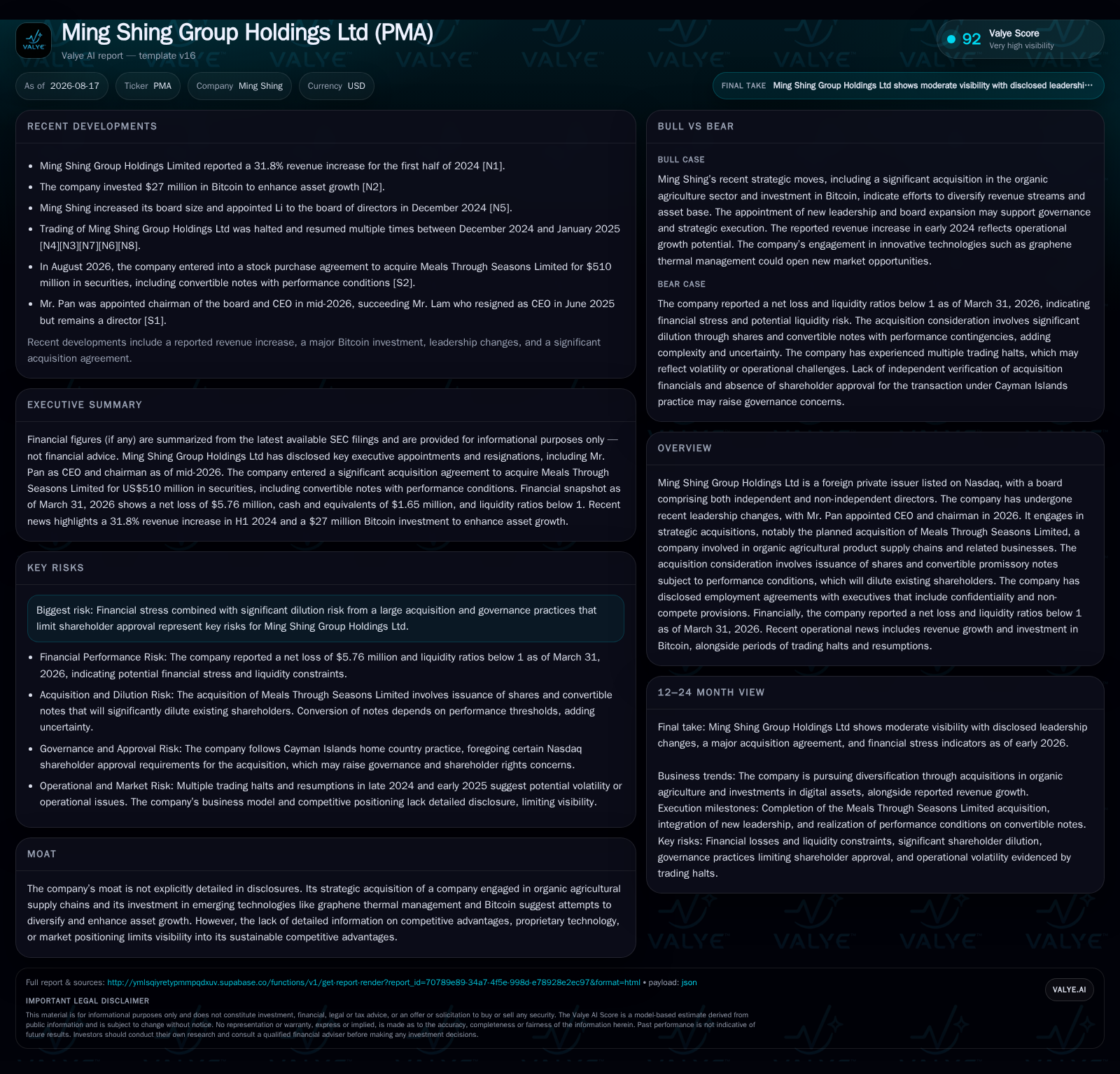
In August 2026, Ming Shing Group Holdings disclosed a pivotal acquisition deal to buy Meals Through Seasons Limited for $510 million via stock and convertible promissory notes, marking a strategic pivot beyond its cyclical industrial construction project management base. The transaction significantly alters capital structure, introducing large convertible debt and shareholder dilution risks amid existing liquidity constraints, with the current ratio at 0.71 as of March 2026. The company also integrates emerging graphene thermal technology through its PMA subsidiary to complement the new agricultural supply chain segment. Ming Shing must navigate cost estimation uncertainties, subcontractor performance dependencies, and volatile tender bidding cycles common to its core revenue model, while managing execution risk of its diversification strategy.
Acquisition Deal Transforms Ming Shing’s Strategic Profile and Capital Structure
In August 2026 filings, Ming Shing Group Holdings announced an agreement to acquire Meals Through Seasons Limited (MTS) for approximately US$510 million paid entirely in securities rather than cash [S2]. The consideration comprises issuance of 150 million Class A ordinary shares valued at US$150 million at a fixed price of US$1.00 per share plus US$360 million in unsecured convertible promissory notes without fixed maturity or interest obligations but convertible into company shares at the same price [S2]. These convertible notes rank pari passu with other unsecured obligations, creating a substantial potential dilution overhang.
This acquisition marks a strategic pivot expanding beyond Ming Shing's traditional project-based construction management into organic agricultural supply chain operations including farming bases, processing centers, cold chain logistics, and channel sales managed by MTS subsidiaries incorporated internationally [S2], [S3]. While this approach conserves cash by using securities for payment, it materially alters the capital structure toward equity and convertible debt financing—raising dilution risks unless future profit accretion offsets these effects.
Project-Based Revenue Model Hinges on Tender Success and Subcontractor Execution Risks
Despite diversification efforts, Ming Shing’s core business continues to rely on executing discrete construction projects won mainly through competitive tender bidding under fixed-price contracts that are inherently non-recurrent [S1]. This model results in volatility driven by tender invitation frequency and bid success rates—factors sensitive to economic conditions such as Sino-U.S. trade tensions affecting Hong Kong and China markets [S1].
Execution depends heavily on subcontractor management since much site work is outsourced based on qualifications, market rates, timing availability, and reputation. Although the company supervises subcontractors closely, it remains exposed to risks from subpar quality or delays that threaten margins and may trigger contractual penalties related to safety compliance failures mandated by clients [S1].
Accurate cost estimation presents another challenge; unforeseen site conditions or material price increases can cause actual costs to exceed estimates. Under fixed-price contracts, these overruns are typically absorbed by Ming Shing itself, risking profitability erosion and liquidity stress [S1]
Emerging Venture: Integrating Graphene Thermal Technology in Agricultural Supply Chains
Complementing the MTS acquisition is Ming Shing’s PMA Nano Carbon Technology subsidiary’s graphene thermal management innovations aimed at temperature control applications within agriculture—such as greenhouses, cold storage facilities, low-temperature drying processes, and deep freezing scenarios [S3].
Initial cooperation under a non-binding Memorandum of Understanding (MOU) targeted pilot projects combining PMA’s technology with MTS’s agricultural infrastructure for product development and commercialization focused on cold-chain logistics efficiency [S3]. Though still early-stage without current revenue from this synergy, this cross-industry integration signals Ming Shing’s intent to innovate beyond traditional construction services toward capturing niche growth opportunities linked to sustainable agriculture supply chains.
Competitive Environment: Cyclicality in Contract Awards and Subcontractor Reliance
Ming Shing operates in a sector marked by significant cyclicality; tender volumes fluctuate with government infrastructure spending patterns and real estate market conditions in Hong Kong/China. Economic uncertainties such as trade disputes can dampen demand for new projects, affecting revenue visibility across periods [S1]
Subcontractor performance variability directly impacts operational risk through potential schedule delays or failure to meet quality/safety standards—leading to penalties or strained client relationships critical for future contract awards. These exposures are acute given Ming Shing's scale compared to larger competitors with more diversified portfolios or geographic reach.
Growth Drivers: Diversification, Technology Adoption, and Market Expansion
The acquisitions reflect a strategic push toward diversifying revenue streams beyond lumpy project-based construction earnings. Specifically, entering organic agricultural product supply chains combined with cold chain logistics taps into growing consumer demand for fresh organic produce supported by advanced thermal technologies from PMA Nano Carbon Technology [S2], [S3], [S1].
Graphene-based thermal solutions could provide competitive differentiation if scaled effectively.
Additionally, recovery prospects in Hong Kong property development could bolster contract volumes while pilot programs expanding agriculture tech applications align with sustainability trends offering long-term demand growth.
Risks: Dilution, Cost Overruns, Liquidity Strain, and Integration Complexity
Key risks include shareholder dilution from issuing $150 million in new shares plus $360 million in convertible notes convertible at $1 per share—potentially expanding equity substantially if conversions occur without proportional earnings growth [S2]
Operationally, inaccurate project cost estimations expose the company to overruns caused by unforeseen conditions or material price hikes borne under fixed-price contracts—compounded by subcontractor reliability issues. Safety-related penalties add further downside risks if subcontractors fail compliance but claims against them are limited by relationship considerations [S1].
Integrating large acquisitions across industrial-agricultural sectors adds execution complexity that may strain management focus or delay realization of synergies essential for improving profitability.
Key Investor Monitors: Tender Wins, Cost Management & Integration Progress
Investors should monitor tender win rates reflecting backlog replenishment ability amid project unpredictability [S1], alongside counts of new contract awards signaling pipeline health.
Cost variance metrics comparing actual expenses versus estimates will indicate execution discipline post-acquisition amidst increased operational complexities.
Subcontractor performance including safety compliance will remain crucial given direct links between penalties incurred previously and profit erosion.
Progress integrating PMA graphene technology with MTS agricultural operations should be tracked via incremental revenue recognition following acquisition closure plus announcements regarding commercialization or pilot expansions [S2], [S3], [S1].
Finally, conversion activity of the sizable convertible notes will materially affect capital structure dynamics and shareholder dilution outlook.
Financial Profile Discussion: Operating Losses Amid Liquidity Constraints and Convertible Debt Exposure
As of March 31, 2026 balance sheet data shows cash and equivalents at roughly $1.65 million against total debt near $7.08 million resulting in net debt around $5.43 million; current liabilities exceed current assets leaving a stretched current ratio near 0.71 highlighting working capital funding pressures exacerbated by reduced accounts receivable balances partly due to contraction in project scale from prior periods [F1]
The newly issued unsecured convertible promissory notes tied to acquisitions carry no interest or fixed maturity but introduce notable leverage embedded within the expanded capital structure requiring careful liquidity management going forward [S2]
Operating losses approximated $5.47 million further strain retained earnings while management acknowledges substantial uncertainty regarding timing for profitable turnaround driven by legacy wet trade contracts renewal prospects aligned with property market recoveries plus uncertain returns from newly acquired businesses venturing into organic agriculture supply chains reliant on maturation of graphene applications introduced through PMA subsidiaries [F1], [S1].
Overall financial flexibility remains constrained pending successful execution milestones driving improved cash flows sufficient to support ongoing operations without excessive reliance on external capital raises.
This analysis synthesizes disclosures available as of August 2026 without extrapolation beyond publicly confirmed data ([F1]) contextualized within industrial construction/project management sector dynamics relevant for Ming Shing Group Holdings Ltd (PMA). It does not constitute investment advice or research views.
Disclaimer: This is research-only, informational analysis and not investment advice. It may include AI-generated interpretation and general industry context. Always verify important details using primary sources.

Comments