
Prime Medicine’s Gene Editing Platform Faces Critical Capital and Regulatory Hurdles
Prime Medicine advances its prime editing therapies while grappling with deepening operating losses, regulatory uncertainties, and arbitration disputes.
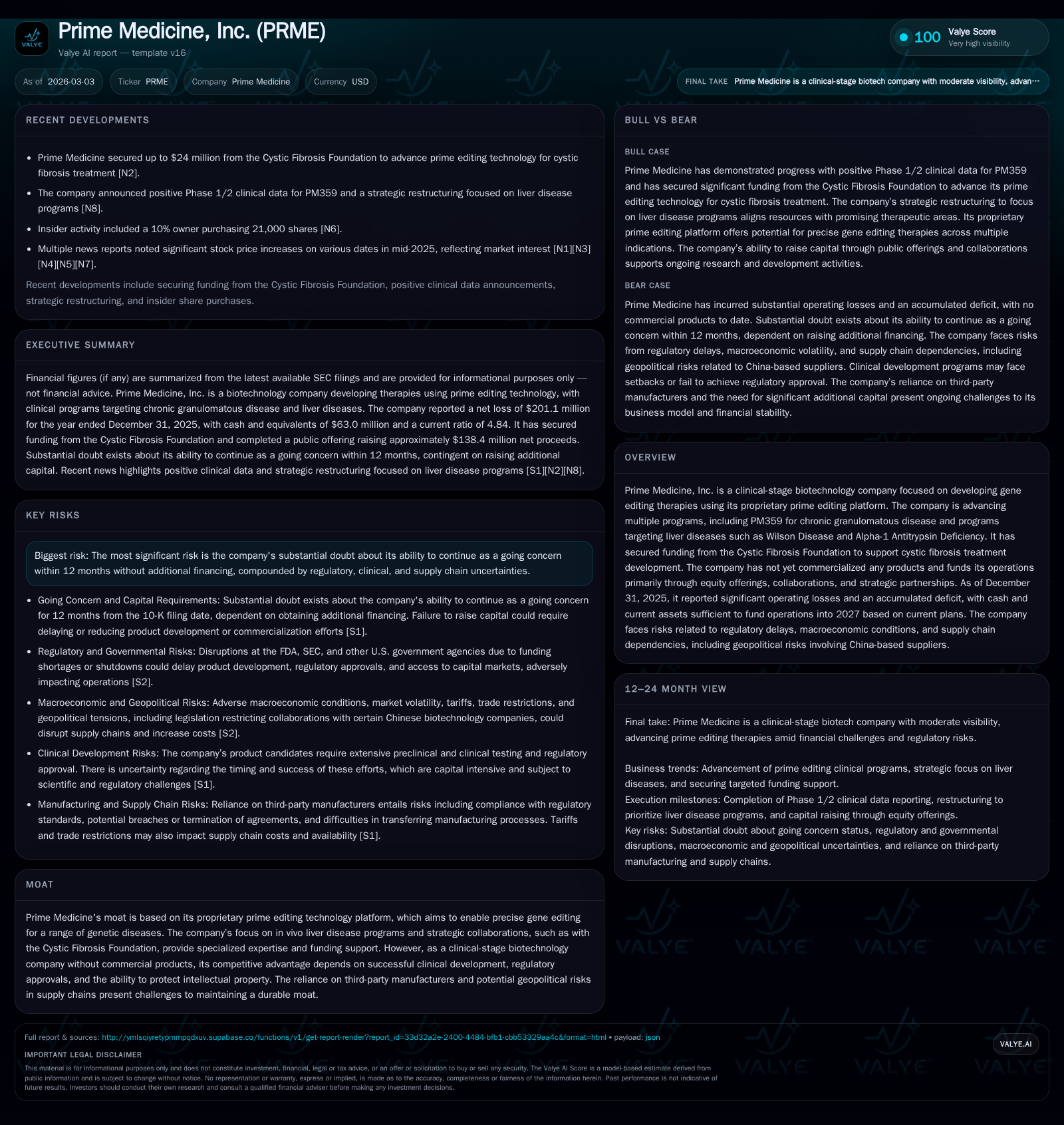
Prime Medicine, Inc. continues to develop its proprietary prime editing technology targeting genetic diseases, focusing its pipeline towards liver disorders such as Wilson Disease and Alpha-1 Antitrypsin Deficiency. Despite expanding laboratory infrastructure and progressing key programs into regulatory submission phases slated for 2026, the clinical-stage biotech faces sustained significant operating losses exceeding $200 million annually, with cash reserves sufficient only to fund operations into 2027. Compounding these financial pressures are regulatory risks including FDA delays due to government shutdowns and an ongoing arbitration dispute with partner Beam Therapeutics, which together raise questions on development pacing and capital sustainability. The company’s ability to secure further financing and successfully navigate regulatory pathways will be critical for advancing clinical milestones and preserving its competitive edge in gene editing therapeutics.
Evolution of Prime Editing: Past Growth and Programmatic Shifts
Historical performance (annual)
| FY | Net ($mm) | CFO ($mm) | OpInc ($mm) | Capex ($mm) | Net YoY |
|---|---|---|---|---|---|
| 2025 | -201 | -163 | -208 | 5 | -2.7% |
| 2024 | -196 | -123 | -202 | 7 | +1.1% |
| 2023 | -198 | -165 | -205 | 9 | -62.6% |
| 2022 | -122 | -132 | -117 | 16 |
Source: SEC companyfacts cache [F1].
Capital returns and efficiency (annual)
| FY | FCF ($mm) | ROE% |
|---|---|---|
| 2025 | -167 | -166.4 |
| 2024 | -130 | -127.9 |
| 2023 | -174 | -148.9 |
| 2022 | -148 | -38.5 |
Source: SEC companyfacts cache [F1].
Prime Medicine’s financial trajectory over recent years highlights the steep costs associated with pioneering gene editing therapies. Operating income worsened from -$116.5 million in FY2022 to -$208.4 million in FY2025 [F1], reflecting growing R&D scale balanced against strategic headcount reductions announced in May 2025 that reduced personnel expenses by approximately $9.3 million between 2024 and 2025 [S1].
The year-on-year increase in total R&D expense (+$5.3 million) was driven mainly by a $11.0 million rise in facility-related costs tied to lab expansions at Cambridge locations (60 First Street and 500 Arsenal Street), illustrating Prime’s commitment to developing infrastructure capable of supporting intensive molecular biology research on prime editing [S1]. In addition, licensing fees and intellectual property costs rose by nearly $6.9 million, predominantly from restricted stock unit issuances enhancing technical talent retention incentives during turbulent financial periods [S1].
Conversely, the company de-emphasized certain research streams; specifically, expenditures related to chronic granulomatous disease (CGD) programs were curtailed by over $6 million as efforts pivoted toward more promising in vivo liver-targeted gene therapies [S1]. This rebalance underscores a strategic recalibration aiming to capitalize on therapeutic indications with clearer commercial potential despite the high inherent clinical risk.
General & administrative costs expanded marginally (+$2.2 million), driven primarily by a $7.0 million surge in professional fees reflecting heightened corporate legal activities—partially attributable to arbitration proceedings—offset by lower personnel expenses resulting from non-cash stock compensation adjustments [S1]. Facility-related overheads allocated outside R&D decreased slightly as more space usage shifted toward scientific pursuits.
This blend of increasing fixed infrastructure commitments alongside deliberate human capital downsizing paints a nuanced cost structure optimizing research capacity while managing cash burn under funding constraints.
Expanding Clinical Frontiers: Advancing Liver Disease Programs
Clinically, Prime Medicine is advancing several lead candidates focused on severe inherited liver disorders – notably Wilson Disease and Alpha-1 Antitrypsin Deficiency (AATD) – with plans for IND or CTA submissions targeted within 2026 [S1], [S2]. These filings are critical regulatory steps designed to gain clearance to initiate human trials for these genetic therapies employing the company’s proprietary prime editing platform.
PM359 remains under evaluation primarily for chronic granulomatous disease but has been deprioritized relative to liver programs due to strategic considerations [S1]. Notably, clinical expense line items grew modestly (+$1.2 million) reflecting increased activity supporting these pending submissions [S1].
The transition from early discovery toward regulated clinical trial readiness reflects typical resource intensification around IND preparation activities encompassing toxicology studies, vector manufacturing scale-up under cGMP protocols, and regulatory dossier assembly – all resource-intensive stages requiring close coordination with FDA reviewers.
In sector terms, securing an IND or CTA represents a complex milestone involving extensive preclinical proof-of-concept validation coupled with safety assays delineating risk profiles before human dosing can commence — underscoring why shifts in resources toward these programmatic fronts dominate expenditure.
Financial Landscape: Operating Losses, Cash Position, and Investment Reliance
Prime Medicine’s financials reveal persistent heavy losses characteristic of clinical-stage biotechs without commercial revenue streams. Operating expenses translated into an operating loss of approximately $208.4 million in FY2025—a slight worsening (-2.9%) versus FY2024’s near $202.5 million loss [F1]. Similarly, net losses edged downwards marginally (-2.7%) from -$195.9 million to -$201.1 million year-over-year.
Operating cash flow deteriorated significantly (-32%) reaching roughly -$162.6 million in 2025 reflecting elevated cash burn aligning with accelerated R&D programs but also exacerbated by timing differences on payables and working capital movements known in biotech cycles [F1]. Capital expenditures diminished steadily by nearly 38% relative to peak FY2022 spending ($16.0 million), settling at about $4.5 million for FY2025 as the company curtailed large upfront facility investments favoring incremental infrastructure enhancements [F1].
Liquidity metrics remain relatively strong; Prime reported cash plus short-term investments approximating $177 million at year-end 2025 [S11], yielding a current ratio near 4.8x when juxtaposed against current liabilities around $37 million—a buffer sufficient for operations forecasted into 2027 at existing burn rates [F1], [S11]. However, management clearly signals significant doubt regarding continued operations beyond this horizon absent additional capital infusion given persistent negative cash flows combined with escalating regulatory demands [S1], [S11].
Financing historically stems predominantly from equity offerings—the August 2025 public placement yielding $138.4 million—as well as collaborative funding exemplified by payments under agreements such as from the Cystic Fibrosis Foundation reaching $12 million during the year [S11], underscoring the company's dependence on external liquidity sources rather than product-derived income.
Maintaining disciplined burn management while aggressively advancing pipeline assets typifies the struggling but innovative biotech growth model noted here.
Regulatory and Legal Risks Posturing Development Timelines
Prime Medicine confronts acute regulatory execution risks emblematic of emerging biotechnologies reliant on FDA oversight amidst U.S. federal institutional complexities. The protracted government shutdown initiated October 1, 2025 disrupted normal functioning across agencies including FDA, SEC, and USPTO—with direct ramifications on investigational new drug reviews, public filing approvals, patent processing times, and potentially delaying clinical trial initiations or amendments [S2], [S5].
Such interruptions heighten timing uncertainties for key development milestones like IND or CTA approvals critical for oncology or genetic disorder trials necessitating precise scheduling under strict compliance frameworks.
Complicating matters further is active arbitration with Beam Therapeutics pertaining to collaboration agreement disputes surrounding AATD development announced March 18, 2025; this legal contention threatens cooperative synergies essential for sharing IP rights or manufacturing capabilities, adding operational friction that may affect timelines or market entry strategies [S4].
The overlay of these legal-regulatory constraints imposes substantial execution risk beyond typical clinical trial uncertainties further compounded by healthcare law intricacies particularly concerning compliance with anti-bribery statutes such as FCPA possibly impacting international trials or collaborations [S6], [S9].
Biotech firms often face such multilayered compliance landscapes that can stall otherwise promising clinical advancements.
Capital Allocation Patterns and Return Metrics Under Stress
Evaluating Prime’s capital deployment reveals heavy prioritization of R&D outlays amid constrained discretionary funds characteristic of pre-commercial biotechnology entities [F1]. Negative return measures—in particular an estimated ROE near -166% in FY2025 derived from net losses over equity—reflect no current profitability typical before product commercialization stages where shareholder value accrues through pipeline valuation growth rather than traditional earnings metrics.
Capex reduction trends signify cautious approach balancing infrastructure needs against limited capital availability; however modest investments remain strategically focused on cGMP manufacturing capabilities and laboratory build-outs essential for later-stage development requirements—a key bottleneck area often underestimated until late development phases.
No dividend distributions or share repurchases exist given early-stage financial profile; all internally generated cash flows remain negative demonstrating reliance on external funding rounds or partnership contributions that dilute shareholder base but provide vital operational runway.
This reinvestment-first paradigm aligns with industry norms where scientific milestones presage eventual commercial returns rather than immediate shareholder yield enhancement.
Strategic Partnerships and Funding Support From Specialty Foundations
While no direct citations enumerate all collaborations explicitly beyond regulatory filings, Prime secured notable funding commitments from specialized entities such as the Cystic Fibrosis Foundation bolstering cystic fibrosis-related gene editing programs per company overview disclosures . This mode of foundation-backed grant funding serves dual purposes—injecting non-dilutive capital while validating therapeutic targets within rare disease niches often overlooked by broader pharmaceutical investment.
Such partnerships enhance risk sharing mechanisms inherent in early development phases mitigating some financing hurdles linked with costly preclinical/clinical trials while providing access to patient networks aiding recruitment strategies essential under highly selective enrollment paradigms.
Foundation support reflects an increasingly prevalent strategy among biotech innovators seeking diversified capital sources beyond traditional venture or public equity pipelines given extant dilution risks.
Key Upcoming Operational Milestones to Watch in 2026
Investor attention should focus keenly on Prime Medicine’s advancement of IND/CTA submissions planned within calendar year 2026 targeting Wilson Disease and AATD gene therapies per latest disclosures [S1]. These filings will serve as bellwether events signaling progress toward first-in-human trials fundamental for de-risking program portfolios.
Although explicit forecast guidance is absent given developmental uncertainties common within biotechnology sectors, successful acceptance of these regulatory packages could catalyze subsequent phase 1 trial initiations potentially accelerating valuation inflection opportunities should clinical proof-of-concept emerge favorably.
Conversely delays attributable either to regulatory bottlenecks induced by governmental agency disruptions or arbitration fallout might defer timelines significantly warranting close monitoring via official communications typically released prior to trial commencements.
Tracking milestone achievement remains a core component of buy-side diligence evaluating binary event-driven risk profiles intrinsic in gene-editing therapeutic innovators.
Manufacturing Dependencies and Supply Chain Vulnerabilities
Prime Medicine benefits technically from exclusive access to its prime editing technology underpinning unique therapeutic potential yet operationally remains reliant on third-party contract manufacturing organizations (CMOs)—a vulnerability underscored given increasing geopolitical uncertainties impacting global supply chains cited within company risk factors sections .
Gene therapy products necessitate stringent cGMP manufacturing environments alongside complex vector production processes reliant on highly specialized biological materials; capacity constraints or quality control lapses at manufacturing partners could delay trial material availability jeopardizing tight clinical timelines.
Although plans exist for potential commercial-scale cGMP facility construction mentioned within risk disclosures contingent upon future strategic decisions (and demanding substantial capital), currently external dependency tempers agility providing exposure embodied uniquely within gene-editing clinical stage developers not yet vertically integrated across the value chain [S1], .
Hence supply chain robustness constitutes a critical operational metric affecting advancement pace uncommonly salient compared to traditional small molecule pharmaceutical pipelines.
Navigating Public Company Costs and Scaling Organizational Infrastructure
Operating as a listed entity introduces considerable incremental fixed costs reflected notably through escalating corporate legal expenditures (+$7M increase largely due to arbitration-related activity) juxtaposed against overall staff reductions reducing non-cash stock compensation expenses thus tempering total general & administrative outlays somewhat ($23M personnel expense down vs prior year) demonstrating deliberate cost control measures amidst organizational complexity growth [S1].
Investments into management systems aimed at enhancing compliance capabilities including finance controls are ongoing necessities demanded by regulators imposed upon emerging biotechs facing layered disclosure requirements above private status privileges.
Balancing scientific depth retention against scaling commercialization readiness presents organizational maturity challenges ubiquitous among transition-phase biotech companies attempting simultaneous innovation management alongside public market scrutiny pressures limiting flexibility.[F1],[S1]
This analysis provides an integrated view grounded strictly in Prime Medicine’s disclosed financial statements and regulatory filings through March 3, 2026. Interpretations regarding strategic shifts or operational implications rely solely on stated facts without speculative forecasts beyond documented evidence provided by company reports or authoritative sources referenced herein.
Disclaimer: This is research-only, informational analysis and not investment advice. It may include AI-generated interpretation and general industry context. Always verify important details using primary sources.

Comments