
Purple Innovation Navigates Profitability Challenges with Proprietary Technology and Omni-Channel Expansion
First quarter 2026 results highlight ongoing investment in innovation and distribution amidst continued net losses.
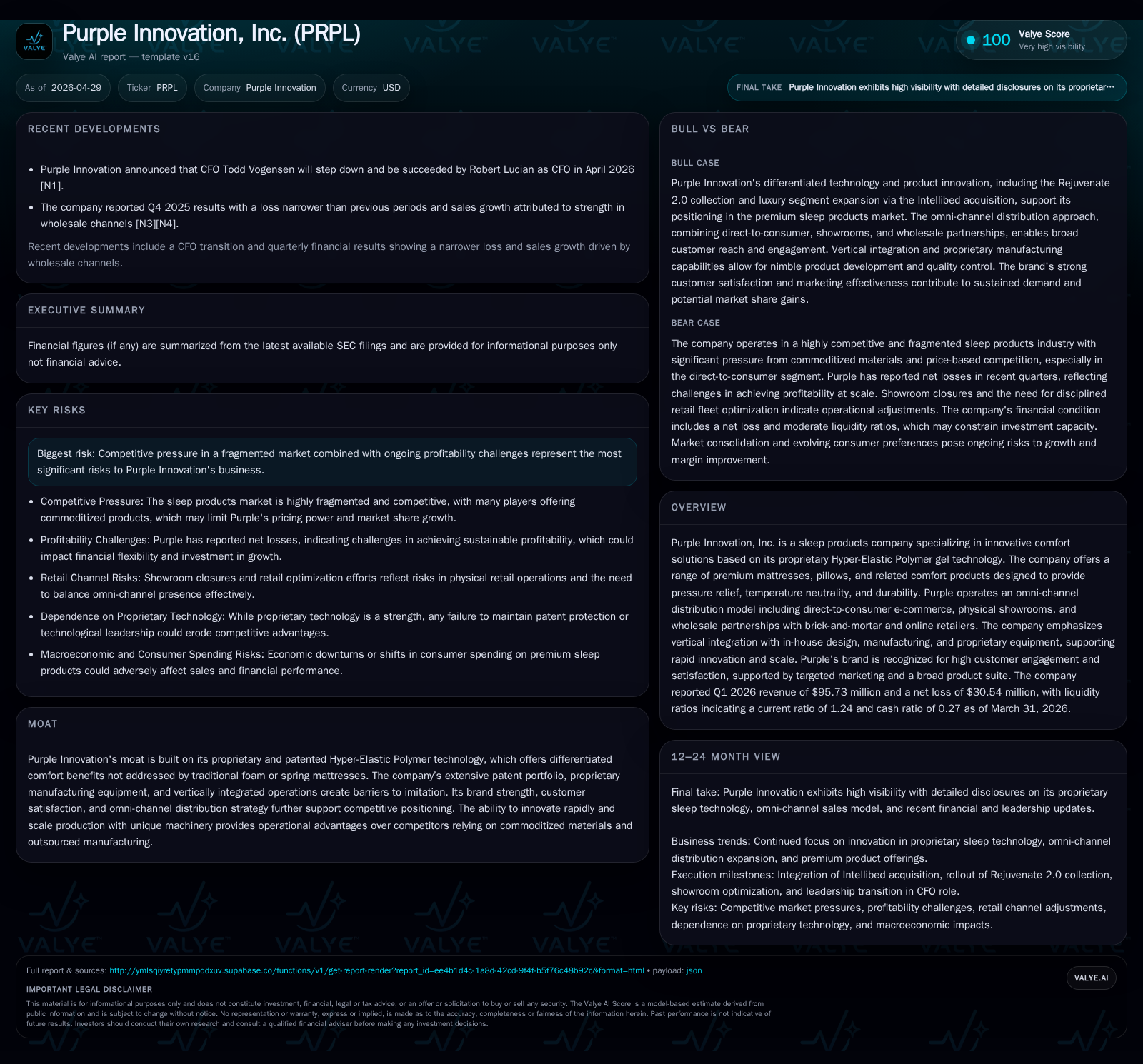
Purple Innovation reported Q1 2026 revenue of $95.73 million but a net loss of $30.54 million, reflecting ongoing profitability challenges despite strong brand and technology differentiation. The company’s Hyper-Elastic Polymer gel technology underpins its product portfolio and distinctive customer experience, supporting an omni-channel business model combining direct-to-consumer and wholesale channels. Strategic investments in manufacturing capabilities and expansion of wholesale relationships position Purple to capture broader market share, while competitive pressure and cost structure remain key risks. Leadership changes in finance signal focus on strategic financial management as the company pursues adjusted EBITDA targets and revises 2026 revenue guidance.
Recent Operating Update: Q1 2026 Financials and Leadership Change
Purple Innovation filed its latest quarterly report on April 28, 2026, revealing first quarter revenue of $95.73 million alongside a net loss of $30.54 million [S2][S3]. The company reaffirmed its adjusted EBITDA guidance while updating its net revenue outlook for 2026 in the accompanying press release [S3], signaling confidence in operating performance improvement despite near-term profitability challenges.
Concurrently, Purple announced the resignation of CFO Todd Vogensen effective May 1, replaced by Robert G. Lucian who brings extensive leadership experience including recent tenure at La-Z-Boy and Procter & Gamble [S16][S17][S18][S19]. This transition underscores a strategic focus on disciplined financial management as the company navigates margin pressures.
Business Model: Proprietary Innovation Coupled with Omni-Channel Reach
Purple Innovation operates at the intersection of premium sleep products and patented material technology. The company's proprietary Hyper-Elastic Polymer gel — developed over three decades originally for medical applications — differentiates its mattresses, pillows, cushions, bases, and sheets by delivering enhanced pressure relief, temperature regulation, and durability [S1]. This unique technology is supported by robust IP protection including patents on both materials and manufacturing processes, forming a tangible moat against commodity mattress competition.
The business model leverages vertical integration encompassing research and development, marketing, manufacturing, and proprietary injection molding equipment designed specifically for their unique polymer gel [S1]. By owning key parts of the value chain — unlike many competitors who outsource production or rely on foam materials — Purple can experiment rapidly with new designs while controlling quality and cost structure scalability.
Revenue generation flows from multiple channels:
- Direct-to-consumer (DTC): via Purple.com ecommerce platform, branded showrooms across key markets, plus a dedicated customer contact center enabling service excellence.
- Wholesale partnerships: The company strategically expanded its retail footprint through partnerships with major brick-and-mortar chains such as Mattress Firm (since 2017), Ashley Furniture, Big Sandy, Costco, Denver Mattress, Living Spaces among others [S1]. These partners carry a curated selection of four to five mattress models balancing assortment complexity against inventory efficiency.
Marketing plays an essential role supported by data-driven campaigns enhancing brand awareness combined with authentic word-of-mouth from highly engaged customers who repeatedly purchase across product lines [S1]. This synergy drives conversion efficiencies across online and offline touchpoints.
Industry Structure & Competitive Positioning
Purple competes within a highly fragmented sleep products market characterized by low switching costs but substantial brand loyalty when comfort innovations resonate. Traditional foam or spring mattresses dominate volume sales due to established price points and supply chains; however, these materials lack the pressure relief or temperature neutrality offered by Purple’s patented gel technology.
The firm's advantage lies in:
- Its patented Hyper-Elastic Polymer delivering clear consumer benefits not easily replicated by foam-centric competitors.
- Proprietary manufacturing technologies that allow for large-format injection molding unattainable by standard third-party producers.
- A growing omni-channel presence bridging ecommerce dynamism with brick-and-mortar convenience.
Yet this differentiation comes with cost tradeoffs given investment in specialized machinery and warranty commitments—Purple offers a ten-year mattress warranty creating long-term liability exposure that must be managed carefully through quality control [S1].
Pricing power appears somewhat constrained by competition from discount mattress brands intensified during cyclical downturns when discretionary consumer spending shrinks.
Growth Drivers
Expanding Wholesale Partnerships
Purple continues adding top-tier wholesale accounts beyond Mattress Firm to broaden distribution reach into traditional furniture stores and big-box retailers offering high foot traffic.[S1] This channel diversification reduces dependency on any single partner while increasing brand visibility among consumers preferring physical shopping experiences.
Product Line Extensions & Innovation Cycle Velocity
New introductions leveraging their proprietary gel technology provide opportunities for upselling existing customers — pillows, bedding accessories alongside mattresses encourage increased average order values.[S1] Vertical integration accelerates time-to-market enabling responsiveness to shifting consumer preferences.
Marketing Efficiency & Customer Loyalty Programs
Data-driven marketing enhances targeting precision reducing customer acquisition costs over time.[S1] Moreover, strong customer satisfaction fosters inbound referrals augmenting organic growth channels.
Operational Scaling & Cost Optimization
Investment in custom manufacturing machinery supports capacity increases necessary for volume expansion while aiming for improved gross margins.[S1]
Risks / Watchpoints / Growth Constraints
Despite technological moat elements, Purple faces meaningful risks:
- Profitability Challenges: Sustained net losses highlight ongoing difficulty balancing growth investments with margin improvement.[S2]
- Competitive Pressure: Fragmented mattress industry intensifies price competition; commoditized foam alternatives may limit price elasticity.[S1][S13]
- Warranty Liability: The ten-year warranty span entails accruing liabilities estimated conservatively but exposing potential volatility if claims trend upward.[S1]
- Manufacturing Complexity: Proprietary production processes introduce operational risk including scaling bottlenecks or higher fixed costs relative to outsourced competitors.[S1]
- Economic Sensitivity: Demand likely exhibits cyclical sensitivity tied to housing activity and consumer discretionary spending impacting premium sleep product purchases.
What to Watch Next
Key milestones include:
- Execution on updated 2026 net revenue guidance reaffirmed post-Q1 results signals progress against growth initiatives.[S3]
- Adjusted EBITDA performance monitoring to assess trajectory toward profitability targets announced.[S3]
- Wholesale channel expansion announcements or deeper assortment placements within existing partners providing indications of scaling success.
- New product launches or innovations exploiting proprietary polymer advantages sustaining category relevance.
- Impact of new CFO Robert Lucian’s financial stewardship on capital allocation decisions given prior restructuring experience.[S16][S17][S18]
Financial Profile (Q1 / Snapshot Context)
Latest financial snapshot
| Metric | Value | Period |
|---|---|---|
| Cash & equivalents | $25mm | |
| 2026-03-31 | ||
| Current assets | $116mm | |
| 2026-03-31 | ||
| Current liabilities | $93mm | |
| 2026-03-31 | ||
| Current ratio | 1.24x | |
| 2026-03-31 |
Source: SEC companyfacts cache [F1].
Purple's liquidity evidence at quarter-end shows cash & equivalents of approximately $25 million versus current liabilities near $93 million resulting in a current ratio of 1.24—marginally above unity but not indicative of excess cushion [F1][S2]. While total debt figures are somewhat dated (reported at roughly $100 million end-2022), derived net debt approximates $75 million when adjusted against cash balances suggesting moderate leverage intensity remains [F1].
Revenue for full year 2025 totaled $468.7 million but operating income was negative at approximately -$43 million alongside a net loss surpassing -$51 million illustrating the margin pressures persisting over recent periods [F1].
This financial backdrop confirms the importance of earnings improvement initiatives even as top-line grows.
This analysis is based solely on publicly filed SEC documents up to April 28, 2026 (), companyfacts data as of March 31, 2026 ([F1]), and reputable news sources (). It does not constitute investment advice or recommendations but aims to provide an informed evaluation of Purple Innovation’s operational state within its industry context.
Disclaimer: This is research-only, informational analysis and not investment advice. It may include AI-generated interpretation and general industry context. Always verify important details using primary sources.

Comments