
Prospect Capital Corp Q3 2026: Portfolio Stability and Capital Structure Update
Prospect Capital Corporation reports a modest NAV decline amid a leveraged capital structure and persistent valuation discounts in its middle-market loan portfolio.
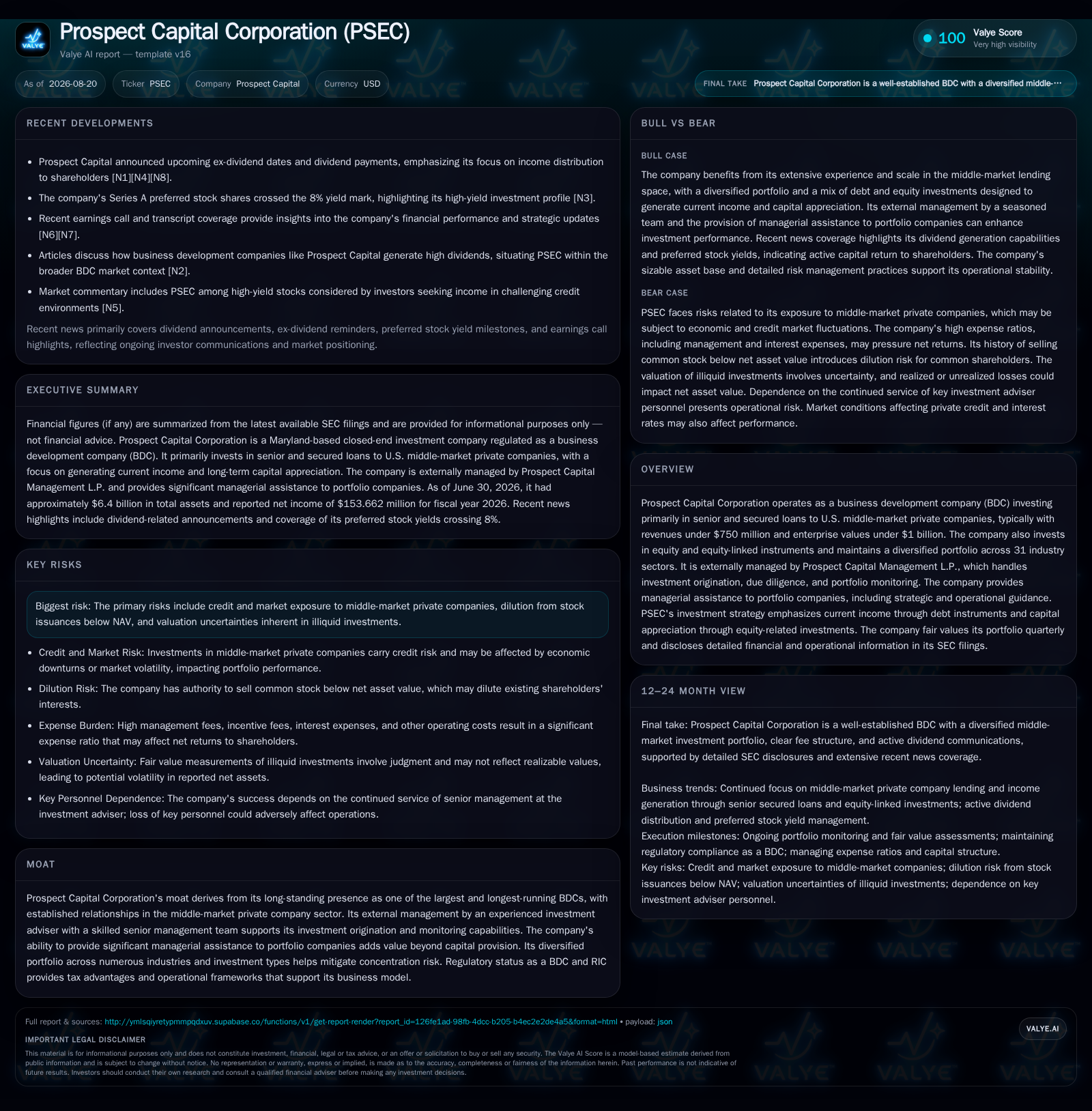
In Q3 2026, Prospect Capital Corporation's net asset value (NAV) per share declined to $6.05, with its common stock trading at nearly a 50% discount to NAV, reflecting ongoing valuation pressures in the middle-market loan portfolio. The company maintains a diversified portfolio focused on senior secured loans to U.S. middle-market private companies, supported by external management and operational assistance. Its capital structure remains highly leveraged, with approximately $1.88 billion in total debt and limited cash liquidity, consistent with typical business development company (BDC) norms but exposing the firm to refinancing and credit risks.
Q3 2026 Operating and NAV Update
Prospect Capital Corporation reported a net asset value (NAV) per common share of $6.05 as of March 31, 2026, down from $6.21 in the prior quarter. Concurrently, the company's common stock traded at a discount of approximately 49.6% to NAV, underscoring persistent valuation challenges within its portfolio [S2]. This discount reflects market skepticism regarding the fair value and liquidity of the underlying assets, which are primarily middle-market private company loans. The company's portfolio remains diversified across 31 industry sectors, focusing on senior and secured loans to U.S. middle-market companies, typically with revenues under $750 million and enterprise values below $1 billion. Individual investments generally do not exceed $250 million, consistent with the company's strategy to mitigate concentration risk [S1].
The NAV decline and large discount to NAV reflect valuation pressures influenced by credit market volatility and the illiquid nature of private investments, which can lead to fluctuations in valuation and investor sentiment [S2]. NAV is fair valued quarterly based on portfolio performance and market conditions, but the exact size of the discount varies over time and should not be assumed to be an exact contemporaneous measure of market value.
Capital Structure and Liquidity Position
As of June 30, 2026, Prospect Capital Corporation's balance sheet showed total debt of approximately $1.88 billion, offset by cash and equivalents of $43.6 million, resulting in a net debt position near $1.84 billion [F1]. This capital structure exhibits significant leverage, typical for business development companies (BDCs) that utilize debt financing to enhance returns. However, the limited liquidity relative to debt levels highlights the company's reliance on debt markets for ongoing investment activities and refinancing needs [S2].
The leverage ratio and net debt position expose the company to refinancing and interest rate risks, particularly if credit conditions deteriorate or capital markets tighten [F1]. The constrained working capital, with cash representing a small fraction of total debt, means that Prospect Capital must maintain access to capital markets to fund new investments and manage maturing obligations. This reliance on external financing is a structural feature of the BDC model but also a potential vulnerability in volatile credit environments
Business Model and Investment Strategy
Prospect Capital operates as an externally managed BDC, with Prospect Capital Management L.P. providing investment origination, due diligence, portfolio monitoring, and managerial assistance to portfolio companies, thereby adding operational value beyond capital provision [S1]. This external management structure allows the company to leverage specialized expertise in middle-market lending and equity investing.
The company’s investment strategy emphasizes generating current income primarily through senior secured loans and second lien loans to U.S. middle-market private companies [S1]. These loans are typically senior debt instruments secured by portfolio company assets, which rank ahead of unsecured debt and equity. Additionally, Prospect Capital invests in equity and equity-linked securities such as convertible debt, preferred equity, common equity, and warrants to capture capital appreciation potential
The portfolio is diversified across 31 industry sectors to mitigate concentration risk, with typical investment sizes under $250 million [S1]. The focus on middle-market companies with revenues under $750 million and enterprise values below $1 billion targets a segment often underserved by traditional lenders, positioning Prospect Capital as a key capital provider for refinancing, acquisitions, capital expenditures, growth initiatives, and recapitalizations
Risks and Valuation Considerations
The nearly 50% discount of the stock price to NAV and the quarter-over-quarter NAV decline to $6.05 reflect ongoing valuation pressures in the company’s middle-market loan portfolio [S2]. These pressures likely stem from credit market volatility, illiquidity of private investments, and uncertainty in portfolio company performance. NAV is fair valued quarterly based on portfolio performance and market conditions, so fluctuations are expected; however, persistent large discounts indicate market skepticism about asset quality or liquidity.
The company’s leveraged capital structure, with net debt approximately $1.84 billion as of June 30, 2026, exposes it to refinancing risk and interest rate fluctuations, which could impact income generation and shareholder returns if credit conditions worsen or capital access tightens [F1]. The limited cash liquidity relative to debt magnifies these risks, as the company depends on capital markets to refinance maturing debt and fund new investments.
Another risk factor is the potential dilution from issuing common stock below NAV, a practice authorized by shareholders and used historically to raise capital. Such dilution can pressure existing shareholders if equity issuance occurs during periods of NAV weakness. This risk is compounded by the persistent discount to NAV, which may necessitate raising capital at prices below intrinsic value, thereby diluting shareholder equity [S2].
Cybersecurity risks also represent a material concern for Prospect Capital, as outlined in the company’s annual filing. The company’s Board of Directors and management maintain oversight and risk management programs to mitigate potential cybersecurity incidents that could impair business operations or data integrity [S1]. The company’s diversified portfolio, experienced external management, and ongoing portfolio monitoring support stable operations; NAV declines have moderated recently [S2][S1][F1]. This scenario assumes no significant credit defaults or impairments, stable or improving middle-market credit conditions, and access to capital markets for refinancing debt. This scenario is plausible given the illiquid nature of middle-market loans and the company’s significant leverage [S2][S1][F1]. Conditions include economic slowdown, rising defaults or downgrades in portfolio companies, and inability to raise capital without significant dilution. Confirmation would include material NAV declines, increased realized losses or credit impairments, and announcements of dilutive stock offerings or dividend cuts.
Conclusion and Watchpoints
Prospect Capital Corporation’s Q3 2026 results highlight the challenges and dynamics typical of BDCs focused on middle-market private company lending. The company’s diversified portfolio and external management structure provide a foundation for income generation, but significant leverage and persistent NAV discounts underscore risks related to credit quality, valuation uncertainty, and capital structure.
Investors may consider monitoring quarterly NAV per share trends and the discount to NAV, as these metrics can provide insight into portfolio valuation and market sentiment. Portfolio credit quality metrics and impairment levels may serve as indicators of financial health, while the debt maturity schedule and refinancing activity could offer information on the company’s approach to managing leverage and liquidity risks. Cash flow from operations and interest income stability may be relevant to the company’s ability to sustain distributions and operations. Additionally, announcements regarding equity issuance or dividend changes might reflect adjustments in capital strategy or financial conditions.
This comprehensive view, grounded in current financial facts and operating disclosures, provides a balanced understanding of Prospect Capital’s position and prospects within the middle-market BDC sector.
Disclaimer: This is research-only, informational analysis and not investment advice. It may include AI-generated interpretation and general industry context. Always verify important details using primary sources.

Comments