
Power Solutions International’s Surge in Profitability Amid Industry Shifts
PSIX leverages engineered power systems and strategic ownership to drive earnings growth while navigating warranty and supplier risks.
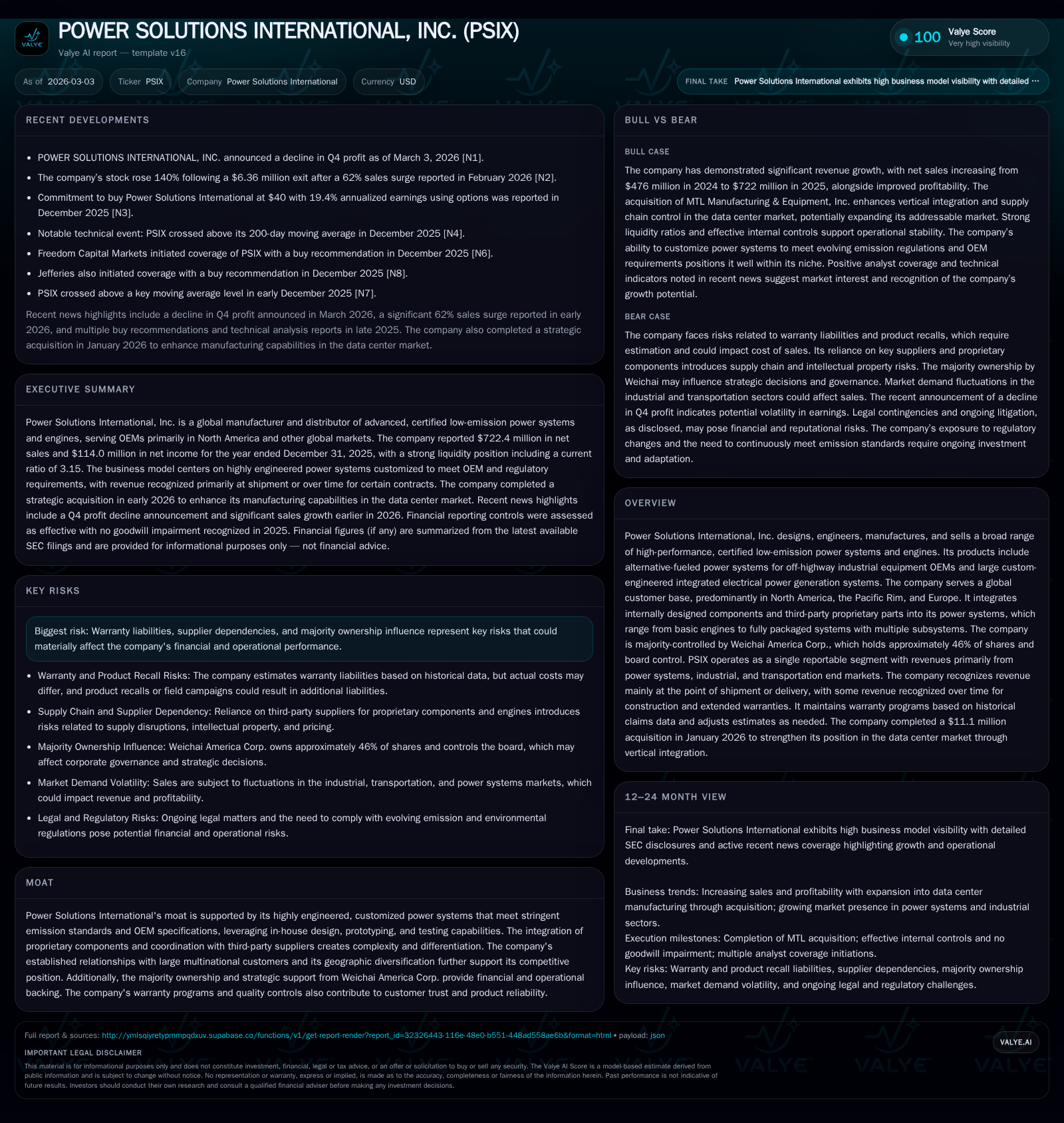
Power Solutions International, Inc. (PSIX) has delivered remarkable profitability acceleration over the past three years, driven by manufacturing efficiency improvements, higher penetration in emission-compliant power systems, and expanding OEM relationships. The company's moat is grounded in its specialized engineering capabilities and stringent emission certification expertise, differentiating it in a competitive power systems market. Despite operational strength, PSIX faces notable risks from warranty liabilities, supplier dependencies, and ongoing litigation. Capital structure has evolved with significant credit facility amendments supporting liquidity while limiting capital returns. Looking ahead, catalysts include recent acquisitions and dual-fuel engine projects, tempered by uncertainties around contract suspensions and legal provisions.
Historical Performance Foundations and Drivers Behind Profit Acceleration
Between fiscal years 2022 and 2025, Power Solutions International (PSIX) markedly reversed its historical profitability trajectory. Operating income surged from $24.6 million in FY2022 to approximately $109.7 million in FY2025 — a near fourfold increase including a robust 34% year-over-year jump from FY2024’s $81.6 million figure [F1]. Concurrently, net income expanded from $11.3 million in FY2022 to roughly $114 million in FY2025, propelled by operating leverage gains and improved product mix.
This escalation rested on several key factors: predominately the company's increasing penetration in power systems certified for low emissions catering mainly to North American OEMs complying with evolving environmental regulations , alongside manufacturing efficiencies reducing unit costs. The Power Systems end market drove the bulk of revenue growth — reaching $586 million in FY2025 from $326 million the prior year as disclosed under segment data [S20]. Complementing this were strengthened customer relationships with industrial equipment manufacturers emphasizing alternative fuel sources such as natural gas, propane, and biofuels integrated into proprietary engine platforms.
Cost controls played an outsized role; warranty expense management during stringent emission warranty compliance programs contributed to margin expansion. The company recognizes revenue both upon shipment of discrete engines and throughout manufacturing for constructed assets enhancing revenue timeliness perception under U.S. GAAP principles governing multi-performance obligation contracts [S21][S22].
Historical performance (annual)
| FY | Net ($mm) | CFO ($mm) | OpInc ($mm) | Net YoY |
|---|---|---|---|---|
| 2025 | 114 | 24 | 110 | +64.5% |
| 2024 | 69 | 62 | 82 | +163.4% |
| 2023 | 26 | 71 | 44 | +133.4% |
| 2022 | 11 | -9 | 25 |
Source: SEC companyfacts cache [F1].
Capital returns and efficiency (annual)
| FY | ROE% |
|---|---|
| 2025 | 63.8 |
| 2024 | 106.2 |
| 2023 | -671.6 |
| 2022 | -37.1 |
Source: SEC companyfacts cache [F1].
Note: Revenue figures are detailed under segment disclosures; operating cash flow volatility likely reflects working capital dynamics.
Custom Engineered Systems: The Moat that Shields Growth
PSIX’s competitive advantage hinges on its ability to engineer custom integrated power systems that meet stringent international emissions regulations while closely calibrating solutions for OEM specifications across off-highway industrial machinery . These low-emission certified powerpacks require sophisticated design, rapid prototyping, rigorous testing regimes, and specialized knowledge in alternative fuels deployment — all contributing significant barriers to entry.
The company operates an ecosystem blending internally designed components with select proprietary third-party parts yielding complex final assemblies tailored by emission standards authorities like EPA and CARB across jurisdictions . These capabilities enable PSIX not only to fulfill large-scale custom-engineered electrical generator packages but also flexible propulsion units optimized for various fuels including bio-derived alternatives.
Moreover, deep-rooted partnerships with worldwide industrial OEMs combined with geographic diversification across North America, Pacific Rim, and Europe cement long-term revenue streams resistant to commoditization pressures common within engine manufacturing sectors . The backing from majority owner Weichai America Corp., who holds a controlling ~46% stake and board influence, provides additional operational stability and access to advanced manufacturing technologies.
Warranty programs complement this moat by embedding trust via quality assurance controls critical for complex emissions warranties often mandated for extended periods post-sale—often challenging competitors reliant on less integrated platforms.
Warranty, Supplier Links, and Legal Challenges: Managing Emerging Risks
Despite operational progress, PSIX navigates pronounced potential headwinds stemming from warranty liabilities linked primarily to emission-controlled products requiring longer post-sale coverage under governmental mandates [S16][S19]. The company recorded accrued product warranty liabilities of $6.6 million at December 31, 2025 indicating active management but persistent exposure.
Supplier dependencies add further complexity since certain supplier warranties are passed through financially but create risk layers in service reliability and component availability impacting customer satisfaction metrics [S16]. Failure rates or repair cost fluctuations materially influence these reserves necessitating ongoing estimate adjustments.
Legal contingencies present financial uncertainty surrounding class action litigation concerning biometric data privacy claims filed under Illinois BIPA statutes resolved through settlement payments totaling approximately $2.4 million during early 2025 – partially covered via insurance reimbursements [S5][S6]. Meanwhile, ongoing arbitration with Mast Powertrain LLC concerning disputed royalty payments carries a liability accrual of about $0.9 million amidst unsettled litigation post-mediation phases evidencing intermittent legal exposures [S19].
Other lawsuits involving former executives’ indemnification claims underscore governance-related risks that could entail unpredictable legal expenses or contingent liabilities without current definitive financial quantification [S19].
These risk factors contrast PSIX’s long-term structural advantages necessitating vigilant warranty cost modeling integrating pass-through mechanisms where feasible as well as proactive legal settlement strategies.
Capital Structure Evolution and Shareholder Returns Dynamics
The company undertook significant capital structure optimization recently highlighted by refinancing activities surrounding its revolving credit facilities secured by most company assets under covenants focused on EBITDA thresholds and interest coverage ratios [S4][S11]. A major milestone was the August 30, 2024 closing on a $120 million Revolving Credit Agreement subsequently amended mid-2025 extending maturity to July 30, 2027 while incrementing borrowing capacity to $135 million at interest tied to SOFR plus defined spreads close to ~2% (adjusted upward if Weichai ownership drops below majority) [S13][S14].
Proceeds offset legacy shareholder loans owed to Weichai amounting to roughly $60 million among other credit line repayments improving leverage profiles significantly within short periods [S4][S11]. As of December 31, 2025 total outstanding long-term debt aggregated around $96.6 million predominantly comprised the revolving credit balance plus minor finance leases whereas cash & equivalents totaled approximately $41.3 million offering moderate liquidity buffers consistent with operating scale [F1][S26].
Cash flow conversion revealed discontinuity; operating cash flow fell steeply by more than 61% year-on-year during FY25 down to $24 million despite record net income growth suggesting increased working capital demand or timing mismatches during revenue recognition cycles typical within project-engineering firms [F1][S22][S23]. Capital expenditures remained controlled supporting steady asset base renewal though reinvestment rates relative to operating cash inflows remain moderate.
No dividends or share repurchases were reported recently nor is there evidence of substantial capital returned beyond debt amortizations implying reinvestment priority into growth initiatives retained earnings deployment primarily targeting scale expansions rather than shareholder distributions yet outcomes may warrant monitoring given elevated ROE near ~64%, signaling efficient equity utilization overall [F1].
Future Catalysts and Constraints Visible in Commercial Agreements
On March 2nd, 2026 PSIX announced closing its acquisition of MTL Manufacturing & Equipment Inc., a niche manufacturer specializing in welded steel components utilized within advanced data center infrastructure among other sectors — an $11.1 million purchase anticipated to enhance supply chain integration while providing access to UL certifications that may unlock incremental contract wins within adjacent markets beyond core engine assemblies[N1][S8]. Vertical integration here ostensibly reduces lead times amid tightening component delivery environments affecting global industrial suppliers.
R&D pipeline drivers include the dual-fuel engine development agreement initially negotiated with KNA (a subsidiary of Weichai), focusing on a novel 2.4L engine fitting materials handling equipment sectors poised for cleaner fuel adoption trends[S8]. While KNA suspended firm purchase plans after milestone completions as of December 31st, 2025 settlement terms permit option resumption through end-2028 without binding commitments signaling conditional future upside anchored around regulatory compliance workflows governing off-highway vehicle fleets[S8].
Revenue outlook consequently incorporates both M&A-led sinkhole mitigation approaches supplemented by organic advances contingent on resumption of scaled production orders aligned with evolving customer fleet renewals adopting alternative fuel propulsion methodologies prevalent within PSIX’s served ecosystems[N2].
Uncertainties remain from tariff regime shifts ruled invalid then reimposed under different authorities impacting component costs ambiguously along with unsettled litigation outcomes potentially recalibrating near-term operating results volatility levels[S15]. Monitoring contract renewals linked to Weichai-related supply agreements including five-year OEM engagements with SWIEC further essential given embedded minimum volume commitments stretching through late decade horizons[S16].
Key Financial Metrics and What Investors Should Monitor Next
Operational strongholds reflect sustained top-tier returns exemplified by an impressive approximate return on equity near 64%, evidencing highly accretive use of shareholder funds propelled by net margin expansions[F1]. However free cash flow generation shows tighter margins — estimated around $16 million calculated as operating cash flow minus capex reflecting ongoing working capital absorption raising concerns about cash cycle efficiency particularly when scaling production volumes[F1].
Investors should await updates regarding resolution status of outstanding legal proceedings especially Mast Powertrain arbitration impacts as well as potential BIPA residual liabilities post-settlement reconciliations[S5][S19]. Furthermore R&D developments related to dual-fuel engines decisions by KNA or emergent partners will be critical inflection points anchoring medium-term growth outlooks.
Additional liquidity metrics worth tracking include covenant compliance under the extended revolving credit facility benchmarks covering EBITDA multiples paired with interest coverage ratios given leverage currently concentrated moderately at ~$96 million debt levels against equity base exceeding ~$178 million end-2025[F1]. Integration progress following MTL acquisition represents another strategic barometer determining success of vertical manufacturing enhancements expected but not yet materially reflected in financial statements[S8].
In summary, key variables shaping PSIX’s trajectory encompass continued successful delivery on OEM-specific emission certification contracts while balancing warranty expense volatility alongside prudent debt management maintaining access to scalable credit lines underpinning operational agility amidst shifting regulatory landscapes.
Disclaimer: This report is intended solely for informational purposes based on publicly available data as of early March 2026 and does not constitute investment advice or recommendations.
Disclaimer: This is research-only, informational analysis and not investment advice. It may include AI-generated interpretation and general industry context. Always verify important details using primary sources.

Comments