
QuantumScape Advances Solid-State Battery Production with Eagle Line Startup Progress
Latest quarterly disclosures highlight QuantumScape’s tangible pilot line milestones and underscore ongoing technical and partnership challenges in solid-state battery scale-up.
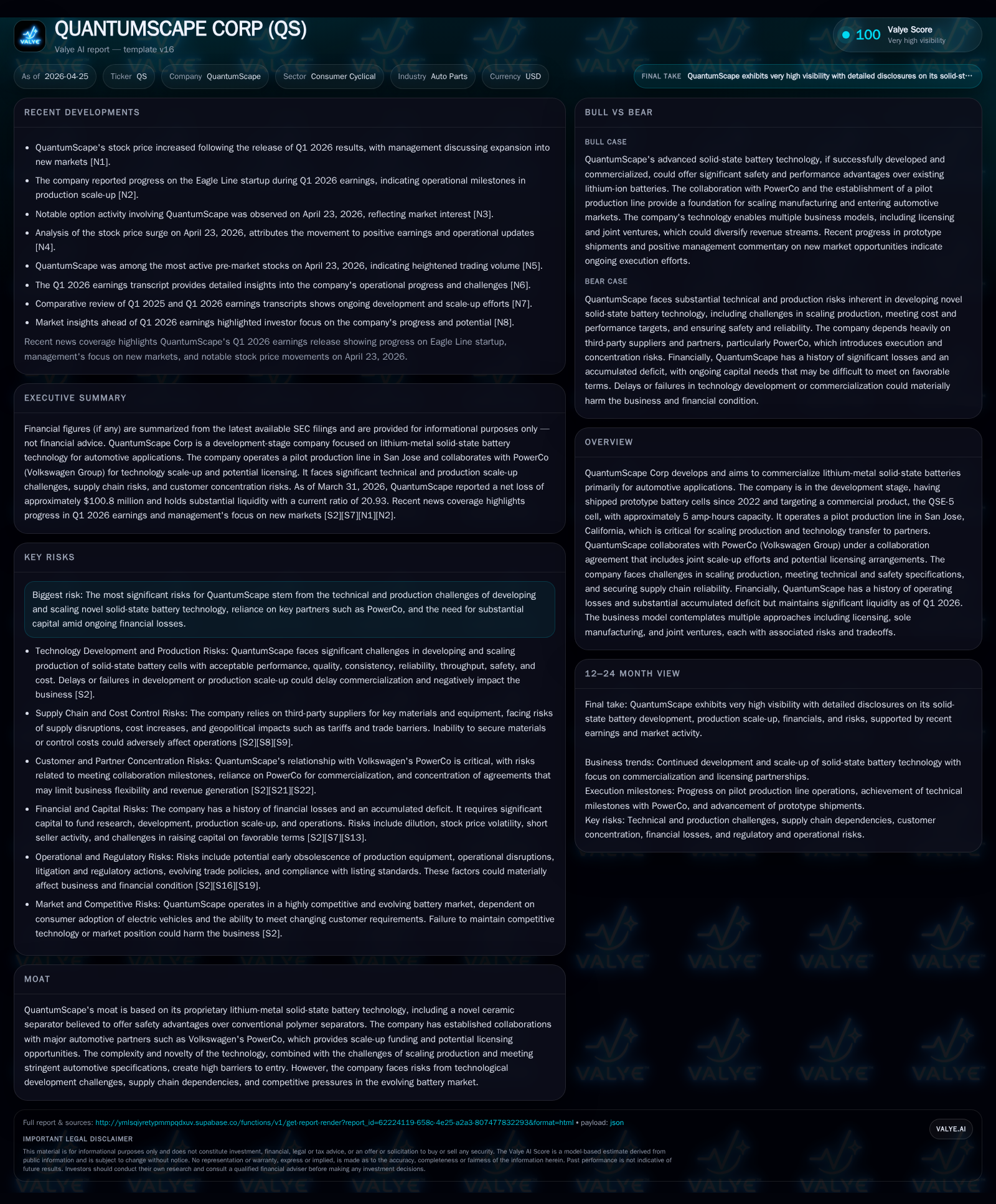
QuantumScape’s Q1 2026 filing reveals critical progress in ramping its Eagle Line pilot production line for proprietary lithium-metal solid-state batteries, moving closer to commercial viability. The company continues to depend heavily on Volkswagen’s PowerCo for scale-up funding and commercialization, introducing concentrated partnership risks. While the novel ceramic separator technology offers potential safety and energy density advantages, key constraints remain around manufacturing scale, supply chain complexity, and regulatory compliance. QuantumScape maintains a strong liquidity buffer but faces persistent operating losses as it invests heavily in R&D toward commercial-scale output. Investors should focus on upcoming production milestones and OEM certification efforts as key growth markers.
Quarterly Progress on Technology Scale-Up and Operational Milestones
QuantumScape’s latest 10-Q filing for Q1 2026 confirms key operational advances centered around its Eagle Line pilot production facility in San Jose. The company commenced initial pilot-scale production runs of its QSE-5 cells featuring proprietary lithium-metal solid-state technology during the quarter [S2]. These prototype cells are reported as shipped to collaborators and select customers, marking a tangible step beyond earlier sampling stages. Management articulated improved reliability metrics within pilot batches but clearly indicated that full commercial ramp remains several steps away given ongoing yield optimization needs and material sourcing challenges [N2][N3]. The quarterly update also flagged continuing stringent requirements to meet automotive-grade cost curves, cycle life, and safety targets—highlighting persistent technical scaling complexities inherent to solid-state separators made from advanced ceramics.
Recent event filings supplement this narrative by discussing evolving collaboration dynamics with PowerCo—the battery manufacturing arm of Volkswagen Group—emphasizing that milestone-based joint scaleup remains the operative framework [S3]. This ongoing dependency signals a high-stakes interplay between emerging production capabilities at Eagle Line and strategic partner execution.
Business Model: Proprietary Lithium-Metal Solid-State Batteries and Strategic Partnerships
QuantumScape’s core business revolves around developing solid-state lithium-metal battery cells distinguished by a patented ceramic separator technology designed to address common weaknesses of polymer separators, especially concerning dendrite formation and cell safety [S1]. Unlike conventional lithium-ion batteries that use liquid electrolytes, QuantumScape's architecture aims for substantially higher energy density potential paired with enhanced thermal stability.
Revenue generation is expected mainly through licensing agreements and collaboration partnerships rather than scaled mass manufacturing by QuantumScape itself. The company's flagship collaboration is with Volkswagen’s PowerCo division that provides essential funding while serving as both a customer and commercialization vehicle under detailed IP license arrangements [S9]. This licensing ecosystem establishes a business model predicated on technology diffusion via major OEMs rather than internal volume production.
The tradeoff centers on maintaining control over intellectual property advancements versus relying on partners’ operational capacity to industrialize complex battery formats at scale—a nuanced balance between IP monetization upside and revenue concentration risk.
Competitive Dynamics Within the EV Battery Industry Structure
Within the auto parts sector specific to EV battery innovation, QuantumScape occupies a differentiated niche focusing squarely on advanced solid-state separator chemistries—high-barrier proprietary tech with significant IP moats [S1]. However, competition is intensifying both from entrenched lithium-ion cell manufacturers optimizing their existing platforms (e.g., nickel-rich layered oxide cathodes with improved electrolyte formulations) and from emerging startups pursuing alternate solid-state designs employing sulfide or polymer electrolytes.
Moreover, the intricate global supply chains required for ultra-pure ceramics, lithium metals, specialized coatings, and precision assembly machinery create entry barriers but also expose supply bottlenecks exacerbated by geopolitical trade tensions, particularly relating to China sourcing risks cited in risk disclosures [S4][S6]. Regulatory gas pedal-and-brake signals regarding sustainability requirements further nuance competitive positioning by penalizing less environmentally congruent processes or materials.
Growth Catalysts from Commercialization and Licensing Traction
Near-term growth levers derive principally from scaling Eagle Line pilot outputs into stable pre-commercial volumes meeting increasingly stringent OEM validation protocols. Successes here could catalyze expanded licensing deals beyond Volkswagen's PowerCo as proof-of-concept transitions into validated readiness for volume automotive deployment [S3]. Additional catalysts include the prospect of third-party licensees adopting QuantumScape’s core tech platform across broader EV or industrial powertrains markets.
Forward momentum depends closely on reaching critical milestones such as: achieving targeted amp-hour cell yields; enhancing cycle life durability; securing regulatory certifications; expanding joint development agreements; and broadening supply chain partnerships that assure raw material continuity at competitive costs. Public markets have reacted positively to incremental progress updates reflecting investor appetite for concrete scale-up operational data points versus earlier-stage theoretical promises [N1][N2].
Constraints: Technical, Production, Partnership Concentration, and Supply Chain Risks
Despite promising technological innovation claims, substantial constraints remain. Scaling solid-state battery production from laboratory prototypes to high-reliability commercial batches involves unique technical challenges related to thin-film ceramic separators' manufacturability and stability under automotive duty cycles [S2][S4]. Meeting OEM automotive certifications also demands rigorous product consistency and long-term warranty-backed assurances.
Close reliance on PowerCo deepens revenue concentration risks as delays or strategic shifts within Volkswagen Group could disrupt QuantumScape’s cash flow prospects drastically [S9][S24]. Intellectual property management complexities arise due to joint ownership clauses in collaboration agreements potentially limiting unilateral enforcement rights or constraining market approaches.
Supply chain vulnerabilities loom large given dependence on scarce raw materials like lithium metal powders and critical ceramic ingredients amid volatile supplier markets affected by international trade regulations and geopolitical frictions [S6]. Heightened regulatory scrutiny around environmental standards introduces additional compliance costs potentially impacting margins or rollout timing.
Upcoming Catalysts: Delivery Targets, Certification Milestones, and Partner Contributions
Investors should track forthcoming quarterly updates emphasizing Eagle Line throughput increases measured by prototype cell shipment volumes alongside quality improvement statistics. OEM certification progress represents a pivotal gating factor; any public announcements regarding formal product qualifications would materially impact commercial visibility [S2][N3].
Other watchpoints include further licensing deal signings or extensions especially outside of Volkswagen Group to signal broad market adoption traction. Progress in mitigating supply chain bottlenecks or diversifying supplier bases also serves as an indicator of scaling robustness amidst geopolitical tensions [N4]. Operational updates about enhanced automation integration or cost reductions from ongoing pilot line optimization will be important execution markers.
Financial Profile: Liquidity Buffer Amid Continuing Investment and Losses
QuantumScape enters 2026 with a substantial liquidity reserve totaling approximately $145 million in cash and equivalents as of March 31st quarter-end coupled with a robust current ratio exceeding 20x—a function of relatively modest current liabilities near $44 million supporting near-term solvency comfortably [F1][S2].
Nevertheless, the firm continues to operate at notable losses indicative of intensive R&D expenditure alongside capital investment for scaling its Eagle Line pilot operations. Fiscal year 2025 net losses amounted to approximately $435 million while operating cash flow remained negative near $242 million even after Capex declined sharply compared to prior years—reflecting shift from plant buildout phase towards steady-state development investments [F1].
This persistent free cash flow deficit underscores ongoing capital needs until revenue scales meaningfully through volume production or licensing royalties ramp. Maintaining access to funding sources will remain vital to sustain pathway towards commercialization amid uncertain time horizons linked to technology maturation.
Historical performance (annual)
|
| FY | Net ($mm) | CFO ($mm) | OpInc ($mm) | Capex ($mm) | Net YoY |
|---|---|---|---|---|---|
| 2025 | -435 | -242 | -473 | 36 | +9.0% |
| 2024 | -478 | -275 | -525 | 62 | -7.3% |
| 2023 | -445 | -240 | -479 | 85 | -8.1% |
| 2022 | -412 | -218 | -421 | 159 |
Source: SEC companyfacts cache [F1].
Capital returns and efficiency (annual)
|
| FY | FCF ($mm) | ROE% |
|---|---|---|
| 2025 | -279 | -37.2 |
| 2024 | -337 | -41.3 |
| 2023 | -325 | -33.3 |
| 2022 | -377 | -31.3 |
Source: SEC companyfacts cache [F1].
In summary, QuantumScape demonstrates methodical but cautious advancement towards solid-state battery commercialization anchored by unique technology strengths coupled with pronounced execution challenges within a competitive auto parts innovation landscape. The firm's future valuation sensitivity hinges critically on demonstration of scalable production aligned with regulatory certifications alongside broadening partner commitments beyond its foundation relationship with Volkswagen's PowerCo.
This analysis is based solely on publicly available information including recent SEC filings up to April 24th, 2026 ([S1],[S2],[S3]), authoritative financial data ([F1]), and reputable market news sources ([N1]-[N4]). It reflects an informed assessment devoid of investment recommendations or price forecasts.
Disclaimer: This is research-only, informational analysis and not investment advice. It may include AI-generated interpretation and general industry context. Always verify important details using primary sources.

Comments