
Real Asset Acquisition Corp.: Strategic Capital Positioning Ahead of Business Combination
RAAQ faces a pivotal phase leveraging sponsor expertise and capital amidst governance and timing risks as it pursues its inaugural real asset acquisition.
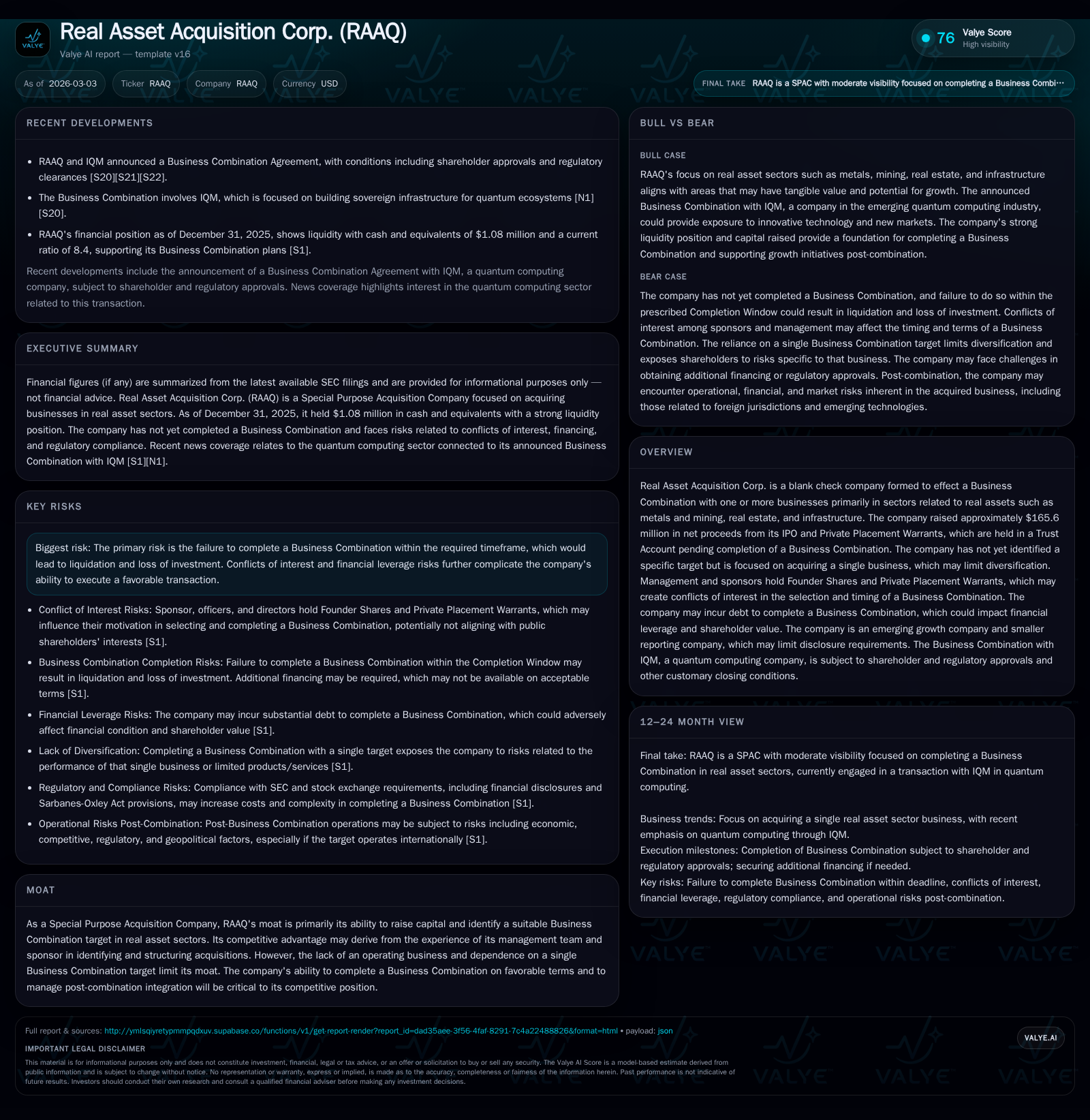
Real Asset Acquisition Corp. (RAAQ) is a Special Purpose Acquisition Company (SPAC) established to merge with a target in real assets sectors, including mining, real estate, and infrastructure. The company secured approximately $165.6 million through its IPO and private placement warrants, held in trust pending a business combination. Founders retain significant equity and voting influence via discounted founder shares and warrants, while no acquisition target has been identified yet, highlighting operational and governance challenges typical of SPACs. RAAQ must navigate shareholder approval asymmetries, potential leverage from debt financing, and increasing regulatory burdens as it pursues its initial transaction.
From IPO to Present: RAAQ’s Capital Foundations and Sponsor Influence
Historical performance (annual)
| FY |
|---|
| 2025 |
Source: SEC companyfacts cache [F1].
Real Asset Acquisition Corp., structured as a Cayman Islands SPAC, raised approximately $165.6 million via its IPO combined with proceeds from private placement warrants held in a Trust Account until deployment into an operating business through a Business Combination [F1][S1][S16].
The Sponsor acquired 5,750,000 Founder Shares for $25,000 (about $0.004 per share), significantly discounted compared to Public Shares priced at $10.00 each [S1][S16]. Additionally, the Sponsor purchased 3,725,000 Private Placement Warrants exercisable at $11.50 per share for $1.00 each [S16]. These holdings represent roughly 25% of total outstanding shares post-IPO, granting the Sponsor considerable influence over key decisions.
Founder Shares convert one-for-one into Class A ordinary shares upon Business Combination completion or earlier at option [S16]. Under Cayman Islands law provisions in RAAQ's charter documents, founders vote alongside public shareholders on deal approvals but their stake often effectively overrides dissent among retail investors due to concentrated ownership [S1]. This governance structure reflects common SPAC tensions where sponsors’ incentives may diverge from minority public shareholders.
Operating Without an Identified Target: Financial Profile
As of fiscal year-end December 31, 2025, RAAQ operates without an active business and has not announced a definitive acquisition candidate [F1]. Operating income was negative approximately $374,000 due to administrative expenses typical for pre-deal SPACs; net income was positive near $4.25 million stemming primarily from accounting residuals rather than operational earnings [F1].
This financial profile underscores inherent risks for investors reliant on management’s capability to identify and complete a viable Business Combination transforming the SPAC into an operating enterprise [S24].
Governance Complexities and Shareholder Rights Ahead of Vote
Approval thresholds for Business Combinations require only a majority vote at general meeting level but are heavily influenced by founder share participation given their concentrated stake (>25%) [S1]. Public Shareholders may not be guaranteed a vote if management opts otherwise unless required by law or listing rules.
If only one-third of total issued shares participate (quorum), founders alone could secure approval given their ownership share [S1]. Founders have contractually agreed to support any proposed deal irrespective of public sentiment, heightening investor exposure to conflicts where sponsors prioritize deal closure over maximizing shareholder value.
Proxy disclosures mandate comprehensive historic and pro forma financial information about any announced target which can limit deal options as some private firms cannot provide such timely audited data [S10].
Capital Structure, Cash Position, and Leverage Risks
At end-2025, RAAQ held cash & equivalents around $1.08 million with current assets near $1.19 million against current liabilities about $141K — yielding a current ratio near 8.4 indicating short-term liquidity though the cash base is minimal relative to substantial trust account funds reserved exclusively for transactions [F1].
The company currently carries no debt but contemplates incurring debt post-Business Combination to finance acquisition costs potentially exceeding available IPO proceeds plus redemptions [S4][S14][S16]. Debt introduction entails risks including covenant breaches accelerating repayments or restricting capital flexibility especially with an unproven post-merger operation.
Given recent market volatility impacting credit access for smaller emerging companies in capital-intensive sectors like metals/mining and infrastructure, RAAQ’s management must balance leverage appetite against financial sustainability.
Approval Milestones and Forward-Looking Considerations
RAAQ has not provided explicit forward-looking guidance on timelines or financial targets for its initial Business Combination [N1][S3]. Industry standards include target announcement followed by SEC-filed proxy statements disclosing audited historical financials prepared under US GAAP or IFRS depending on circumstances [S10].
Investors should monitor:
- Specific real asset sector targeting announcements,
- Timely SEC filings of proxy materials,
- Shareholder voting or tender offer launches,
- Redemption activity levels affecting available funding,
- Regulatory or exchange approvals. Failure to meet Completion Window deadlines may force liquidation returning pro rata trust amounts minus fees to investors [S14].
Capital Allocation Strategy: Sponsor Incentives and Financial Returns
Sponsor’s nominal founder share cost ($0.004/share) versus Public Share price ($10) plus ownership concentration creates strong incentives aligned with deal consummation rather than maximizing pre-close per-share returns [S16][S1]. Private placement warrants provide upside optionality if share price appreciates post-merger but become worthless if no deal occurs.
Return on equity is approximately -72.9%, reflecting absence of earning assets typical of pre-operating SPAC entities but signaling caution regarding immediate returns prior to Business Combination success [F1].
No dividends or share buybacks are planned as focus remains on transaction execution; regulatory constraints restrict premature distributions from Trust Account except approved expenses [S7][S11][S16].
This allocation approach embodies classic SPAC sponsor economics balancing founder equity stakes with investor protections via redemption rights yet inherently favors sponsors’ incentives to close deals timely over minority investor optionality.
Key Risks: Regulatory, Litigation, and Execution Challenges
RAAQ faces multiple risks including:
- Increasing compliance costs driven by SEC regulations augmented by Sarbanes-Oxley Act internal control mandates effective post-merger raising general administrative expenses [S5][S6],
- Potential amendments by board altering founder share restrictions without broader shareholder consent elevating governance uncertainty [S18],
- Management involvement in unrelated litigation or investigations posing reputational risk that could affect partnerships or investor confidence [S6][S19],
- Heightened competition among numerous SPACs seeking attractive real asset businesses increasing valuation premiums demanded by targets,
- Complex multi-jurisdictional transaction challenges requiring US federal securities law compliance alongside Cayman Islands corporate law limitations restricting shareholder remedies compared with US domestic corporations [S18],
- Cybersecurity vulnerabilities due to limited early-stage IT investments potentially exposing sensitive deal information requiring robust confidentiality controls. Vigilant monitoring around definitive deal announcements and proxy solicitation phases is essential.
Post-Combination Outlook: Integration and Sector-Specific Challenges
RAAQ’s strategic advantage rests on management’s real asset sector experience sourcing acquisitions efficiently coupled with potential scalability across metals/mining, real estate, and infrastructure verticals once integrated operationally post-merger.
Reliance on a single Business Combination introduces concentration risk offsetting diversification benefits typically sought by traditional investment vehicles.
Post-closing performance will depend heavily on successful onboarding of merged entities while managing sector-specific hurdles including commodity price cyclicality affecting mining companies; regulatory zoning impacting real estate/infrastructure projects; and capital intensity constraining swift margin expansion.
Effective integration paired with prudent capital management can create competitive advantages particularly if synergies between acquired assets enable expense rationalization not easily replicated by competitors lacking similar sector specialization. Nonetheless, usual SPAC integration risks remain: cultural mismatches between sponsor team and acquired personnel; legacy contract liabilities undisclosed pre-merger; macroeconomic shocks affecting asset valuations. Transparency around financial performance following combination will be critical given skepticism surrounding recent post-SPAC merger periods.
Disclaimer: This report provides an analytical overview based solely on documents accessible as of March 2026 relating to Real Asset Acquisition Corp. It does not constitute investment advice nor endorsement of any securities involved. Readers should conduct their own due diligence considering evolving facts beyond this publication.
Disclaimer: This is research-only, informational analysis and not investment advice. It may include AI-generated interpretation and general industry context. Always verify important details using primary sources.

Comments