
Sturm Ruger Faces Profit Downturn Amid Regulatory and Shareholder Pressures
The company’s 2025 results show declining operating profitability under evolving regulatory and shareholder governance complexities.
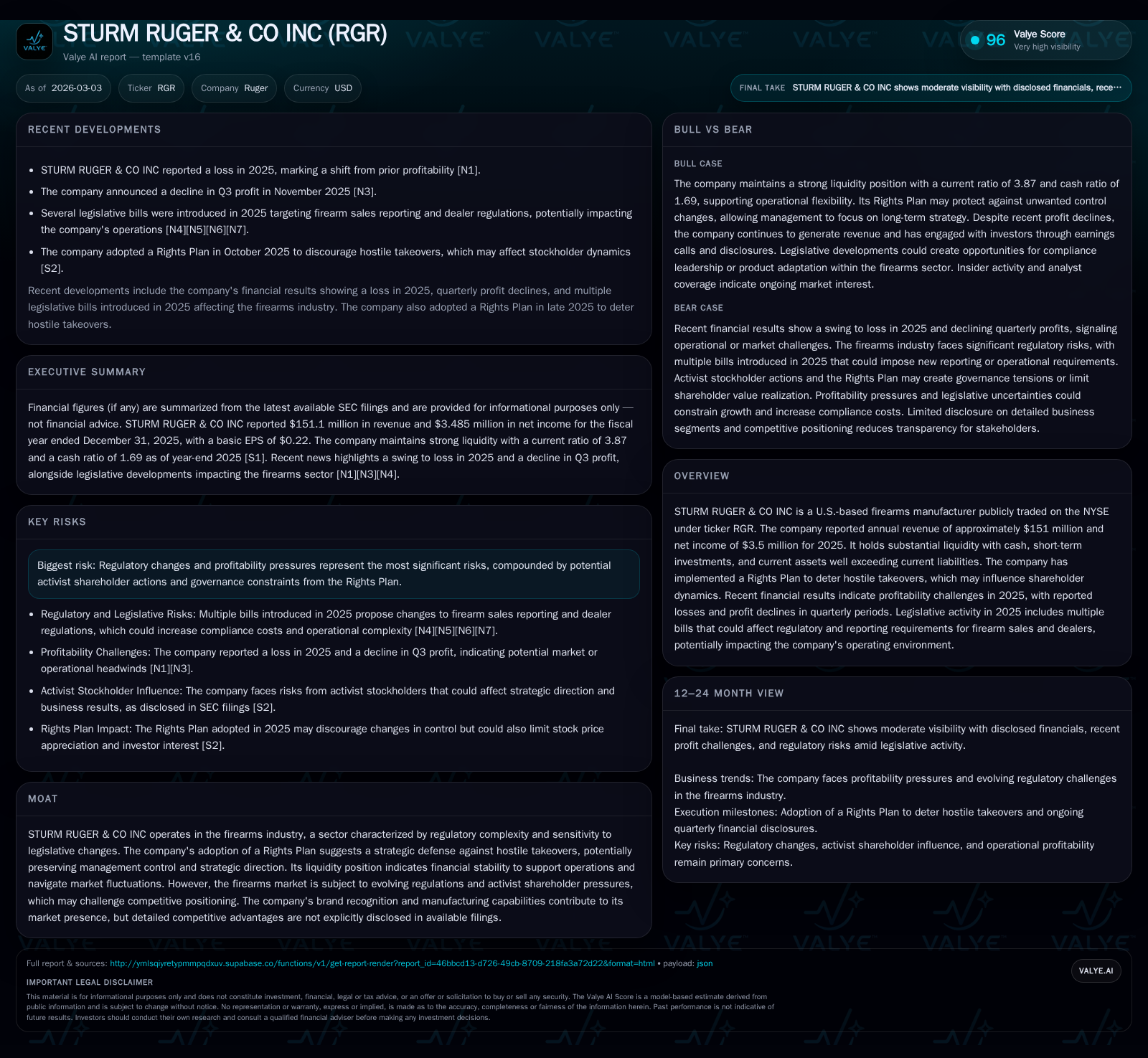
Sturm Ruger reported modest revenue growth in 2025 but experienced a steep decline in operating income, ending the year with a small net profit. The introduction of a Rights Plan aims to protect against activist investor influence, while new firearms regulations increase compliance challenges. Strong liquidity and disciplined capital allocation have provided resilience, though margin pressures and external uncertainties temper near-term outlooks.
Revenue and Profit Trajectory: Analyzing the 2025 Inflection
Sturm Ruger reported fiscal year 2025 revenue of approximately $151 million, marking a moderate increase of about 3.6% from $145.8 million in 2024 [F1]. This growth follows a fluctuating pattern over recent years marked by sensitivity to market demand shifts in firearms manufacturing. However, while top-line expansion continued modestly into 2025, operating income reversed sharply from positive $31.7 million in 2024 to a loss of $12.3 million in 2025 [F1]. This significant downturn reflects operating margin compression likely related to rising input costs, altered sales mix favoring lower-margin products, or increased expenses tied to regulatory compliance.
Despite this negative operating result — representing an approximate -139% year-over-year change — the company managed to report a positive net income of $3.5 million in 2025 [F1]. This suggests mitigating factors beyond core operations such as favorable tax treatment or non-operating income components buffering bottom-line performance during deteriorating operating profitability.
Historical performance (annual)
| FY | Rev ($mm) | Net ($mm) | CFO ($mm) | OpInc ($mm) | Rev YoY | Net YoY |
|---|---|---|---|---|---|---|
| 2025 | 151 | 3 | 54 | -12 | +3.6% | -66.7% |
| 2024 | 146 | 10 | 56 | 32 | +11.6% | +2.2% |
| 2023 | 131 | 10 | 34 | 52 | -12.5% | -45.9% |
| 2022 | 149 | 19 | 77 | 103 |
Source: SEC companyfacts cache [F1].
Capital returns and efficiency (annual)
| FY | Div ($mm) | Buybacks ($mm) | FCF ($mm) |
|---|---|---|---|
| 2025 | 10 | 26 | 38 |
| 2024 | 12 | 34 | 35 |
| 2023 | 12 | 18 | |
| 2022 | 0 | 50 |
Source: SEC companyfacts cache [F1].
Note: All figures are rounded; Year-over-year percentages based on available fiscal year end data [F1].
Operating Environment: Regulatory Headwinds and Legislative Developments
The firearms industry continues to face an increasingly complex legal landscape that shapes operational strategy and risk management.
Sturm Ruger's recent filings highlight multiple newly enacted or pending legislative proposals enhancing reporting requirements for firearm dealers and manufacturers—including expanded background check mandates and record-keeping obligations [S4][S5].
These regulations increase compliance costs through direct administrative expenses and indirect effects such as slowed sales cycles or restricted market access for certain products.
Such regulatory burdens exacerbate margin pressures already observed in core manufacturing segments while increasing uncertainty around future investment decisions.
Shareholder Activism and the Impact of the Rights Plan
In October 2025, Sturm Ruger's Board adopted a Rights Plan as an anti-takeover defense mechanism [S2][S7]. The plan grants existing shareholders purchase rights exercisable if any person or group acquires beneficial ownership exceeding approximately ten percent [S11][S14].
This measure discourages unsolicited takeover attempts or activist campaigns that might conflict with management's strategic vision.
The Rights Plan includes "flip-in" provisions allowing shareholders other than the acquirer to purchase shares at half the market price after a triggering event [S11]. The Company retains discretion to redeem rights preemptively.
While protecting against unwanted changes, these mechanisms may constrain share liquidity and valuation under takeover speculation scenarios.
Capital Allocation: Dividends, Buybacks, and Cash Flow Management
Despite profitability fluctuations, Sturm Ruger sustains disciplined capital allocation aligned with strong cash generation.
Operating cash flow remained robust at approximately $54 million in FY25 despite reduced operating earnings—down slightly from $55.5 million in FY24 [F1].
Capital expenditures declined nearly twenty-four percent year-over-year to about $15.8 million in FY25, possibly reflecting completion of prior investments or conservative spending amid uncertainty [F1].
Free cash flow after capex approximated $38.5 million for the year—supporting dividends and share repurchases.
Dividends paid were $10.1 million in FY25, modestly below FY24 levels; share buybacks also decreased from about $34 million in FY24 to roughly $26 million in FY25 [F1][S9][S10].
This payout moderation reflects prudent stewardship balancing shareholder returns with financial flexibility.
Liquidity and Balance Sheet Strength as Defensive Assets
At fiscal year-end 2025, Sturm Ruger's balance sheet showed strong liquidity essential for managing sector cyclicality and regulatory challenges.
Current assets of approximately $212 million exceeded current liabilities of about $54.7 million, yielding a current ratio near 3.87x—a sign of solid short-term liquidity [F1][S20][S26].
Equity stood at roughly $284 million, down modestly from prior years but maintaining a sound capital base supporting operational resilience [F1].
This financial footing reduces dependence on external financing amid activist pressures or unforeseen regulatory costs.
Future Outlook: Growth Prospects Against Market Constraints
While explicit management guidance is limited, commentary acknowledges opportunities tempered by headwinds potentially restricting top-line momentum [N1][S4][S5].
Enduring brand strength supports demand for legacy products alongside potential innovation-led expansions.
However, escalating compliance costs and geopolitical factors affecting supply chains pose constraints on margin improvement efforts.
Investors should monitor legislative trends regarding background checks and firearms control measures given their impact on sales volumes and operating expenses.
What Investors Should Monitor Moving Forward
Key considerations include:
- Earnings volatility reflecting cost inflation and sales mix shifts; upcoming quarterly results will indicate margin trends [N1].
- Developments related to the Rights Plan's implementation or amendments impacting shareholder dynamics [S2][S7].
- Potential activist investor actions influencing strategic direction or capital policies [S2].
- Regulatory changes affecting dealer reporting requirements and compliance costs [S4][S5].
- Capital allocation balance between dividends and buybacks signaling management’s confidence in cash flow sustainability.
This analysis is based solely on currently available SEC filings and reliable news sources without subjective forecasting or investment recommendations. All financial figures cited originate directly from company disclosures ensuring factual accuracy within the given disclosure framework.
Disclaimer: This is research-only, informational analysis and not investment advice. It may include AI-generated interpretation and general industry context. Always verify important details using primary sources.

Comments