
Richmond Mutual Bancorporation Inc: Navigating Growth and Integration Amidst Regional Banking Challenges
Richmond Mutual Bancorporation advances through a transformational merger while managing typical regional bank risks and maintaining stable financial footing.
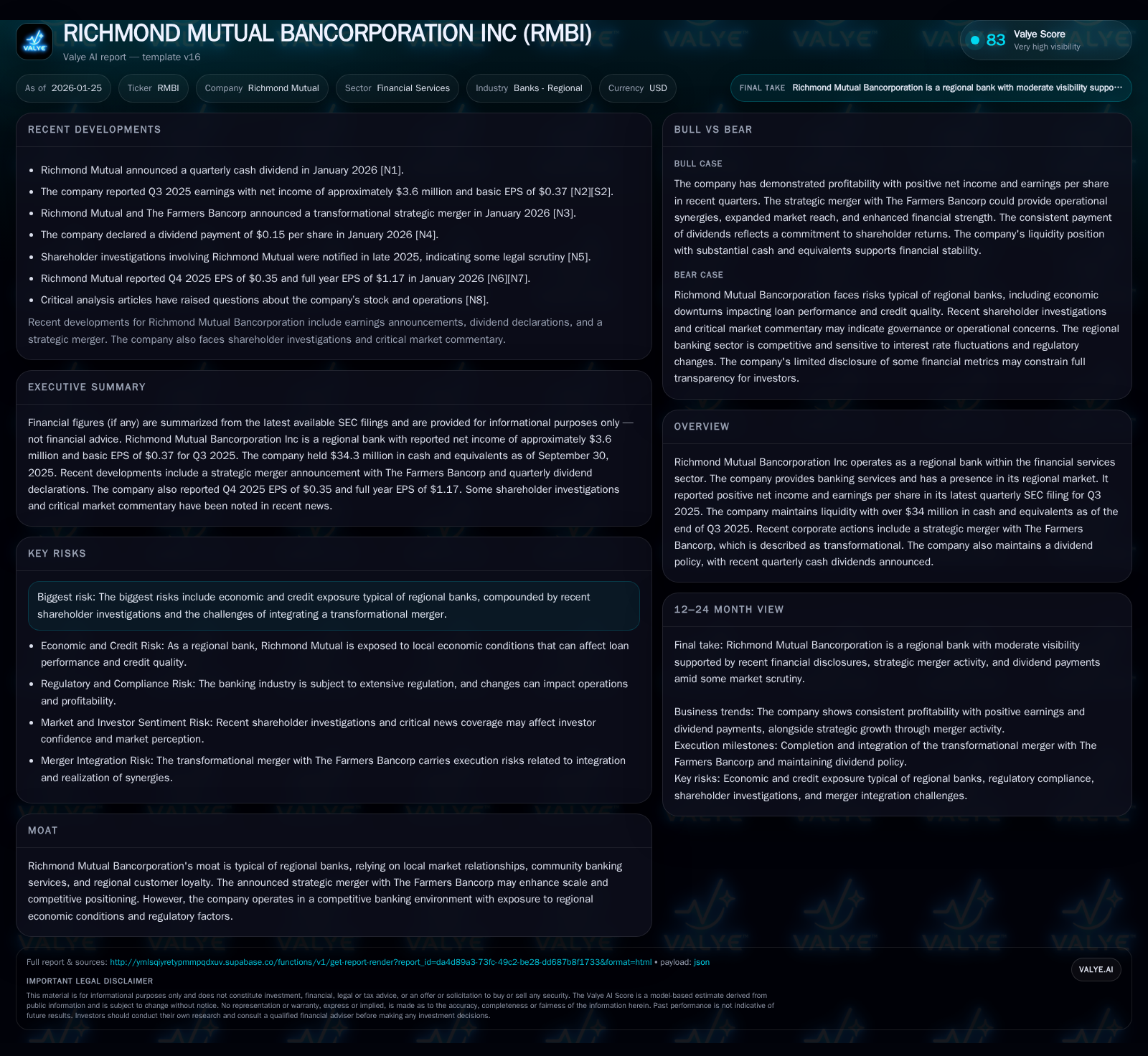
Richmond Mutual Bancorporation, a regional bank, recently announced a strategic merger with The Farmers Bancorp that aims to expand scale and strengthen market presence. The company reported positive Q3 2025 net income and maintained solid liquidity with over $34 million in cash and equivalents. Operating in a competitive and economically sensitive regional banking environment, Richmond Mutual faces integration challenges and shareholder scrutiny, but its local relationships and dividend policy underscore resilience. Key uncertainties remain around merger execution and credit risk dynamics.
What Changed Recently
Richmond Mutual Bancorporation announced a transformational strategic merger with The Farmers Bancorp in January 2026, intended to significantly expand its scale and competitive footprint within the regional banking sector [N4]. This merger represents a major corporate action that could alter the company's operational dynamics and market reach. Concurrently, Richmond Mutual reported solid Q3 2025 financial results, including net income of approximately $3.6 million and an EPS of $0.35 in Q4 2025, underscoring ongoing profitability [N2][N5][N8]. The company also declared a quarterly cash dividend, continuing its shareholder return policy [N1][N9]. However, shareholder investigations related to Richmond Mutual have surfaced, introducing reputational and legal uncertainties [N6][N7]. These developments frame a pivotal moment for Richmond Mutual as it seeks to integrate a major acquisition while maintaining financial stability.
Business Model as a System
Richmond Mutual Bancorporation functions as a traditional regional bank, with its business model centered around gathering deposits, extending a diversified portfolio of loans, and generating fee-based income from ancillary banking services [S1][S4]. The bank primarily serves local consumers and small-to-medium businesses within its regional footprint, leveraging long-standing community relationships that foster customer loyalty and repeat business. Its loan portfolio spans commercial mortgages, consumer loans, home equity lines of credit, and direct financing leases, exposing it to multiple credit segments [S4][S6][S8]. Interest income from these loans, net of interest paid on deposits and borrowings, constitutes the bulk of revenues.
Liquidity and capital adequacy are maintained through a mix of customer deposits, borrowings, and prudent cash reserves—evidenced by over $34 million in cash and cash equivalents as of Q3 2025 [S1]. The bank's capital structure includes Tier 1 leverage capital positioned to meet regulatory requirements, providing a buffer against credit losses and economic downturns [S12][S13]. Richmond Mutual also employs incentive compensation and equity plans to align management interests with shareholder value creation [S1].
The announced merger with The Farmers Bancorp is designed to expand Richmond Mutual’s asset base and customer reach, potentially delivering operational efficiencies and enhanced product offerings [N4]. However, the business model faces constraints typical of regional banks, including sensitivity to local economic cycles, competition for deposits and loans, regulatory compliance costs, and the challenge of managing credit risk across diverse portfolios [S5][S16].
Industry Map & Competitive Battlefield
Richmond Mutual operates within the regional banking industry, a segment characterized by institutions that serve defined geographic areas with a focus on community and relationship banking. Competitors range from other regional banks to credit unions, non-bank lenders, and larger national banks targeting regional markets. Competition hinges on pricing of loans and deposits, service quality, branch accessibility, and digital banking capabilities.
In this landscape, scale matters for cost efficiency, technology investment, and product diversification. Richmond Mutual’s merger with The Farmers Bancorp is a strategic response to these pressures, aiming to bolster scale and improve competitive positioning [N4]. However, regional banks generally face low barriers to entry but strong local customer loyalty, which can serve as a moat if well cultivated. The regulatory environment also imposes capital and operational requirements that can disproportionately affect smaller institutions.
Emerging fintech competitors and shifts in customer expectations toward digital services add complexity to the competitive battlefield. Richmond Mutual’s ability to integrate the merger and invest in technology will influence its competitive sustainability. Additionally, regional economic conditions such as employment trends, real estate markets, and interest rate cycles directly impact loan demand and credit quality, defining the playing field dynamics [S5].
Where the Economics Become Real
Richmond Mutual’s unit economics hinge on net interest margin (NIM), loan portfolio performance, and operational efficiency. The bank reported a net interest rate spread of approximately 3.95%, reflecting the difference between yields on earning assets and costs of interest-bearing liabilities [S9][S17]. This spread, coupled with asset volumes, directly drives net interest income, the largest revenue component.
Loan portfolio quality is critical; credit losses or increased provisions can quickly erode profitability. The bank’s diversified loan mix helps moderate risk, but exposure to commercial real estate and consumer credit segments entails cyclical vulnerabilities [S4][S5]. Loan growth is a lever for earnings expansion, constrained by credit risk appetite and deposit funding availability.
Operational costs include branch maintenance, personnel, technology investments, and regulatory compliance expenses. Scale economies from the merger could reduce per-unit operating expenses if integration realizes synergies effectively. Liquidity management is another economic factor; sufficient cash reserves and borrowings ensure funding stability but come at a cost [S12].
Dividend payments, recently declared at $0.15 per share, reflect confidence in cash flow generation but also commit capital that could otherwise fund growth or strengthen reserves [N1][N9]. Shareholder expectations and regulatory capital requirements balance these allocation decisions.
Diligence Questions / Disconfirming Signals
- How will Richmond Mutual manage the integration risks and cultural alignment challenges following the transformational merger with The Farmers Bancorp? The strategic benefits depend heavily on smooth execution.
- What is the detailed credit quality breakdown of the combined loan portfolio, especially regarding riskier segments such as commercial mortgages or direct financing leases? Are there early signs of stress?
- How is the bank positioned relative to digital transformation, given competitive pressures from fintech and larger institutions? Are there plans for significant technology investments?
- What are the implications and potential outcomes of the ongoing shareholder investigations? Could these lead to material financial or reputational impacts?
- How sensitive is Richmond Mutual’s margin and loan growth outlook to anticipated interest rate movements and regional economic conditions?
- Is the dividend policy sustainable if economic conditions deteriorate or if merger-related costs rise unexpectedly?
- What are the key regulatory risks, including capital adequacy and compliance, that could impose constraints or costs in the near term?
- How does the bank’s competitive positioning compare with peers post-merger in terms of size, market share, and service offerings?
Richmond Mutual Bancorporation’s status as a regional bank with a community focus positions it well within its market niche, yet the competitive and regulatory environment, coupled with macroeconomic sensitivities, impose significant operational demands. The recent merger with The Farmers Bancorp is a pivotal development with potential upside from scale and market penetration but introduces execution and integration risk. Financial results through Q3 2025 indicate profitability and liquidity strength, yet ongoing shareholder inquiries and the broader risk profile warrant close monitoring. The bank’s ability to manage credit risk, operational costs, and competitive pressures while delivering shareholder returns will be central to its medium-term trajectory.
Disclaimer: This analysis is based on publicly available information and does not constitute investment advice or a recommendation to buy or sell securities.
Disclaimer: This is research-only, informational analysis and not investment advice. It may include AI-generated interpretation and general industry context. Always verify important details using primary sources.

Comments