
Avidity Biosciences Advances RNA Therapeutics Pipeline Amid Novartis Merger and Strategic Spin-Off
The company leverages its proprietary Antibody Oligonucleotide Conjugate platform to develop novel RNA-based therapies for rare muscular dystrophies while navigating transformative corporate transactions.
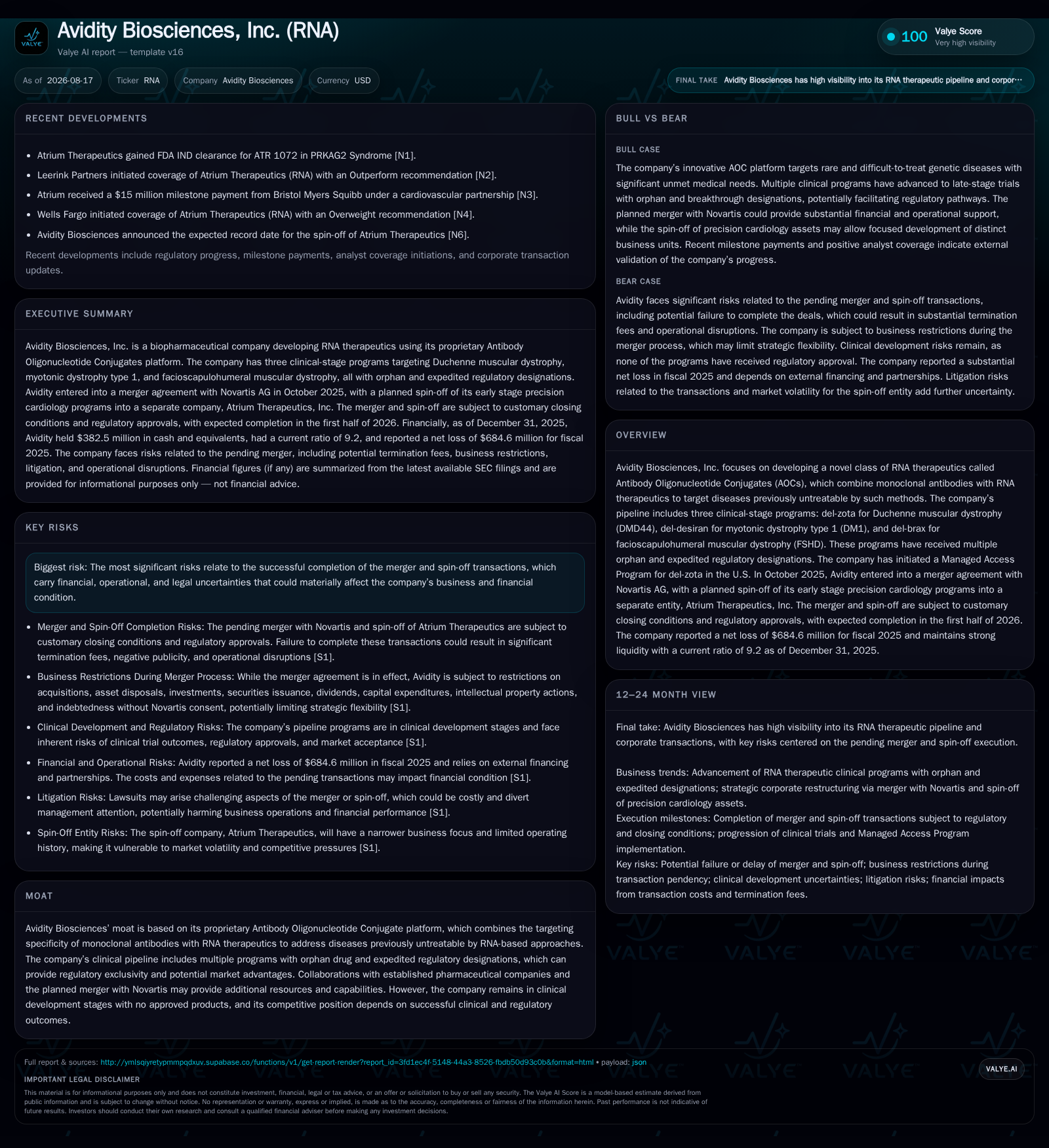
Avidity Biosciences is progressing three clinical-stage RNA therapeutic programs targeting rare neuromuscular diseases, supported by orphan, fast track, and breakthrough designations that enhance regulatory exclusivity and accelerate pathways. The company announced a merger agreement with Novartis AG alongside a spin-off of its early-stage cardiology programs into Atrium Therapeutics, reflecting strategic portfolio focus. Key near-term execution risks include completing the merger and spin-off under customary conditions. Financially, Avidity maintains a strong liquidity position with over $380 million in cash and no debt as of year-end 2025, supporting ongoing development activities.
Recent Operating Developments
Avidity Biosciences’ latest quarterly filings reflect ongoing clinical development momentum alongside significant corporate restructuring moves. As of November 2025’s Form 10-Q, the company detailed progress toward completing a merger with Novartis AG announced in October 2025 [S2][S24]. This alliance will result in Avidity becoming a wholly owned Novartis subsidiary following the completion of customary closing conditions including stockholder and regulatory approvals [S1]. Concurrently, Avidity is executing a spin-off of its early-stage precision cardiology assets into a newly formed entity, Atrium Therapeutics, Inc. (formerly Bryce Therapeutics), separating these from its core RNA therapeutic muscular dystrophy programs [S1][S6][S13]. The spin-off involves transfer of specific cardiology-focused assets including investigational therapies targeting rare cardiomyopathies as well as collaborations with Bristol-Myers Squibb and Eli Lilly [S6]. The spin-off is conditioned on regulatory effectiveness filings and stockholder approval, expected to complete immediately before the merger closing anticipated in early 2026 [S7][S13].
This structural reorganization aims to sharpen focus on Avidity’s proprietary Antibody Oligonucleotide Conjugate (AOC) platform addressing muscle disorders while allowing Atrium Therapeutics to pursue precision cardiology indications separately. Notably, the spin-off triggered contractual rights of first negotiation with an existing collaboration partner for certain assets; however, Avidity has navigated this through negotiations culminating in the planned transfer [S7]. These transactions carry risks including potential delays, litigation from dissatisfied stakeholders contesting terms or timing, legal costs, as well as operational distractions to management teams [S17][S27].
Business Model Analysis
Avidity operates within the biotechnology industry’s R&D value chain focusing on clinical-stage drug development rather than commercialization at present. Its key asset is the proprietary AOC technology that chemically conjugates monoclonal antibodies (mAbs) with RNA oligonucleotides to achieve selective delivery of RNA therapeutics into specific tissues such as muscle fibers [S1]. This dual modality leverages antibodies’ targeting specificity combined with RNA’s ability to modulate gene expression — an innovative approach designed to overcome limitations inherent in standalone oligonucleotide therapies.
Revenue mechanics typical for companies at this stage include milestone payments from collaborations or licensing deals as well as grants supporting development; direct product sales have yet to commence due to absence of approved products [S1]. The clinical pipeline features three main programs:
- Del-zota targeting Duchenne Muscular Dystrophy patients with exon 44 amenable mutations (DMD44). It is being evaluated in a registrational Phase 2 Open Label Extension study EXPLORE44-OLE™ aimed at supportive evidence toward eventual FDA filing.
- Del-desiran for Myotonic Dystrophy Type 1 treatment currently in global Phase 3 HARBOR™ trials including an open-label extension.
- Del-brax addressing Facioscapulohumeral Muscular Dystrophy (FSHD), under evaluation in Phase 1/2 biomarker cohort FORTITUDE™ studies progressing towards registrational intent.
Each program benefits from multiple FDA orphan drug designations conferring regulatory exclusivity post-approval plus fast track status accelerating review processes. Del-zota additionally holds a Breakthrough Therapy designation reflecting promising clinical data that may facilitate priority FDA interactions [S1]. Such designations reduce time-to-market potential while protecting market share from biosimilars or competitors.
Managed Access Programs (MAPs) are initiated for patients eligible for del-zota treatment under FDA-authorized protocols ahead of formal approval [S1]. This approach permits early patient access while generating real-world safety evidence that may support submission dossiers
Key operational drivers impacting revenue potential will be successful trial enrollment ratios, timely milestone achievements based on data readouts, regulatory submissions aligned with Fast Track/Breakthrough pathways, and patent protection ensuring sustainable exclusivity. Collaboration agreements such as those embedded in the spin-off illustrate common biotech strategies of leveraging partnerships for funding share and downstream commercialization expertise.
Industry Structure and Competitive Position
The broader biotechnology sector specializing in RNA-based therapeutics is marked by intense innovation around delivery modalities combined with stringent regulatory scrutiny. Peer entities focusing on neuromuscular or rare genetic disorders include Sarepta Therapeutics (notably exon-skipping for DMD), Ionis Pharmaceuticals (antisense oligonucleotides), Alnylam Pharmaceuticals (RNA interference mechanisms), Biogen (neuromuscular diseases), and Regeneron Pharmaceuticals (mAb platforms).
Avidity’s proprietary AOC technology differentiates it by enabling targeted intracellular delivery exploiting antibody internalization pathways — an advantage over traditional oligonucleotide approaches that suffer from poor cellular uptake or off-target effects. This technical moat aligns with enhanced clinical rationale for addressing diseases historically underserved by genetic medicines.
The competitive landscape nonetheless remains nuanced due to multiple competing modalities advancing concurrently alongside emerging gene therapy techniques aiming at durable cures beyond chronic treatments. Regulatory designations obtained by Avidity’s candidates reinforce potential market advantages but must be validated by confirmatory late stage trial results.
Corporate partnerships like the pending acquisition by Novartis provide critical scale advantages: deep pockets for costly late-phase trials, global commercialization infrastructure, manufacturing scale-up capabilities, and expertise managing complex launch strategies across diverse healthcare systems.
Growth Drivers
Several factors underpin Avidity’s growth trajectory:
- Advances in RNA Delivery Technology: Continued refinement of AOC designs enhancing tissue penetration efficiency widens therapeutic scope.
- Regulatory Incentives: Orphan drug status entitles exclusivity up to seven years in the U.S., alongside accelerated review pathways granted by breakthrough and fast track designations facilitating faster access.
- Expansion Pipeline: Preclinical programs beyond neuromuscular indications are expected to leverage platform versatility; spin-off concentrates cardiology efforts separately enhancing strategic focus [S1][N1].
- Strategic Partnerships: Merger with Novartis signals confidence in platform scalability and unlocks broader resource access supporting registrational studies and eventual commercialization.
- Managed Access Uptake: Early patient utilization via MAPs generates safety data improving payer confidence ahead of launch.
- Increasing Diagnostic Rates: Growing awareness leading to higher detection rates within genetic rare disease populations expands addressable markets over time.
Success milestones will be visible through timely progression of registrational studies into filing-ready phases sustained enrollment rates stable across extensions, positive safety signals within managed access patients, definitive marketing approvals following FDA interactions guided by breakthrough status benefits, plus smooth execution of corporate transactional integrations.
Risks and Constraints
Significant risks center around both clinical/regulatory uncertainties intrinsic to biotech development as well as transactional complexities:
- Clinical failures or adverse results could derail registration timelines damaging investor sentiment.
- Delays or inability to close merger/spin-off transactions may disrupt funding continuity or distract management focus; litigation risks related to these deals pose cost/liability exposure [S17][S27].
- Intellectual property challenges against novel conjugate technologies could threaten exclusivity windows critical for return on substantial early-stage R&D investment.
- Manufacturing scale-up challenges remain given novelty requiring specialized biologics production know-how potentially limiting supply chain reliability during commercial launch phases.
- Market adoption hurdles including payer reimbursement uncertainty due to high-cost specialty therapies common among RNA biologics exist despite orphan incentives.
- Competitive pressure from alternative modalities evolving rapidly within gene editing or viral vector sectors may impact long-term positional durability.
Careful monitoring of trial data dissemination timelines relative to regulatory guidance interactions will gauge pipeline robustness while stakeholder communications around deal milestones provide visibility into transaction progress.
What To Watch Next
Key upcoming markers include:
- Completion status updates on merger closing contingent on stockholder vote outcomes anticipated early 2026 followed immediately by distribution of Atrium Therapeutics shares per agreement terms [S12][S28].
- Clinical trial interim/final readouts especially from Phase 2 EXPLORE44-OLE study for del-zota informing filing strategy predominantly within Duchenne muscular dystrophy indication subpopulation.
- Expansion metrics from Managed Access Program uptake for del-zota assessing real-world patient reach ahead of formal approvals.
- Regulatory application filings leveraging Breakthrough Therapy designations aimed at accelerated review pipelines.
- Preclinical program disclosures particularly from separated SpinCo effort enhancing atrial focus or novel modalities deployment.
Avidity has communicated intention for orderly transition through these steps minimizing disruption risk while aligning pipeline assets strategically under their distinct operational umbrellas.
Financial Profile Discussion
As of December 31, 2025, Avidity Biosciences reported cash & equivalents totaling approximately $382.5 million against modest current liabilities near $195 million yielding a current ratio exceeding 9.2 — indicative of strong near-term liquidity supportive of ongoing R&D investments without immediate financing pressure [F1]. No reported outstanding debt enhances financial flexibility reducing risk exposure typically associated with leverage during costly clinical development phases.[F1]
This fiscal positioning underscores reliance principally on equity capital raises or milestone payments stemming from partnership arrangements — likely influenced by ongoing deal structures embedded in the pending Novartis acquisition framework facilitating additional capital inflows tied to transaction milestones. The large cash runway envisages sustaining operational scale through critical late-phase trials integral to validating the AOC platform’s commercial viability.
-- This analysis reflects information available through August 2026 filings and industry context without suggesting investment research views [N1][F1]. All forward-looking statements are subject to substantial uncertainties inherent in drug development timelines, regulatory reviews, corporate transactions execution risk factors outlined above. Readers should not interpret this report as financial advice but rather an informed overview grounded solely on disclosed public data sources.
Disclaimer: This is research-only, informational analysis and not investment advice. It may include AI-generated interpretation and general industry context. Always verify important details using primary sources.

Comments