
RELIANCE, Inc. Expands Market Leadership While Managing Cyclicality and Price Volatility
Reliance’s extensive decentralized network and disciplined pricing underpin its leading position in a fragmented metals service sector.
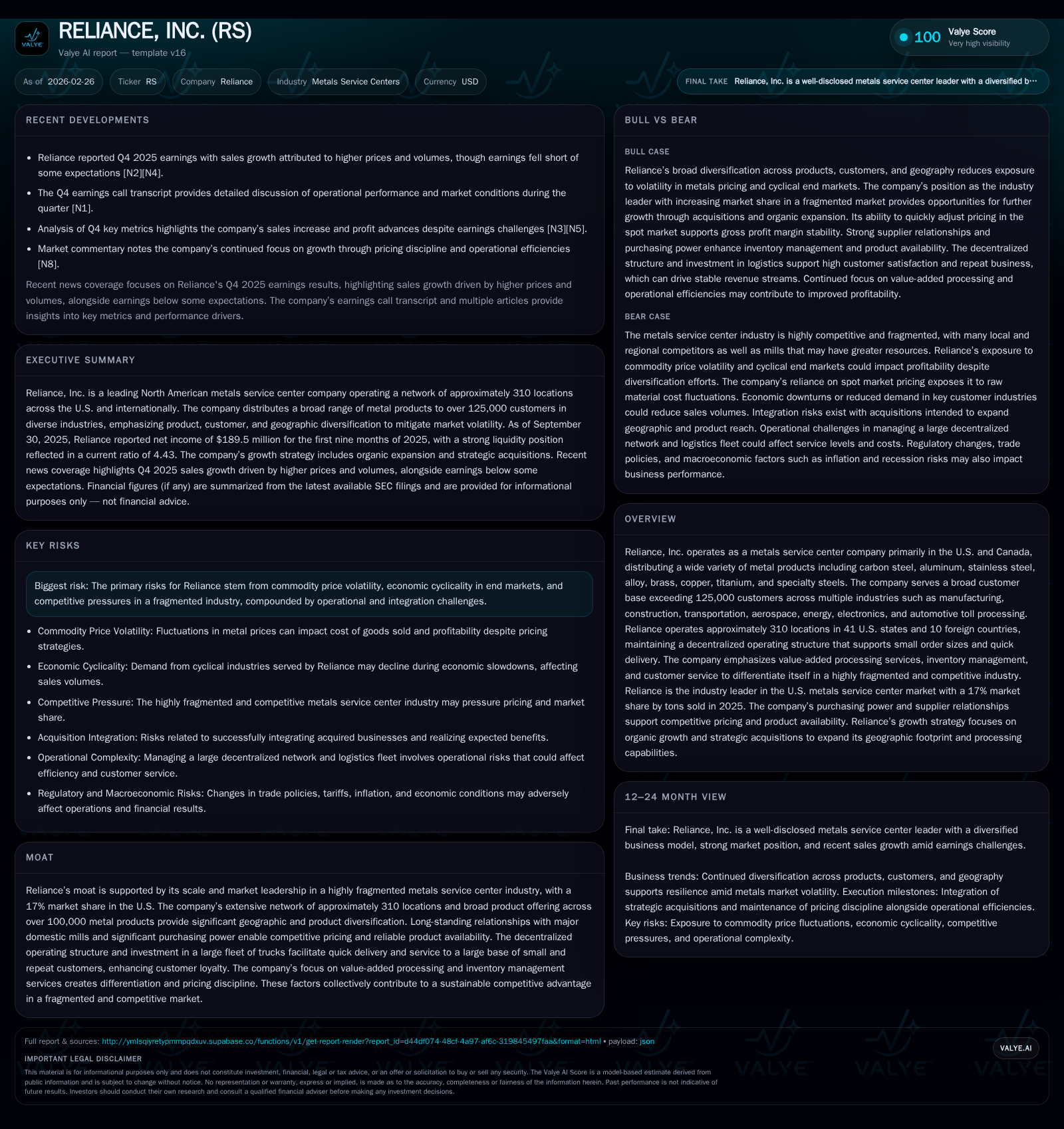
RELIANCE, Inc. maintains industry leadership in the U.S. metals service center market through a sprawling network of approximately 310 locations and a diversified product portfolio exceeding 100,000 metal SKUs. The company reported a revenue decline in 2025 but sustained profitability by leveraging pricing discipline amid volatile commodity inputs and economic cyclicality. Strategic growth combines targeted acquisitions with organic expansion focused on value-added processing services. Capital allocation balances share repurchases and dividends while preserving cash flow amid moderating capex spending. Investors should monitor revenue trends, margin stability, and integration of acquisitions given competitive pressures and commodity price swings.
Scale and Market Position: The Backbone of RELIANCE's Moat
RELIANCE, Inc. is the largest metals service center company in North America by revenue, commanding approximately 17% of the U.S. market based on MSCI-reported tons sold in 2025—up from about 15% in the prior year [S6]. Operating around 310 facilities across 41 states and ten countries—including significant Canadian operations accounting for roughly 28% of international sales—the company offers broad geographic reach and product diversity [S4][S9][S11].
The product portfolio spans over 100,000 metal products including carbon steel, aluminum, stainless steel, alloy steels, brass, copper, titanium, and specialty metals [S9]. Long-standing relationships with major domestic mills enhance RELIANCE’s purchasing power amid industry consolidation that has reduced supplier options but strengthened scale advantages [S4][S6].
A decentralized operating structure empowers local management teams with purchasing authority allowing nimble responses to regional market conditions. This supports RELIANCE’s focus on small orders with quick turnaround times—approximately 40% of sales orders are delivered within 24 hours—and drives high customer retention rates with over 90% repeat business from more than 125,000 customers across aerospace, automotive toll processing, construction, transportation, energy, semiconductor fabrication, industrial machinery, and heavy equipment sectors [S10][S16][S12].
2025 Financial Performance: Revenue Decline Amid Sustained Profitability
For fiscal year 2025, RELIANCE reported net sales of $14.29 billion—a contraction compared to prior years reflecting challenging industry conditions including demand softness and commodity price volatility [F1][S9]. This represents a decline of approximately 13% relative to FY2024 levels [F1]. Operating income decreased nearly 12.7%, totaling about $1.01 billion compared to $1.16 billion the previous year [F1], illustrating pressure on core profitability.
Notably, net income rose sharply by over 280%, reaching $739 million for FY2025—likely influenced by discrete items or tax effects discussed during earnings calls—highlighting differentiation between operating performance trends and bottom-line results [F1][N9].[N2]
Operating cash flow declined by nearly 42% to approximately $831 million amid these conditions despite ongoing working capital management efforts [F1]. Capital expenditures were reduced by about 24%, amounting to roughly $329 million as the company moderated investment pacing while continuing to upgrade processing facilities aligned with strategic priorities [F1].
Historical performance (annual)
| FY | Rev ($bn) | CFO ($bn) | OpInc ($bn) | Capex ($mm) | Rev YoY |
|---|---|---|---|---|---|
| 2025 | 0.8 | 1.0 | 329 | ||
| 2024 | 1.4 | 1.2 | 431 | ||
| 2023 | 14.8 | 1.7 | 1.7 | 469 | -13.0% |
| 2022 | 17.0 | 2.1 | 2.5 | 342 | +20.8% |
Source: SEC companyfacts cache [F1].
Capital returns and efficiency (annual)
| FY | Div ($mm) | Buybacks ($mm) | FCF ($mm) |
|---|---|---|---|
| 2025 | 594 | 503 | |
| 2024 | 63 | 1094 | 999 |
| 2023 | 59 | 480 | 1203 |
| 2022 | 53 | 630 | 1777 |
Source: SEC companyfacts cache [F1].
Note: Revenue for FY2024 and FY2023 not explicitly provided; revenue figure for FY2025 sourced from SEC filings.
Growth Drivers: Customer-Centric Operations and Value-Added Services
RELIANCE’s growth is underpinned by meeting diverse customer needs through small average order sizes ($3,120) coupled with expedited delivery capabilities enabled by one of the largest leased trucking fleets (1,800 trucks), supporting about 40% of orders delivered within one day—a competitive advantage amid industry-wide freight driver shortages impacting peers [S10].
The customer base includes numerous small machine shops requiring just-in-time materials alongside OEMs across cyclical industries such as aerospace defense components fabrication or heavy machinery assembly reliant on specialty alloys processed through sophisticated cutting or machining services offered internally or via toll processing contracts [S7][N1].[S12]
Investments in value-added processing remain central to RELIANCE’s strategy; recent acquisitions have enhanced technological capabilities and geographic presence rather than focusing solely on scale expansion. This approach aims to stabilize margins during commodity price swings or demand slowdowns as value-added services typically generate higher gross profit margins compared to bulk volume sales that dominate spot-market transactions [S7][S6].[N7]
Pricing Power Amid Commodity Price Volatility
RELIANCE primarily operates in spot markets for both purchases and sales which enables swift pricing adjustments protecting gross margins against raw material cost fluctuations—a critical competitive advantage given limited long-term contractual pricing arrangements that can delay cost pass-throughs [S6][S7].[N2]
Industry consolidation among mills has enhanced RELIANCE’s purchasing power allowing preferred allocations or accelerated deliveries crucial during supply chain disruptions caused by geopolitical events or trade disputes such as increased tariffs imposed mid-2025 under Section 232 steel regulations affecting Canadian aluminum imports—factors influencing landed costs amid inventory turnover constraints [S18].[N4]
Strategic Outlook: Acquisitions Coupled with Organic Investments
Growth initiatives integrate bolt-on acquisitions expanding into complementary geographies or specialty metal categories alongside ongoing investments upgrading state-of-the-art value-added processing technologies essential for meeting evolving customer specifications—often complex machining or finishing services tied closely to advanced manufacturing supply chains like semiconductors or aerospace requiring stringent quality controls unavailable at smaller centers [S7].[N7]
Canadian operations contribute significantly with approximately one-quarter of consolidated revenues indicating successful cross-border integration reducing risk concentration while capturing incremental multinational business leveraging U.S.-Canada production synergies [S4].[N11]
Toll processing volumes have increased strategically as a margin-enhancing segment that processes client-owned metals under fee-for-service models decoupling revenue streams from commodity exposure thus improving earnings visibility amidst cyclical downturns impacting inventory-based sales models [S6][S7].
Capital Allocation: Balancing Shareholder Returns and Investment Needs
Dividends remain measured yet consistent; RELIANCE’s yield was noted at approximately 1.36%, reflecting steady capital returns aligned with shareholder value principles balanced against operational investment requirements—FY2024 dividend payments totaled around $62 million validating payout stability amid earnings fluctuations [F1].[N11]
Share repurchases moderated following record levels exceeding $1 billion in FY2024; repurchases slowed to about $594 million in FY2025 reflecting cautious cash preservation amid macroeconomic uncertainties while maintaining infrastructure renewal investments ($329 million capex vs prior $431 million) supporting asset longevity without overspending under softening demand pressures [F1].[S25]
Free cash flow remained positive at an estimated $502 million (operating cash flow minus capex), supporting financial health alongside a strong current ratio near five indicating ample liquidity buffers against working capital volatility common in metals distribution heavily influenced by raw material price swings [F1].
Equity stood near $7.17 billion at year-end yielding an approximate return-on-equity of about 10%, indicative of moderate leverage suited for cyclical industrial exposure balancing growth financing with shareholder returns without excessive risk inflation [F1].[S29]
Risks: Economic Cyclicality and Competitive Landscape Challenges
RELIANCE faces significant cyclicality tied to end markets such as non-residential construction equipment manufacturing and automotive assembly closely correlated with broader economic activity susceptible to inflationary pressures or recessionary contractions reducing raw materials consumption amidst capacity idling risks—demand shocks cascade quickly due to just-in-time manufacturing limiting inventory buffers thus compressing margins if pricing adjustments lag raw material cost inflation spikes uncorrelated with underlying demand gains [S20].[N4]
Competition remains intense locally within a highly fragmented landscape hosting thousands of smaller standalone players lacking scale benefits; larger integrated mills pursuing downstream vertical integration pose threats potentially crowding traditional distributors especially during periods of surplus capacity triggering aggressive discounting eroding established trade margins historically preserved through value-added differentiation tactics deployed by RELIANCE at local facilities [S8][S20].[N4]
Acquisition integration risks include potential operational disruption given the dispersed subsidiary model requiring uniform corporate governance adoption while retaining localized autonomy presenting challenges sustaining cultural cohesion without diluting responsiveness critical for customer retention—a core success factor over more than eight decades since IPO initiation in the mid-1990s—management monitors these risks closely though inherent unpredictability remains within expansion agendas necessitating ongoing investor vigilance [S7].[S20]
Investor Watchpoints: Key Metrics and Milestones
Investors should focus on quarterly trends including average order size stability (~$3,120), delivery performance consistency (approximately 40% sub-24-hour dispatch), acquisition pipeline developments providing forward-looking growth insights balancing geographic expansion against capital efficiency.
Monitoring margin resilience relative to raw material cost movements against spot market pricing dynamics will illustrate management effectiveness navigating input cost inflation while preserving gross profits—a key competency given limited contractual hedging inherent within spot-dependent procurement models.
Capital return policies encompassing share buyback cadence vis-à-vis dividend adjustments will reflect management confidence regarding future cash generation framed within macroeconomic uncertainties heightened by geopolitical trade policies affecting import duties consequential for landed cost competitiveness within North American markets.
This analysis synthesizes information available up through February 26th, 2026 compiled from company filings ([F1], [S#]) and recent news reports ([N#]). It is intended solely for informational purposes without providing investment advice or recommendations.
Disclaimer: This is research-only, informational analysis and not investment advice. It may include AI-generated interpretation and general industry context. Always verify important details using primary sources.

Comments