
RetinalGenix Faces Critical Liquidity Challenges as It Advances Ophthalmic Genetic Testing and Imaging Platforms
Amid severe cash constraints, RetinalGenix progresses toward launching genetic tests and a home retinal imaging device targeting early detection of ocular diseases.
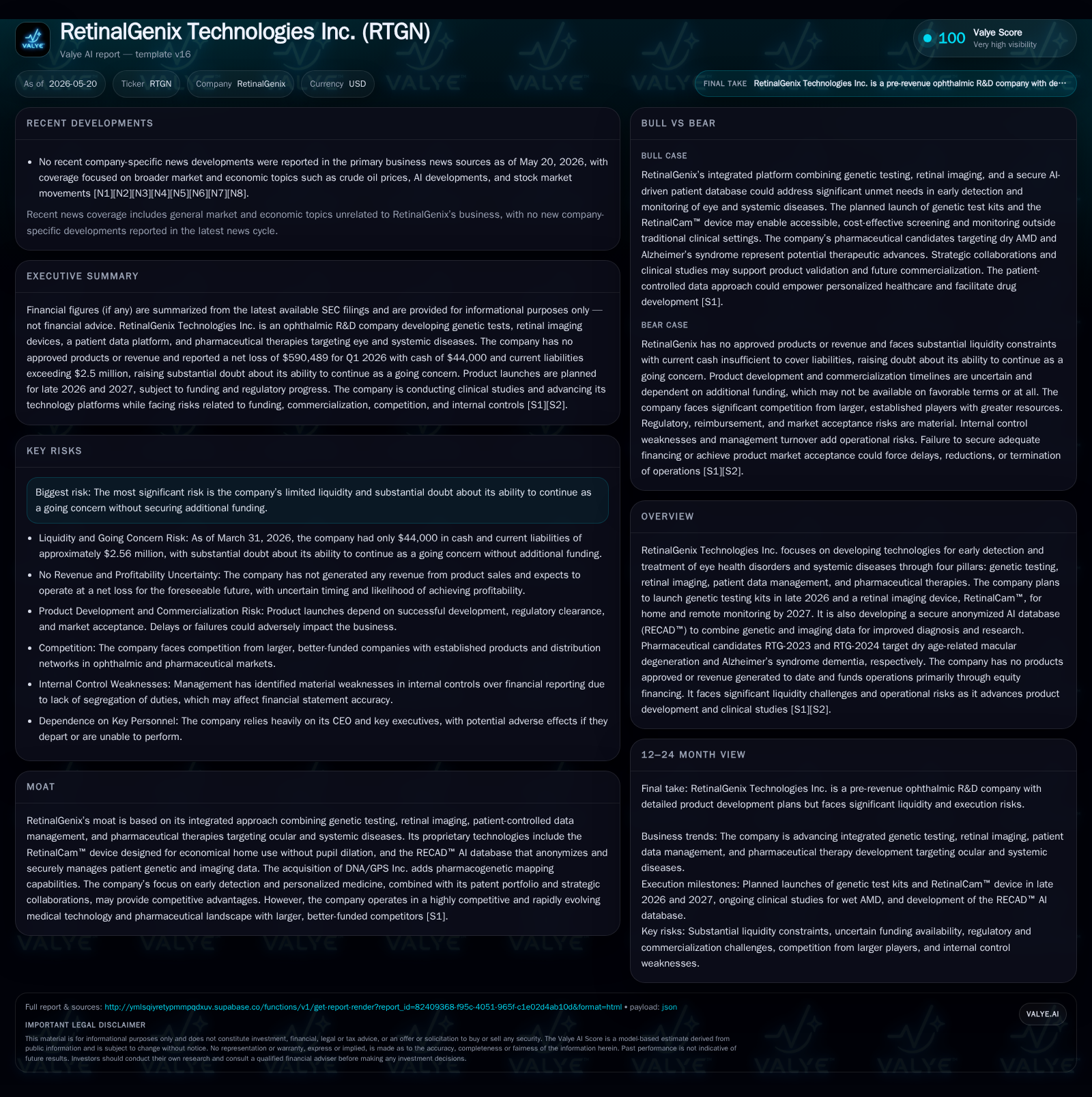
RetinalGenix Technologies remains in the clinical-stage development phase with no commercial revenue to date, confronting acute liquidity pressures that cast significant doubt on its ability to continue as a going concern. The company’s strategic focus spans four pillars: genetic testing, retinal imaging, patient-controlled anonymized AI data management, and pharmaceutical therapies for dry AMD and Alzheimer’s dementia. Initial product launches are targeted for late 2026 (genetic tests) and 2027 (RetinalCam™). RetinalGenix’s integrated platform aims to deliver cost-effective, non-invasive diagnostic tools paired with personalized medicine insights. However, regulatory uncertainties, intense competition from established med-tech firms, high capital requirements, and recent CFO turnover present formidable risks. Near-term value drivers include product development milestones, clinical partnerships, and capital raises critical to sustaining operations.
Recent Operating Update
Compounding financial pressures is executive turnover: the Chief Financial Officer resigned unexpectedly in March 2026 ([S3]), potentially impacting financial management during this critical juncture.
Business Model Overview
RetinalGenix is a clinical-stage ophthalmic technology company focused on early detection and treatment of eye disorders alongside systemic conditions such as Alzheimer's dementia. The firm has yet to generate revenues but anticipates initial commercialization commencing in late 2026 with its genetic testing products ([S1], [S11]).
The business model centers on four interconnected pillars:
- Genetic Testing: Utilizing pharmacogenetic mapping through the acquired DNA/GPS Inc. platform to identify biomarkers related to ocular and systemic diseases. Consumer-facing oral swab test kits are planned for launch in late 2026 with sales executed through third-party manufacturing and distribution partners.
- Retinal Imaging Platform: The RetinalCam™ device aims to provide a portable, non-invasive home-use retinal imaging solution that requires no pupil dilation or FDA clearance. Beta testing is targeted for 2026 with commercial availability expected in 2027.
- Patient Informational Database: The RECAD™ anonymized AI system seeks to securely integrate genetic data with retinal images under patient control to facilitate personalized diagnostics.
- Pharmaceutical Therapies: Early-stage drug candidates RTG-2023 (for dry age-related macular degeneration) and RTG-2024 (for Alzheimer’s syndrome dementia) are under development but require additional funding for clinical advancement.
Revenue generation will initially depend on sales of genetic testing kits; subsequent income streams are anticipated from the RetinalCam™ platform following regulatory clearance where applicable.
Industry Structure and Competitive Position
RetinalGenix operates at the convergence of ophthalmic diagnostics, personalized medicine via pharmacogenetics, telehealth-enabled monitoring devices, and niche pharmaceutical development targeting degenerative diseases. This positioning aligns with broader trends favoring integrated diagnostic platforms combining multi-modal data for precision medicine.
However, the competitive landscape is challenging. Established medical device manufacturers dominate retinal imaging markets with FDA-approved products supported by extensive distribution networks. Pharmaceutical companies advancing AMD and dementia treatments operate at scale with advanced pipelines. These competitors benefit from greater financial resources, regulatory expertise, and clinician relationships.
RetinalGenix’s differentiation lies in its integrated four-pillar platform offering cost-efficient home-use imaging without pupil dilation paired with proprietary pharmacogenetic mapping capabilities acquired through DNA/GPS Inc., potentially enabling earlier disease risk assessment than conventional methods ([S1], [S7], [S11]). Its RECAD™ system proposes patient-controlled data interoperability uncommon among peers.
Nonetheless, stringent FDA regulation for medical devices and pharmaceuticals, reimbursement complexities, switching costs within clinical practice environments, and data privacy regulations represent significant barriers to rapid scaling.
Growth Drivers
Targeted Product Launches in Late 2026 - Early 2027
The imminent launch of DNA/GPS oral swab genetic testing kits represents RetinalGenix’s first step toward revenue generation ([S1], [S11]). This transition from R&D into commercialization marks a critical milestone.
The RetinalCam™ device’s beta testing scheduled within 2026 aims to validate its suitability for home use; commercial launch is expected in 2027 ([S1]). Its non-invasive design requiring no pupil dilation positions it for expanded adoption beyond traditional clinics into telehealth contexts.
Personalized Medicine Data Integration
The RECAD™ AI-powered database promises improved diagnostic accuracy by combining anonymized genetic profiles with retinal images under patient control ([S1], [S11]). Success here could attract healthcare providers seeking data-driven tools for stratifying eye disease risks or customizing treatments.
Pharmaceutical Pipeline Potential
Although early stage and dependent on future funding infusions, RTG-2023 and RTG-2024 offer potential upside if clinical trials demonstrate efficacy ([S19]). These repurposed drugs address unmet needs given limited options especially for prophylactic dry AMD interventions.
Strategic Collaborations & Clinical Studies
Partnerships such as the Pearl IRB study evaluating pharmacogenetic predictors of anti-VEGF treatment efficacy underscore efforts to embed scientific validation into product offerings ([S25]). Such collaborations may enhance credibility ahead of commercialization.
Risks and Constraints
Severe Capital Shortfall Endangering Operational Continuity
Despite recent modest equity raises ([S2], [S18]), cash depletion juxtaposed with multi-million dollar liabilities highlights imminent insolvency risk absent substantial new funding.[F1]
Regulatory Uncertainty & Approval Delays
While RetinalCam™ may bypass FDA clearance due to its non-dilating design ([S11]), other products require regulatory approvals subject to lengthy unpredictable processes ([S14], [S17]). Delays could postpone revenue realization.
Intense Competition From Established Med-Tech Firms
Competitors possess deeper pockets, broader portfolios, established clinician networks, and regulatory experience complicating market penetration without distinctive advantages or significant marketing investment ([S7]).
Management Stability Concerns Amid Financial Strain
The CFO resignation during tightening finances introduces governance uncertainty affecting fundraising execution ([S3], [S16]).
Reliance on Third Parties For Manufacturing & Distribution
Outsourcing production/distribution limits direct supply chain control potentially adding timing or cost risks ([S10], [S25]).
Pricing & Reimbursement Challenges In Dynamic Healthcare Environment
Success depends on securing favorable reimbursement from government payors/private insurers amid evolving policies including Medicaid/Medicare constraints ([S16], [S21]).
Key Watchpoints
- Execution against late-2026 launch timeline for GPS oral swab genetic testing kits including manufacturing scale-up progress.
- Beta testing milestones and regulatory interactions related to the RetinalCam™ throughout remainder of 2026.
- Fundraising or strategic partnership developments addressing liquidity challenges evident from Q1 results.
- Clinical data outcomes from Pearl IRB study validating pharmacogenetic personalization approaches.
- Initiation or advancement of clinical trials for RTG-2023 and RTG-2024 impacting approval prospects.
- Organizational adjustments following CFO departure influencing operational stability.
- Regulatory policy changes affecting device clearance pathways or reimbursement frameworks impacting commercialization viability.
Financial Profile Summary
RetinalGenix continues operating at a loss consistent with early-stage medtech/pharma development cycles. Cash equivalents stood at $180 as of March 31, 2026 versus current liabilities exceeding $2.56 million reflecting extreme liquidity erosion over recent quarters ([F1], [S2]). Total debt approximates $49,000 but is minor relative to liabilities indicating working capital challenges rather than leverage issues.[F1] Net loss was approximately $2.43 million for fiscal year ended December 31, 2025.[F1] These metrics underscore urgent need for fresh capital before anticipated product launches can translate into meaningful revenues.
Disclaimer: This analysis reflects publicly filed SEC disclosures as of May 20, 2026 and does not constitute investment advice.
Financial position in context
As of 2026-03-31, companyfacts shows $49000 of total debt [F1]. Companyfacts also indicates net debt of roughly $48956 for the latest available period [F1]. Current assets of $180 and current liabilities of $3mm imply a current ratio near 0x for 2026-03-31 [F1].
Disclaimer: This is research-only, informational analysis and not investment advice. It may include AI-generated interpretation and general industry context. Always verify important details using primary sources.

Comments