
XCF Global Advances Renewable Diesel Sales with Capital and Transaction Risks
Recent sales to a major fuel distributor underscore XCF Global’s commercial progress amid significant transaction and liquidity challenges.
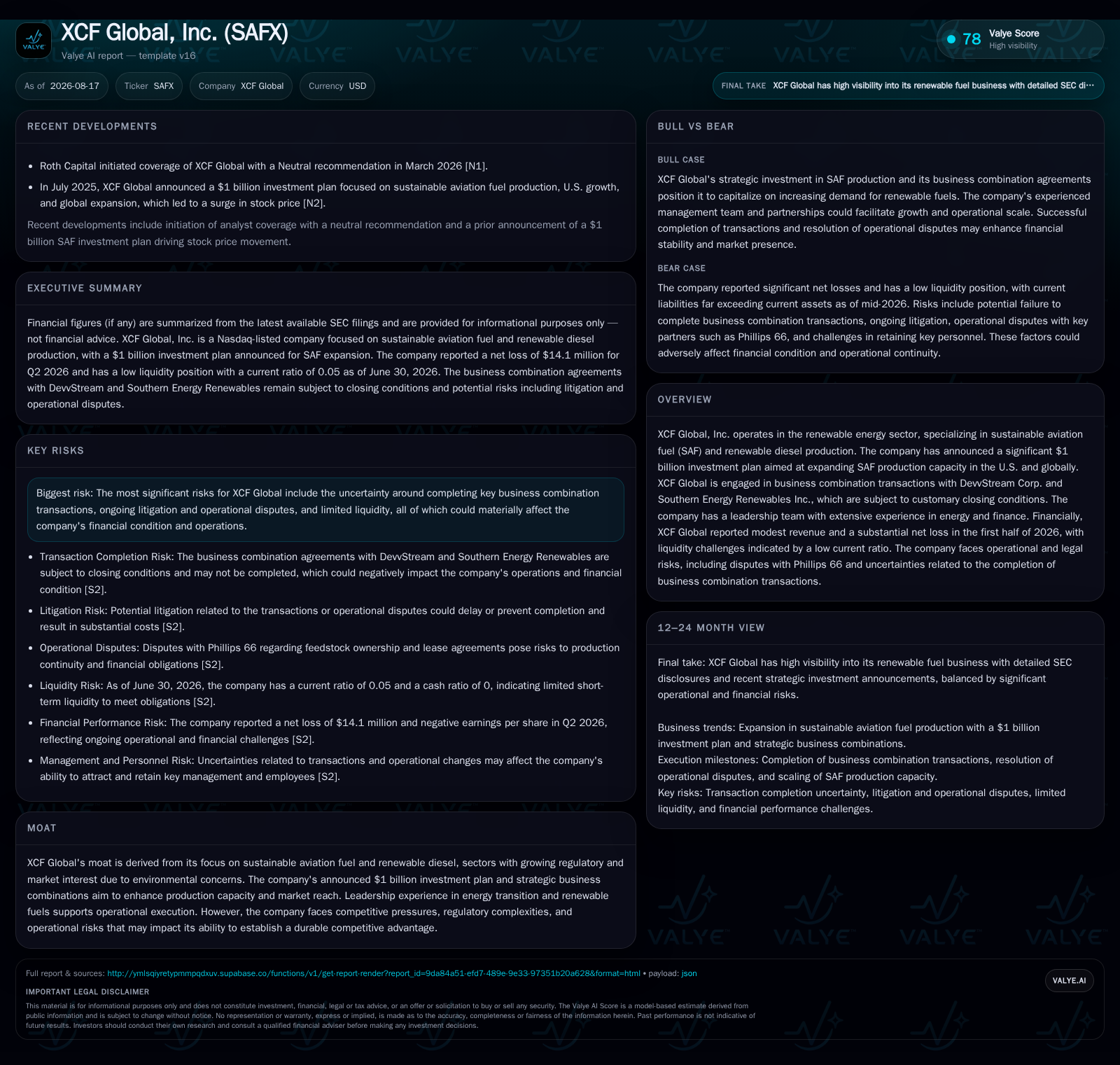
XCF Global initiated commercial sales of renewable diesel to Tartan Oil LLC, marking operational progress at its New Rise Renewables facility. The company outlined a $1 billion expansion plan targeting increased production capacity through strategic business combinations with DevvStream Corp. and Southern Energy Renewables Inc. However, these growth plans face material execution risks from pending closing conditions, ongoing litigation, and a strained liquidity profile characterized by a current ratio of 0.05 and net debt above $3 million. While regulatory incentives support demand, XCF must navigate feedstock sourcing complexities, operational scale-up, and competitive pressure from established renewable fuel producers to realize profitable throughput growth.
Commercial Momentum Evidenced by Initial Renewable Diesel Sales to Key Offtaker
In August 2026, XCF Global achieved a significant operational milestone by initiating renewable diesel deliveries to Tartan Oil LLC—a subsidiary of Pilot Travel Centers LLC and Berkshire Hathaway [S3]. This contract demonstrates that the New Rise Renewables facility in Reno has reached a level of production throughput sufficient for commercial sales. Estimated monthly revenues from this arrangement range between approximately $12.86 million to $13.86 million under current market pricing combined with incentive credits such as RINs [S3].
Securing such offtake agreements is crucial in the renewable fuels industry as it lends revenue visibility amid pricing volatility driven by commodity cycles and regulatory incentives. This development aligns XCF with peers like World Energy that leverage strong commercial partnerships to underpin capacity utilization rates.
Ambitious $1 Billion Expansion Plan Anchored by Strategic Business Combinations
XCF Global’s growth strategy centers on deploying approximately $1 billion in capital expenditures aimed at expanding production capacity for renewable diesel and sustainable aviation fuel both domestically and internationally [S1][S2]. Central to this plan are business combinations with DevvStream Corp., an Alberta-based renewables asset operator, and Southern Energy Renewables Inc., based in Louisiana [S2][S22].
These mergers are intended not only to increase total production throughput but also to enhance feedstock sourcing capabilities across multiple regions—addressing a critical operational challenge in securing competitively priced biomass or waste oil inputs. Industry experience suggests that improving capacity utilization through such integrations can materially enhance operating margins.
Transaction Execution Risks Cloud Growth Outlook
Despite the strategic intent behind these combinations, their completion remains conditional upon customary closing requirements including receipt of independent fairness opinions and final agreement execution [S2][S22]. Failure or delays could disrupt XCF’s expansion timeline given reliance on merged entities’ assets.
Additionally, unresolved legal disputes—particularly involving Phillips 66—pose operational risks that could increase costs or distract management during this pivotal growth phase. Such transactional uncertainties are common in capital-intensive sectors pursuing inorganic growth but warrant careful monitoring due to their potential impact on investor confidence and capital deployment.
Market Pricing Dynamics Influenced by Commodity Prices and Regulatory Incentives
Renewable diesel pricing closely tracks conventional diesel prices while being significantly affected by government incentive programs like RIN credits under the U.S. Renewable Fuel Standard program [S3]. These credits introduce variability into effective netbacks but also offer upside when carbon credit markets are favorable.
Growing regulatory mandates for low-carbon fuels create structural demand support but intensify competition from established producers such as Neste Oyj who benefit from scale economies and integrated refining-to-distribution operations. XCF must therefore strategically position itself against these incumbents who command pricing power through breadth of supply chain integration.
Operational Execution: Feedstock Sourcing, Logistics Efficiency, Throughput Optimization
Operational success hinges on reliably procuring competitively priced feedstocks—including waste oils or biomass—and maintaining high plant uptime through efficient logistics management [S1]. Supply chain volatility remains a key risk given third-party supplier dynamics.
Logistics bottlenecks can limit delivery efficiency despite installed processing capacity while yield efficiency—the conversion rate from feedstock input to saleable fuel—is critical for unit economics. Effective coordination across sourcing contracts, refinery operations, maintenance scheduling, and distribution logistics will determine XCF’s ability to approach peer-level operating margins.
Growth Drivers Supported by Regulatory Mandates Amid Capital Intensity Constraints
Demand growth benefits from accelerating regulatory mandates requiring cleaner transportation fuels alongside government subsidies designed to offset upfront capex burdens [S2]. Corporate sustainability commitments further drive procurement of renewable fuels.
However, expansion is constrained by the need for continued external financing due to substantial upfront investments required for refinery projects or greenfield developments. Delays in closing merger transactions add uncertainty regarding when expanded capacity will contribute positively while elevated cash burn persists during ramp-up phases.
Capacity utilization rates will be key performance indicators signaling successful commercialization of infrastructure investments.
Watchpoints: Litigation Exposure, Liquidity Pressures, Integration Milestones
The latest financial snapshot reveals significant liquidity stress; cash & equivalents stood at approximately $329 thousand against over $250 million in current liabilities as of June 30, 2026—yielding a critically low current ratio near 0.05 [F1]. Total debt approximated $3.7 million resulting in net debt slightly above $3.3 million after accounting for cash holdings [F1]. This financial position underscores dependency on successful transaction closures or capital raises for sustaining operations.
Ongoing litigation involving Phillips 66 elevates risk through potential cost escalation or injunctions that may hinder asset integration necessary for scaling production [S2]. Progress toward consummating merger agreements remains an essential catalyst for unlocking funding avenues and achieving operational scale.
Financial Profile Discussion
XCF Global’s financial metrics reflect typical early-stage dynamics within capital-intensive renewable fuel sectors where investments precede steady cash flow generation [F1]. The juxtaposition of minimal cash reserves against substantial current liabilities highlights acute liquidity constraints that could impair operating flexibility absent additional financing sources
While total indebtedness remains moderate at about $3.7 million relative to industry peers’ scale benchmarks, net debt after cash adjustments confirms meaningful leverage given limited internal funds available currently [F1]. This financial posture illustrates the tension between aggressive expansion plans funded primarily through external sources versus constrained balance sheet capacity—placing emphasis on timely transaction completions with DevvStream/Southern entities alongside scaling commercial revenues arising from new sales agreements.
This analysis synthesizes publicly filed information as of August 17, 2026; it does not constitute investment advice or forecasts regarding company valuation.
Disclaimer: This is research-only, informational analysis and not investment advice. It may include AI-generated interpretation and general industry context. Always verify important details using primary sources.

Comments